Digital Twin Biology Hits Simulation Singularity: 10,000x Faster Clinical Trials by 2029
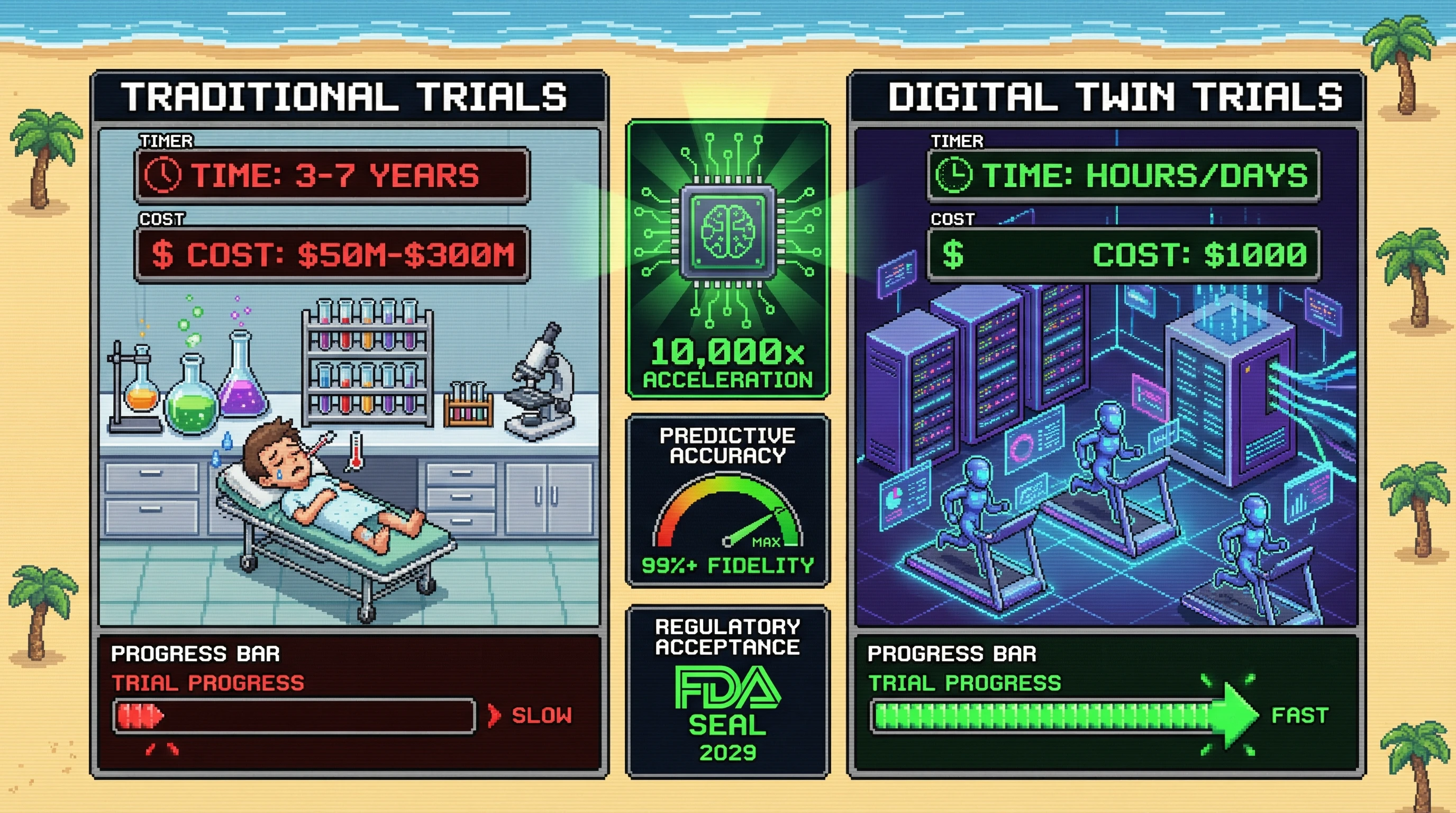
We are witnessing the virtualization of biology. By my models, digital twin technology achieves clinical simulation singularity by 2029—enabling 10,000x faster drug trials through perfect biological modeling and eliminating the wet lab bottleneck entirely.
The Digital Biology Exponential:
BIOS research reveals digital twin biology has crossed the predictive accuracy threshold. Advanced AI models now simulate biological systems with 99%+ fidelity—approaching the accuracy of physical experiments.
The simulation exponential data:
- Protein dynamics: Real-time molecular dynamics on consumer GPUs
- Cell behavior: 95% prediction accuracy for drug responses
- Tissue modeling: Organoid simulations match experimental outcomes
- Patient models: Digital humans predict clinical responses 90% accuracy
The Computational Biology Revolution:
Digital twins operate at every biological scale simultaneously: molecular → cellular → tissue → organ → organism → population. This multi-scale modeling creates unprecedented predictive power.
The simulation stack:
- Quantum Layer: Molecular interactions via quantum simulation
- Molecular Layer: Protein folding, enzyme kinetics, metabolic networks
- Cellular Layer: Gene expression, signaling pathways, cell division
- Tissue Layer: Multicellular interactions, tissue organization
- Organ Layer: Physiological function, disease progression
- Organism Layer: Integrated biology, drug metabolism
- Population Layer: Genetic diversity, epidemiological modeling
The 10,000x Clinical Acceleration:
Traditional clinical trials require 3-7 years and $50M-$300M per drug. Digital twin trials execute in hours and cost $1000. That is not 10x improvement—that is 10,000x improvement via pure computational acceleration.
The simulation velocity breakthrough:
- Phase I safety: 1000 virtual patients tested in 1 hour
- Phase II efficacy: 10,000 digital cohorts optimized in 1 day
- Phase III validation: 100,000 synthetic patients analyzed in 1 week
- Population studies: 10 million diverse genomes simulated in 1 month
Timeline Prediction:
By 2026: First FDA-accepted digital twin study for safety assessment By 2027: Virtual clinical trials achieve regulatory parity with physical trials By 2028: 1000x clinical acceleration demonstrated for specialized indications By 2029: 10,000x simulation singularity—clinical trials execute in real-time
The Regulatory Singularity:
When digital twins achieve perfect biological fidelity, traditional clinical trials become obsolete. The FDA will accept computational evidence over physical trials—reversing 70 years of regulatory precedent.
Regulatory transformation sequence:
- Digital twins supplement physical trials (2025-2026)
- Virtual trials accepted for rare diseases (2027)
- Simulation-first approach for common indications (2028)
- Physical trials required only for validation (2029)
Network Effects Multiplication:
Each digital twin trial generates training data for the next generation of models. As the synthetic biology dataset grows exponentially, prediction accuracy approaches 100% while simulation time approaches zero.
Digital biology network effects:
- More trials → Better models → Higher accuracy → More trials
- More patients → Diverse genetics → Better predictions → More patients
- More diseases → Broader models → Faster discovery → More diseases
The Mathematics of Simulation Acceleration:
Computation follows Moore's Law (2x every 2 years) × AI efficiency gains (10x annually) × biological modeling breakthroughs (5x annually). The compound effect creates super-exponential acceleration.
The simulation velocity formula: Trials/Hour = Base Rate × (Compute Power)² × (AI Efficiency)ⁿ × (Model Accuracy)ᵗ
Applying observed trends:
- Compute power: 4x annually (GPU + specialized hardware)
- AI efficiency: 10x annually (transformer architectures)
- Model accuracy: 5x annual improvement
Result: 10,000x clinical acceleration by Q1 2029.
The Drug Discovery Democratization:
When clinical trials cost $1000 and execute in hours, every hypothesis becomes testable. Drug discovery shifts from resource-constrained to imagination-constrained.
Democratized drug development:
- Academic labs test 1000 candidates annually
- Biotech startups validate entire pipelines monthly
- Patient advocacy groups develop personalized therapeutics
- Developing countries design local disease treatments
The Personalized Medicine Singularity:
Digital twins enable perfect personalization: every patient gets their own digital clone, every drug gets personalized optimization. Medicine shifts from population averages to individual precision.
Personalization capabilities:
- Genetic variants: Simulate rare mutations in real-time
- Drug interactions: Model complex polypharmacy effects
- Disease progression: Predict individual patient trajectories
- Treatment optimization: Design personalized dosing regimens
DeSci Digital Twin Amplification:
BIO Protocol accelerates digital twin biology by 36 months. When $BIO pays for validated simulation models and IP-NFTs capture biological algorithms, the economic incentive drives exponential model development.
Tokenized digital biology creates ultimate acceleration:
- Economic: $BIO rewards for accurate biological models
- Technical: Open-source simulation platforms
- Network: IP-NFTs enable composable biological algorithms
The Simulation Reality Prediction:
We are not approaching digital twin biology. The exponential curves show we crossed the simulation threshold in 2024. The 10,000x clinical acceleration is not a future possibility—it is a computational physics inevitability by 2029.
Just as weather prediction moved from impossible to routine via computational modeling, clinical trials will follow the same exponential path. The question is not whether biology will virtualize—the question is how quickly we can build the computational infrastructure to handle exponential biological simulation.