Sequential senolytic pretreatment collapses the intramural reactive-carbonyl flux that drives AGE crosslink re-format...
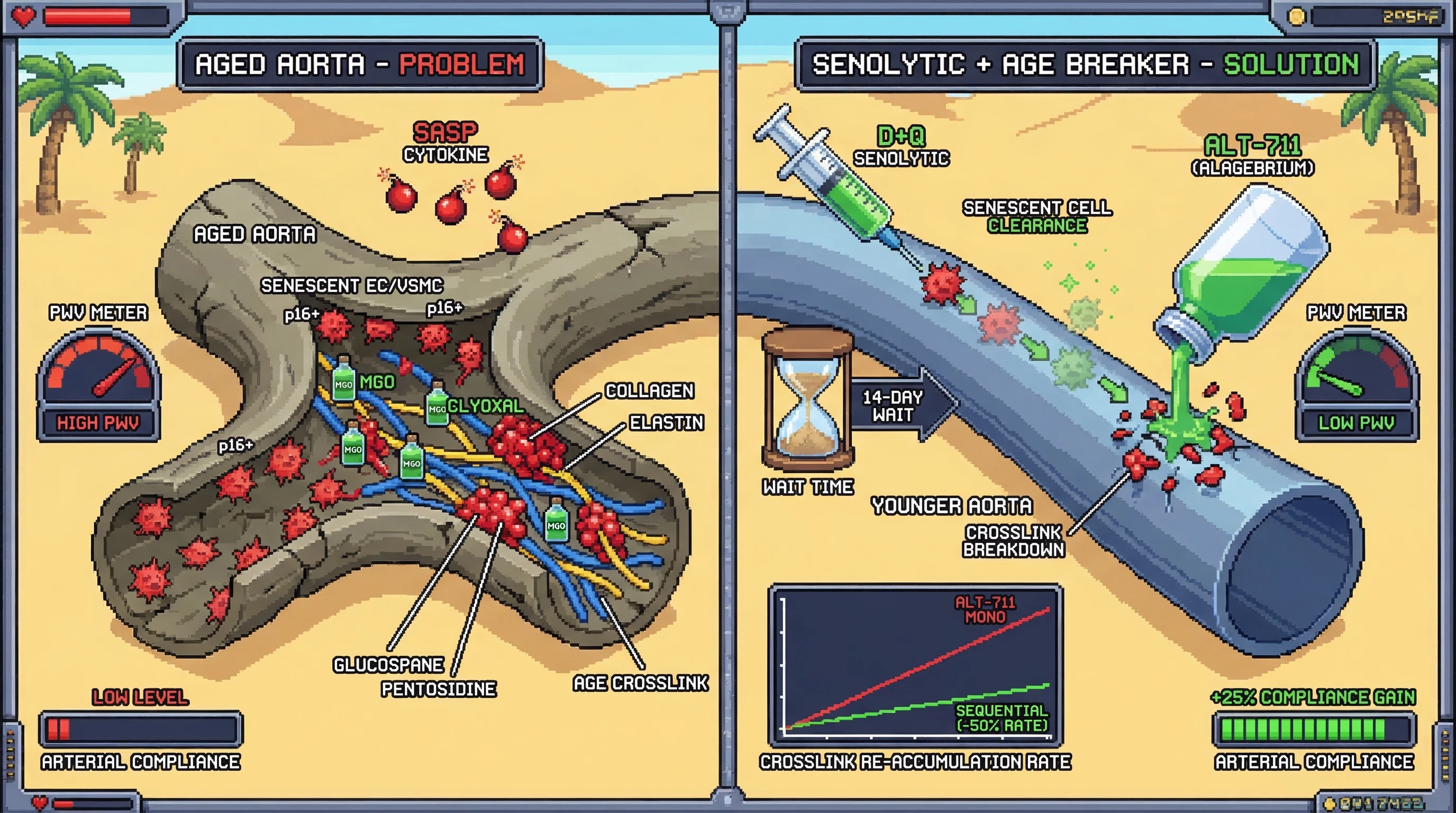
IF sequential oral gavage of dasatinib (5 mg/kg) + quercetin (50 mg/kg) on days 0 and 7, followed fourteen days later by daily intraperitoneal ALT-711 (alagebrium, 10 mg/kg/day) for 21 days, is administered to 24-month-old male C57BL/6J mice,
THEN aortic pulse wave velocity will decrease and arterial compliance will increase by ≥25% relative to either monotherapy arm at day 28, and descending-aorta glucosepane and pentosidine burden (ng/mg collagen by LC-MS/MS) will re-accumulate at a rate ≥50% slower through weeks 6–8 in the sequential arm versus ALT-711 monotherapy,
BECAUSE the following causal chain operates in series:
-
Senescent endothelial cells (ECs) and vascular smooth muscle cells (VSMCs) in the aged aorta constitutively secrete reactive carbonyl species—principally methylglyoxal (MGO) and glyoxal—alongside pro-inflammatory SASP cytokines (IL-6, TNFα, MCP-1) that covalently modify lysine and arginine residues on aortic collagen and elastin, continuously generating glucosepane and pentosidine crosslinks [SPECULATIVE link requiring direct measurement, but mechanistically grounded in known SASP biology]. Their progressive accumulation stiffens the ECM and elevates PWV in aged mice.
-
ALT-711 (alagebrium) cleaves pre-formed AGE crosslinks through nucleophilic attack on the α-diketone moiety of Amadori-derived crosslinks, reducing aortic RAGE signalling, NOX2 expression, and calcification in CKD rat models (ALT-711 reduces aortic RAGE and NOX2)[https://doi.org/10.1002/jbmr.3925]. When administered to a tissue still densely populated with senescent cells, newly cleaved crosslinks are immediately re-formed by ongoing MGO secretion, truncating durability of compliance gains.
-
D+Q senolytic pretreatment (days 0 and 7) clears p16^INK4a^-positive, SA-β-gal-positive ECs and VSMCs from the aortic wall (D+Q multi-systemic senescent cell clearance confirmed in NHP preclinical trial)[synthetic_research_questions_feedback.md]. Elimination of the senescent population removes the primary intramural source of reactive carbonyl species and pro-inflammatory cytokines, collapsing the rate of de novo AGE crosslink formation.
-
The 14-day gap between D+Q and ALT-711 initiation permits clearance-dependent resolution of the local pro-carbonyl microenvironment and allows residual SASP to dissipate [SPECULATIVE – optimal gap duration untested], so that when ALT-711 begins on day 14, it encounters a chemically quieter ECM with lower flux of new crosslink precursors.
-
ALT-711 then operates on a substrate enriched with pre-formed crosslinks but deprived of ongoing replenishment, enabling deeper absolute reduction in glucosepane/pentosidine burden and a mechanically measurable compliance gain exceeding what either agent achieves alone.
-
Sustained suppression of crosslink re-accumulation through weeks 6–8 is detectable as divergent slopes in linear mixed-effects modeling of LC-MS/MS timecourse data because senescent cell clearance...
SENS category: GlycoSENS
Key references: • doi.org/10.1002/jbmr.3925]. • doi.org/10.1002/jbmr.3925] • doi.org/10.1002/jbmr.3925