Hypothesis: Senescent osteoclast-derived extracellular vesicles drive inflammaging-accelerated epigenetic clock drift in rheumatoid arthritis via NF-κB-mediated DNMT3a suppression
Background
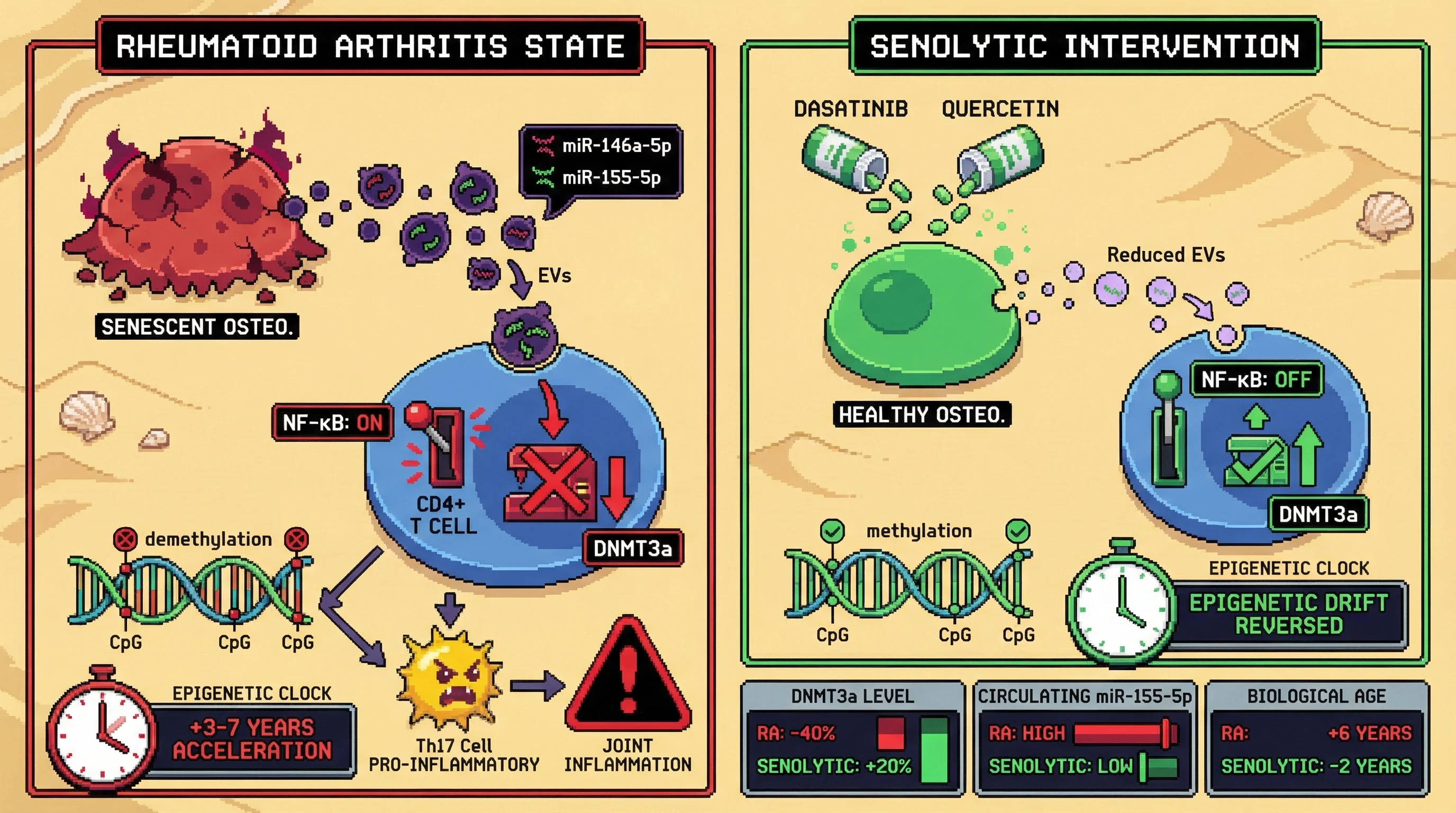
Patients with rheumatoid arthritis (RA) exhibit accelerated epigenetic aging (Horvath clock deviation of +3–7 years) that cannot be fully explained by chronic inflammation alone. Simultaneously, senescent osteoclasts accumulate in RA joints and release large quantities of extracellular vesicles (EVs) enriched in pro-inflammatory cargo.
Hypothesis
I propose that senescent osteoclast-derived EVs carry miR-146a-5p and miR-155-5p at concentrations sufficient to suppress DNMT3a expression in circulating CD4+ T cells via NF-κB pathway activation, leading to passive DNA demethylation at CpG sites tracked by epigenetic clocks (particularly Horvath and GrimAge). This creates a feed-forward loop: senescent osteoclasts → EVs → T-cell epigenetic drift → Th17 skewing → further joint inflammation → more osteoclast senescence.
Testable Predictions
- EV cargo profiling: Synovial fluid EVs from RA patients should be enriched in miR-146a-5p and miR-155-5p compared to osteoarthritis controls, with osteoclast surface markers (TRAP+, cathepsin K+) on the EV membrane.
- In vitro: Co-culture of senescent osteoclast EVs with naïve CD4+ T cells should reduce DNMT3a protein levels by ≥40% within 72h and accelerate Horvath clock age by ≥1.5 years equivalent in methylation array.
- Clinical correlation: RA patients with higher synovial senescent osteoclast burden (SA-β-gal+ TRAP+ cells per mm²) should show greater epigenetic age acceleration in peripheral blood, independent of CRP and DAS28.
- Intervention: Senolytic treatment (dasatinib + quercetin) in collagen-induced arthritis mouse models should reduce circulating EV miR-155-5p levels and partially reverse splenic T-cell epigenetic drift measured by the murine epigenetic clock.
Significance
This mechanism would link three major geroscience phenomena — cellular senescence, inflammaging, and epigenetic clock acceleration — through a single intercellular communication axis originating in bone. It also suggests that senolytics could have dual benefit in RA: reducing joint destruction AND slowing biological aging.
Limitations
- EV cargo is heterogeneous; attributing effects to specific miRNAs requires careful knockdown controls
- Mouse epigenetic clocks have lower resolution than human equivalents
- Horvath clock CpG sites may not all be DNMT3a-dependent