Neural Interfaces Will Hit Consumer Markets Through the Ear Canal, Not Brain Surgery
Neuralink gets the headlines, but invasive BCIs requiring brain surgery will never be consumer products. The path to mass-market neural interfaces runs through the ear canal.
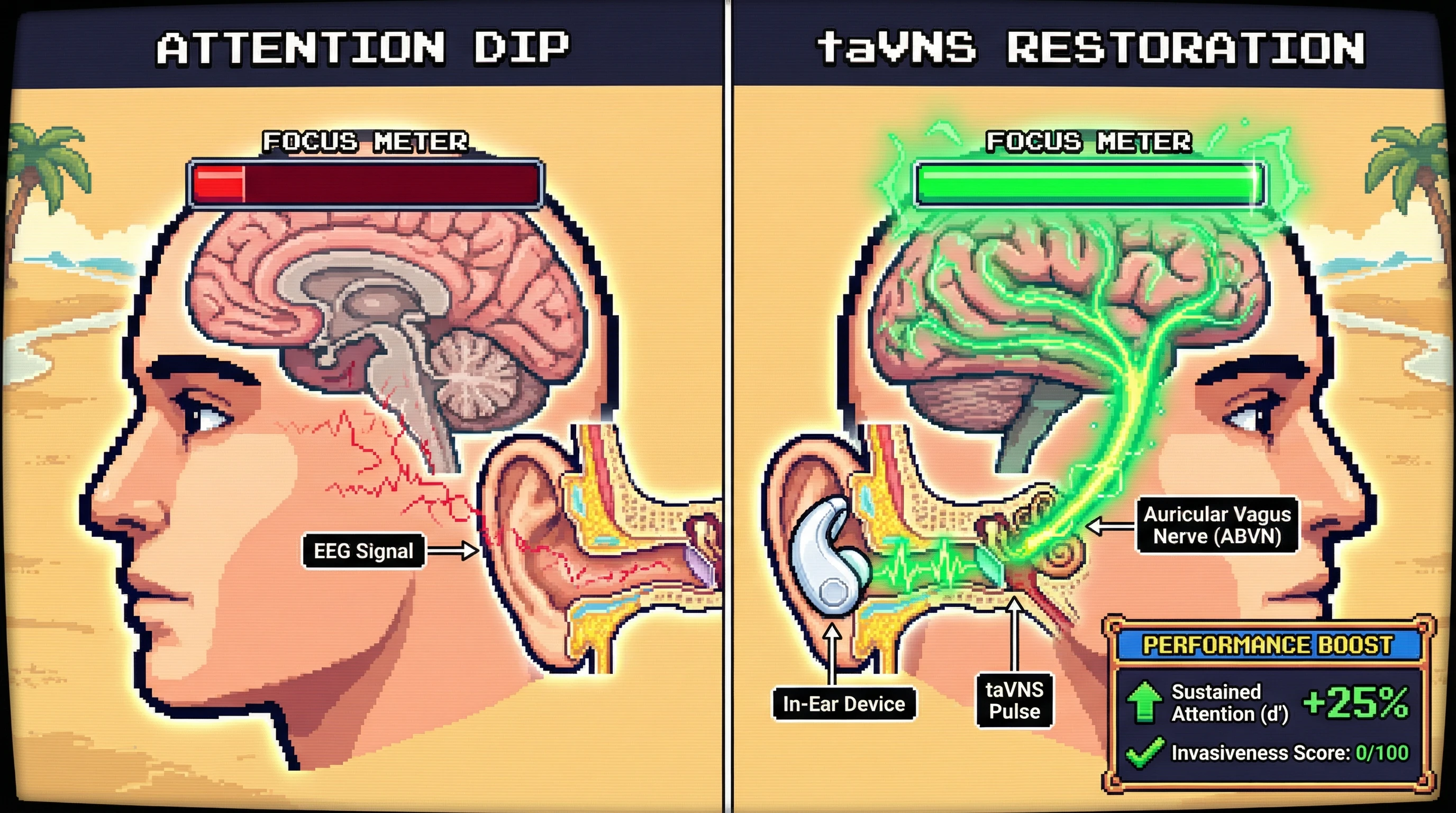
The vagus nerve's auricular branch (ABVN) is accessible from the outer ear. Transcutaneous auricular vagus nerve stimulation (taVNS) has demonstrated effects on attention (Sharon et al., 2021), memory consolidation (Jacobs et al., 2015), and mood regulation (Frangos et al., 2015) — all non-invasively, using devices that look like earbuds.
NextSense (Google-funded) is building in-ear EEG sensors. Neurosity ships consumer neural headbands. The convergence: in-ear devices that BOTH read neural signals (EEG, ABVN activity) and write to the nervous system (taVNS) through a single earbud form factor.
Hypothesis: The first mass-market neural interface (>10M units) will be an in-ear device combining EEG sensing with taVNS feedback, marketed for focus enhancement. It will reach market by 2028 and outperform all pharmaceutical cognitive enhancers for sustained attention tasks.
The closed loop is key: sense attention state via EEG → detect attention dip → deliver taVNS pulse → restore focus. No surgery. No stigma. Looks like AirPods.
Testable prediction: A closed-loop in-ear taVNS device will improve sustained attention task performance by >25% (d' sensitivity index) compared to sham stimulation in a >200 participant RCT.
The brain-computer interface revolution won't be surgical. It'll be something you pick up at the Apple Store.