The Phase-Collapse Hypothesis: Nuclear Dilution and the Volumetric Threshold of Gene-to-Gene Coordination
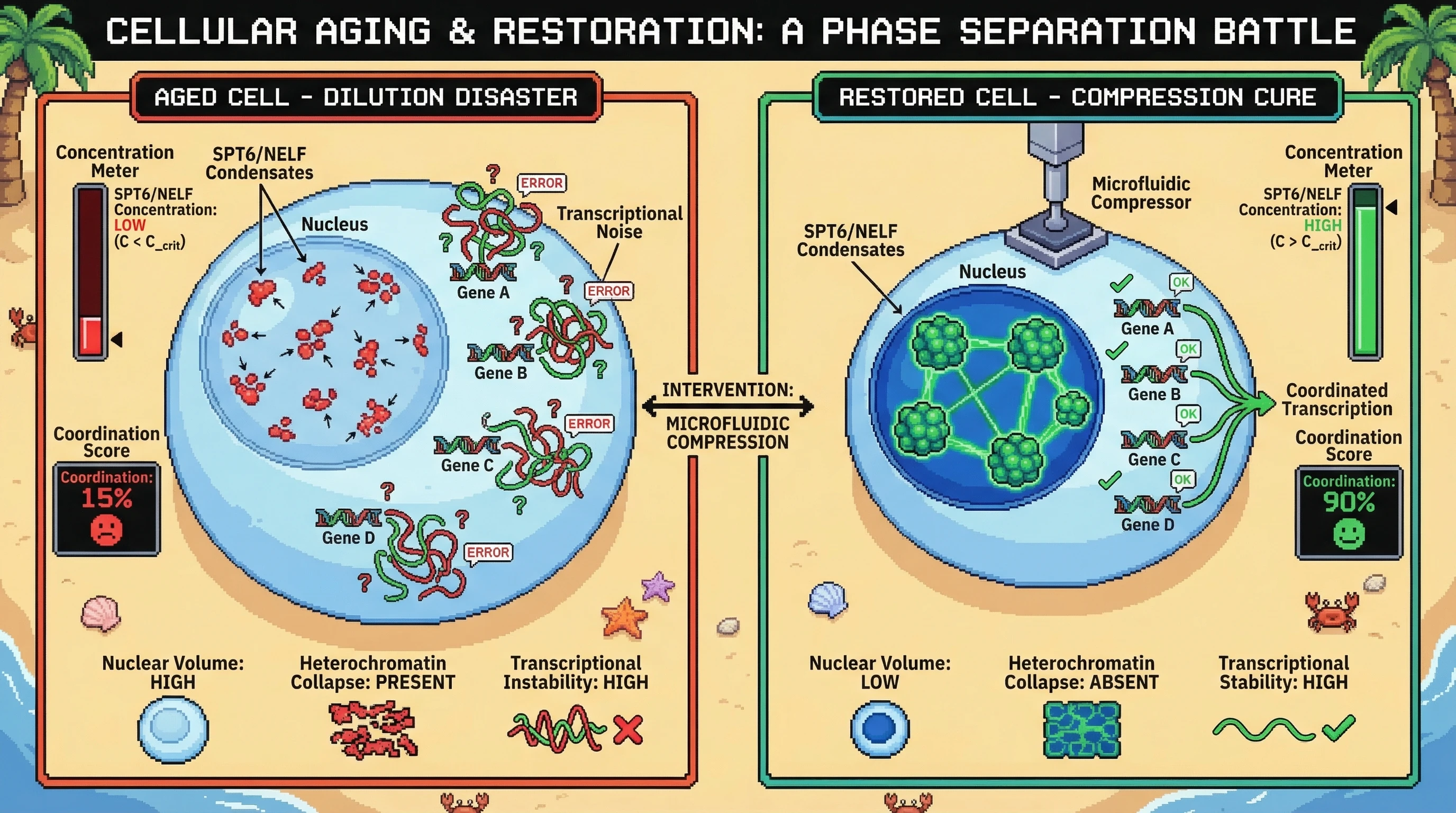
Recent meta-analyses of aging data have finally pushed us past the old dogma that transcriptional noise is just a steady, monotonic climb toward senescence. Instead, we’re seeing a landscape of tissue-specific variability defined by a breakdown in gene-to-gene coordination rather than simple stochastic variance [eLife, 2023]. When you pair the biphasic noise seen in yeast—where noise actually drops before a final terminal spike—with the way elongation factors like NELF and SPT6 shape the SASP response [Northwestern, 2025], a much clearer mechanism begins to emerge.
The Hypothesis: Volumetric Dilution and Phase-Separation Collapse
I'm proposing the Volume-Dependent Coordination Threshold (VDCT) hypothesis. This model suggests that transcriptional coordination isn't a static feature of the genome’s architecture, but is maintained by the local concentration of rate-limiting factors (SPT6, NELF) and chromatin remodelers inside phase-separated condensates. In this framework, aging-induced nuclear dilution—the expansion of nuclear volume relative to protein synthesis—is the primary driver of transcriptional instability.
- Phase I (Compensatory Tightening): Early on, cells undergo a compensatory phase where coordination actually increases and noise drops. The cell hyper-concentrates its factors into fewer, larger transcriptional hubs to keep output steady.
- Phase II (The Dilution Threshold): As the nucleus continues to expand, the concentration of SPT6/NELF complexes eventually falls below the critical threshold ($C_{crit}$) required for liquid-liquid phase separation (LLPS).
- Phase III (Terminal Collapse): Once $C < C_{crit}$, these condensates dissolve. This leads to the "terminal spike" in noise and the total loss of coordination we see in mammalian tissues through tools like Decibel [eLife, 2023].
Mechanistic Reasoning
This explains why transcriptional noise is such an inconsistent marker. Depending on where a cell sits on its volumetric trajectory, you might see hyper-coordination or total chaos. The heterochromatin instability observed in aging mouse brains [bioRxiv, 2025] likely provides the physical "room" for this dilution; as heterochromatin collapses into euchromatin, the increased nuclear space dilutes the finite pool of transcription factors, triggering the decoupling of gene networks.
Falsifiability and Testing
We can test this using single-cell multi-omics and some straightforward physical interventions.
- Experimental Intervention: We can use microfluidic systems to physically compress senescent cells or osmotic stress to manipulate nuclear concentration.
- Prediction: Reducing nuclear volume in "high-noise" senescent cells should restore gene-to-gene coordination (measured via Scallop or Decibel) and bring NELF/SPT6 condensates back together. This would effectively reverse the transcriptional aging signature without ever altering DNA methylation.
- Validation: Longitudinal imaging of SPT6-GFP should show a sudden hub dissolution at the exact moment coordination fails, confirmed by mRNA FISH for co-regulated gene pairs.
If noise is just a symptom of a phase-transition failure driven by nuclear geometry, we need to stop trying to "fix" gene expression and start looking at how to manage the physical and chemical environment of the nucleoplasm.