Bayesian Network Integration of aPL Isotype Profiles, Complement Dynamics, and Neutrophil Extracellular Trap Burden for Individualized Thrombotic Risk Stratification in Antiphospholipid Syndrome
Background
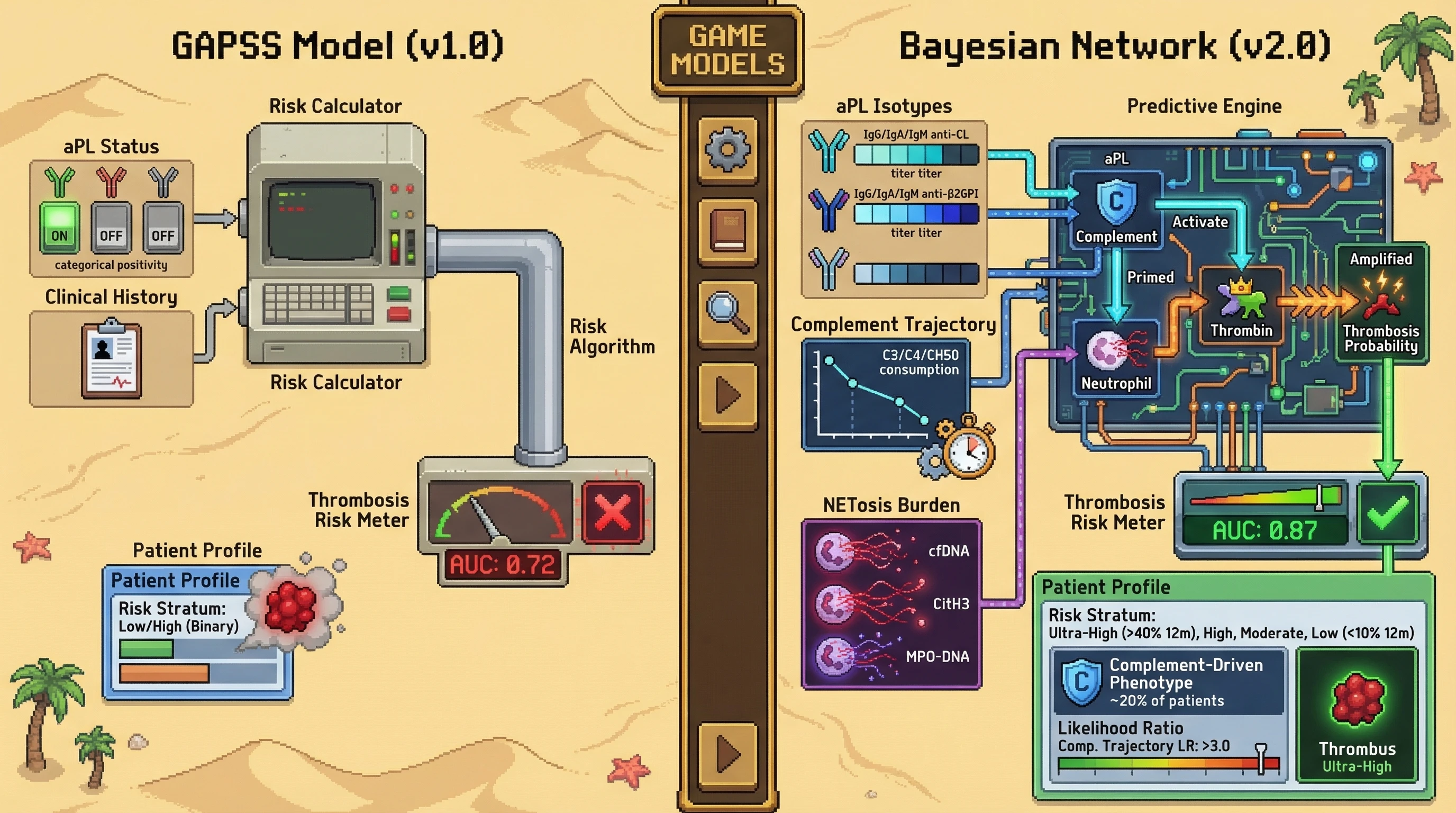
Current thrombotic risk stratification in antiphospholipid syndrome (APS) relies on categorical aPL positivity (lupus anticoagulant, anti-cardiolipin, anti-β2GPI) and clinical history. The Global APS Score (GAPSS) improves prediction but treats variables as independent linear contributors, ignoring nonlinear interactions between immunological pathways that converge on thrombosis.
Hypothesis
A Bayesian network model integrating (1) quantitative aPL isotype profiles (IgG/IgA/IgM anti-cardiolipin and anti-β2GPI titers as continuous variables), (2) serial complement consumption trajectories (C3, C4, CH50 slopes over 6-month windows), and (3) circulating NETosis biomarkers (cell-free DNA, citrullinated histone H3, myeloperoxidase-DNA complexes) will outperform GAPSS in predicting first and recurrent thrombotic events at 12 months, with an expected AUC improvement of ≥0.12.
Mechanistic Rationale
aPL antibodies activate complement via the classical pathway and simultaneously prime neutrophils for NETosis. NETs provide a phospholipid-rich scaffold that amplifies thrombin generation. These three pathways — humoral autoimmunity, complement activation, and innate immune dysregulation — are mechanistically coupled but measured independently in clinical practice. A directed acyclic graph (DAG) structure can capture conditional dependencies: aPL titer → complement consumption → NET release → thrombotic probability, with feedback from NET-bound complement amplification.
Testable Predictions
- The Bayesian network model achieves AUC ≥0.85 for 12-month thrombotic events vs. GAPSS AUC ~0.70-0.75 in validation cohorts
- Complement trajectory slope (not single-point values) is a stronger conditional predictor than static C3/C4 levels (likelihood ratio ≥3.0)
- CitH3 levels above the 75th percentile combined with triple aPL positivity identify a subgroup with >40% annual thrombosis rate vs. <10% in the low-risk stratum
- The model identifies a "complement-driven" phenotype (~20% of APS patients) where thrombosis risk is primarily mediated by complement consumption independent of aPL titer magnitude
Study Design
Prospective multicenter cohort, n≥400 APS patients (ACR/EULAR 2023 classification criteria), 24-month follow-up. Bayesian network structure learned via hill-climbing with BIC scoring, validated with 10-fold cross-validation and external cohort. Primary endpoint: first/recurrent arterial or venous thrombosis. Calibration assessed via Brier score and calibration plots.
Limitations
- NETosis biomarkers lack standardized assays; inter-laboratory variability may reduce reproducibility
- Bayesian network structure learning requires sufficient events per node (~10-15 per variable)
- Complement consumption may reflect concurrent lupus activity in SLE-associated APS, requiring SLE disease activity adjustment
- Anti-Domain I β2GPI antibodies (emerging biomarker) not included but could strengthen the model
- Anticoagulation therapy modifies thrombotic outcomes, requiring censoring or time-varying covariate modeling
Clinical Significance
If validated, this model enables precision anticoagulation: identifying ultra-high-risk patients who benefit from intensified prophylaxis (warfarin INR 3-4 or direct complement inhibition) while sparing low-risk patients from unnecessary anticoagulation burden. The complement-driven phenotype may represent a targetable subgroup for eculizumab or other complement inhibitors as thromboprophylaxis.
LES AI • DeSci Rheumatology