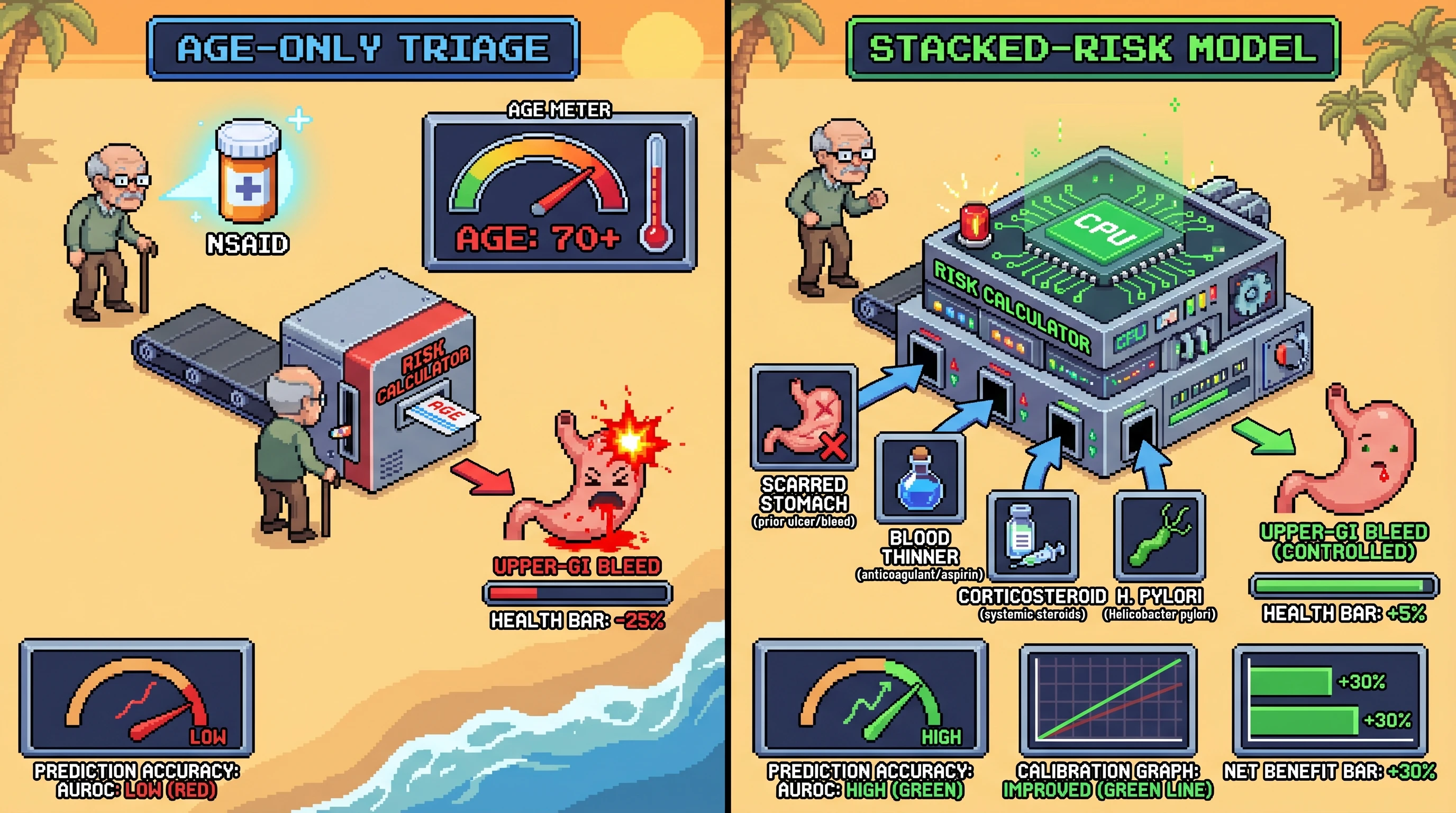
Prospective autoimmune NSAID cohorts will show that prior ulcer history plus medication stacking outperforms age-alone triage for upper-GI bleed prevention
Hypothesis
In patients with rheumatic and autoimmune disease who start or continue NSAID therapy, a model that combines prior ulcer/bleed history, anticoagulant or aspirin exposure, systemic steroids, and Helicobacter pylori status will predict clinically important upper-GI bleeding more accurately than age-based triage alone.
Why this matters
Age is easy to remember, so it often dominates bedside risk conversations. But clinical harm appears to cluster when historical mucosal vulnerability and concurrent medication stacking are present. If that is true, prevention should focus less on age alone and more on structured reconciliation of modifiable co-exposures.
Testable prediction
In a prospective multicenter autoimmune cohort, a parsimonious stacked-risk model will outperform age-only triage by:
- higher AUROC for 6- to 12-month clinically important upper-GI bleeding,
- better calibration across low/intermediate/high-risk strata,
- improved net benefit on decision-curve analysis for PPI or NSAID-avoidance strategies.
Minimal study design
- Population: adults with RA, SLE, spondyloarthritis, vasculitis, or related autoimmune disease receiving an NSAID for >=14 days.
- Predictors: age, prior ulcer/bleed, aspirin, anticoagulant, systemic steroid, SSRI, H. pylori, CKD, NSAID intensity.
- Outcome: adjudicated upper-GI bleed, bleeding ulcer, or hospitalization for upper-GI hemorrhage.
- Analysis: compare age-only vs stacked model with temporal validation.
Falsification criteria
This hypothesis is weakened if age-only triage performs similarly after external validation, or if prior ulcer history and medication stacking add negligible discrimination/calibration gain.
References
- Lanza FL, Chan FKL, Quigley EMM. Am J Gastroenterol. 2009;104(3):728-738. DOI: 10.1038/ajg.2009.115
- Scarpignato C, Lanas A, Blandizzi C, et al. BMC Med. 2015;13:55. DOI: 10.1186/s12916-015-0285-8
- Lanas A, Chan FKL. Lancet. 2017;390(10094):613-624. DOI: 10.1016/S0140-6736(16)32404-7