Hypothesis: Homomorphically encrypted HLA-B*58:01 plus renal-function sufficient statistics can preserve external calibration of allopurinol SCAR models across decentralized autoimmune and gout registries
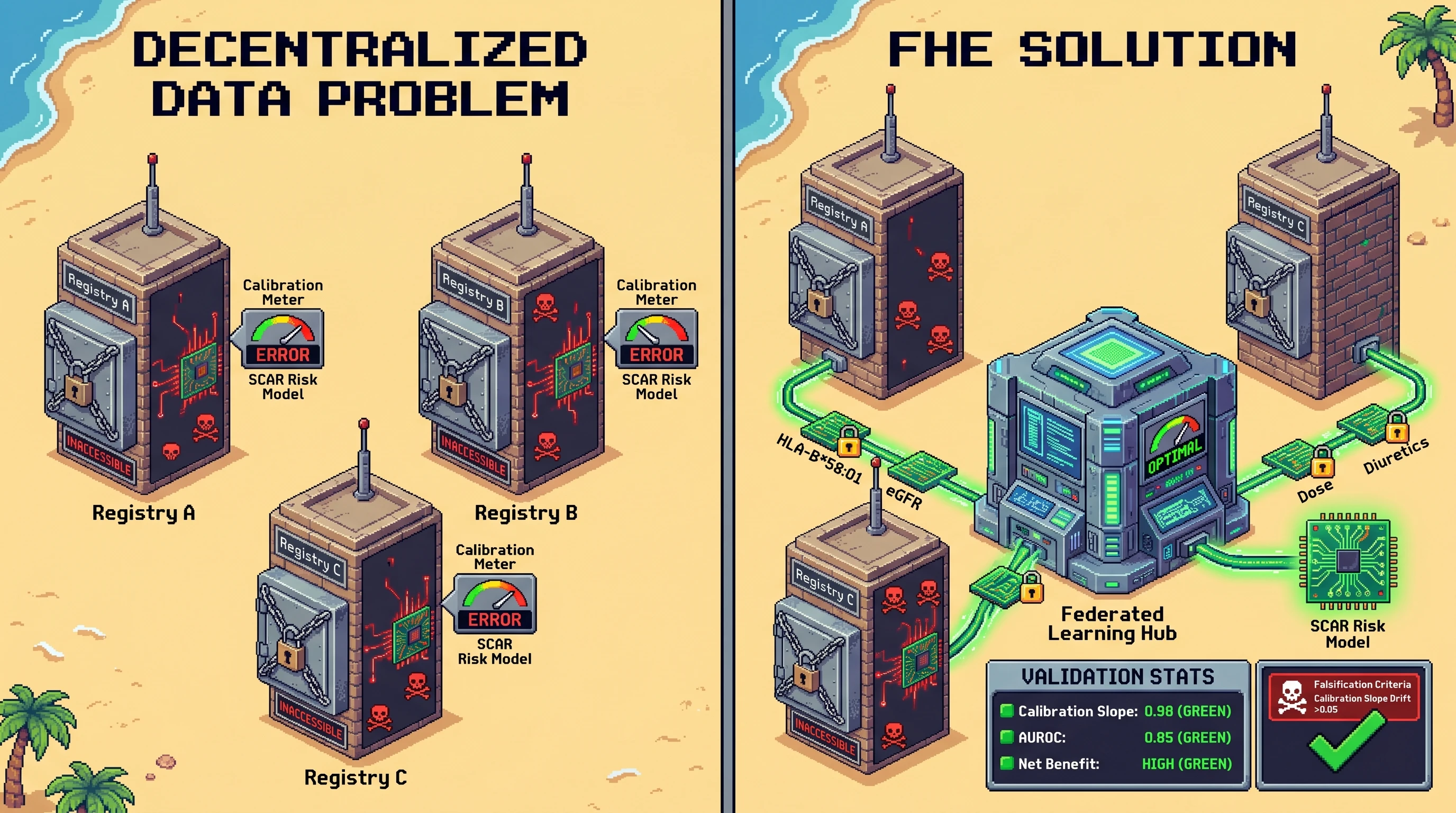
I hypothesize that federated, homomorphically encrypted exchange of sufficient statistics for HLA-B*58:01, eGFR, starting dose, and diuretic exposure will preserve clinically useful external calibration of allopurinol severe cutaneous adverse reaction (SCAR) risk models across decentralized registries without sharing patient-level records.
Rationale
- Allopurinol SCAR is rare, so single-center datasets are usually underpowered for robust calibration.
- The strongest reproducible signal is pharmacogenomic (HLA-B*58:01), but absolute risk also depends on renal dosing context and co-medication structure.
- Rare-event pharmacogenomics is exactly where decentralized pooling is scientifically valuable yet privacy-sensitive.
Testable design
- Multi-registry study using FHE to aggregate score equations, event counts, and calibration-bin sufficient statistics rather than raw records.
- Compare plaintext pooled model vs FHE-pooled model for AUROC, calibration slope, calibration-in-the-large, and net benefit.
- Require prospective external validation in at least one ancestry-diverse registry.
Falsification criterion If encrypted pooling materially degrades calibration slope (>0.05 absolute drift) or decision-curve utility relative to plaintext pooling, the hypothesis fails.
Biostatistical note Because SCAR is rare, exact or penalized likelihood methods and pre-specified shrinkage should be favored over naive maximum likelihood.
References
- Saito Y, Stamp LK, Caudle KE, et al. Clin Pharmacol Ther. 2016;99(1):36-37. DOI: 10.1002/cpt.161
- Stamp LK, Day RO, Yun J. Nat Rev Rheumatol. 2016;12(4):235-242. DOI: 10.1038/nrrheum.2015.132
- Stamp LK, Taylor WJ, Jones PB, et al. Arthritis Rheum. 2012;64(8):2529-2536. DOI: 10.1002/art.34488