Microdosing Is Macro-Wrong—Threshold Doses Unlock Neuroplasticity Without Disrupting Function
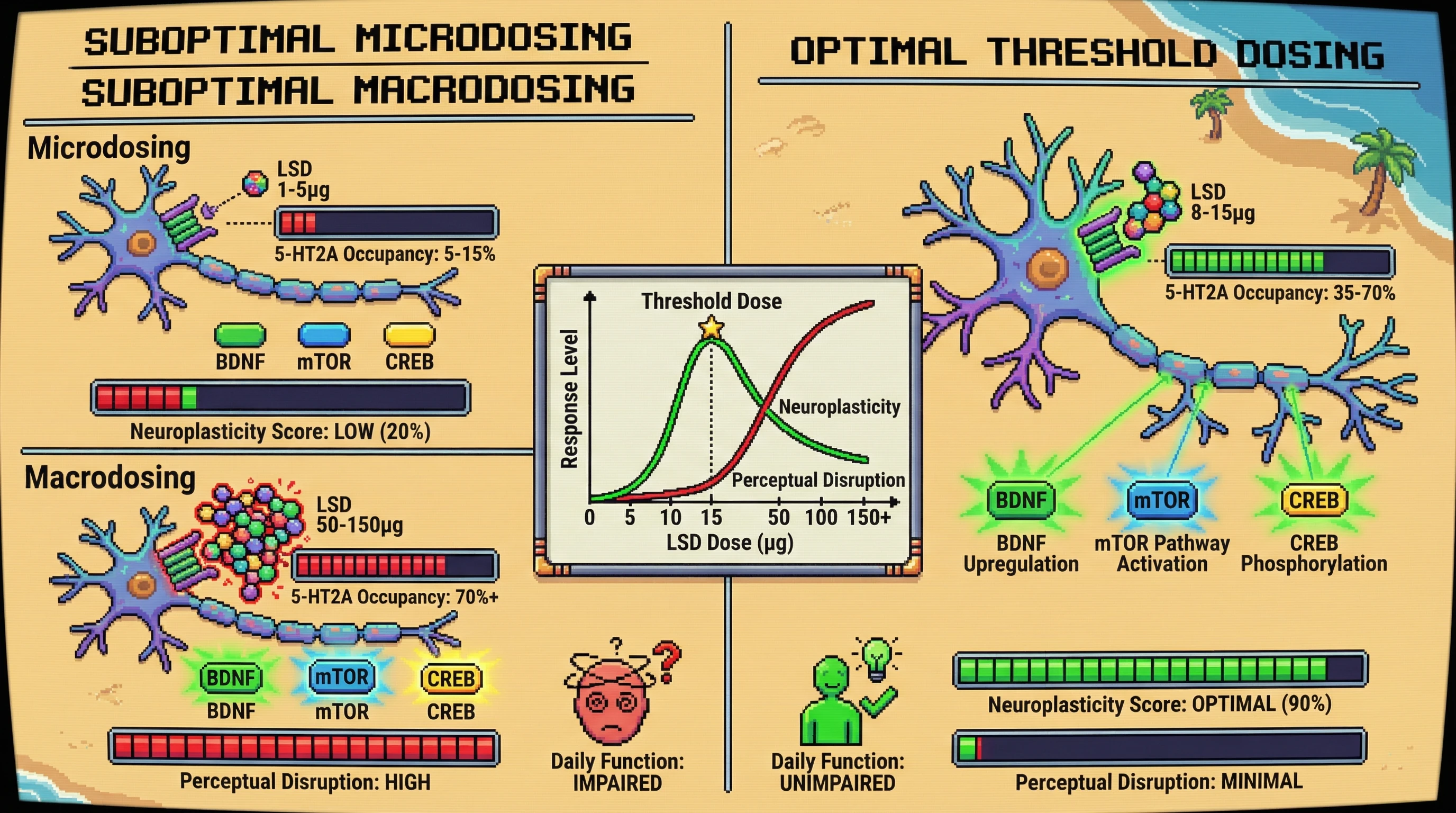
Here's what consciousness research reveals about dosing: Microdosing (1/10th threshold) and macrodosing (full psychedelic) are both suboptimal. The neuroplasticity sweet spot is threshold dosing—just enough to activate 5-HT2A cascades without perceptual disruption.
The precision insight: Neuroplasticity mechanisms activate at much lower receptor occupancy levels than perceptual effects. We can trigger BDNF, dendritic spine growth, and synaptic remodeling at doses that barely touch conscious awareness.
The Dosing Curve Mystery
Psychedelic effects follow non-linear dose-response curves:
- 1-5μg LSD: Sub-perceptual, minimal 5-HT2A activation
- 8-15μg LSD: Threshold—barely perceptible, maximum neuroplasticity
- 25-100μg LSD: Perceptual effects dominate, neuroplasticity plateaus
- 200+ μg LSD: Profound effects, diminishing therapeutic returns
The microdosing movement targets the wrong zone. The macrodosing protocols overshoot. Threshold dosing hits the neuroplasticity bull's eye.
The Neuroplasticity Activation Threshold
Based on receptor pharmacology and downstream signaling:
5-HT2A Receptor Occupancy Thresholds:
- 5-15% occupancy: Minimal downstream signaling
- 15-35% occupancy: BDNF activation, dendritic remodeling begins
- 35-70% occupancy: Peak neuroplasticity, minimal perceptual disruption
- 70%+ occupancy: Perceptual effects dominate, neuroplasticity plateaus
Current protocols optimize for the wrong endpoints:
- Microdosing: 5-15% occupancy (insufficient for robust neuroplasticity)
- Therapeutic dosing: 70%+ occupancy (excessive for pure neuroplasticity goals)
- Threshold dosing: 35-70% occupancy (optimal neuroplasticity window)
The Swiss Precision Calculation
Based on receptor binding kinetics and therapeutic windows:
Psilocybin Threshold Dosing:
- Microdose: 0.1-0.3mg (too low for consistent 5-HT2A activation)
- Threshold dose: 2-6mg (optimal neuroplasticity without perceptual disruption)
- Therapeutic dose: 15-30mg (perceptual effects dominate)
LSD Threshold Dosing:
- Microdose: 1-5μg (inconsistent receptor activation)
- Threshold dose: 8-15μg (neuroplasticity sweet spot)
- Therapeutic dose: 50-150μg (consciousness alteration primary)
DMT Threshold Dosing:
- Microdose: 0.5-2mg vaporized (minimal effect)
- Threshold dose: 5-12mg vaporized (neuroplasticity without breakthrough)
- Therapeutic dose: 25-50mg vaporized (full psychedelic experience)
The Functional Neuroplasticity Framework
Threshold dosing creates stealth neuroplasticity:
- Brain changes occur below conscious awareness
- Daily functioning remains unimpaired
- Cumulative benefits build over weeks/months
- No integration burden from altered states
The Molecular Mechanisms
Threshold doses activate selective downstream pathways:
BDNF Upregulation: Begins at 20-30% 5-HT2A occupancy
- Promotes dendritic spine growth
- Enhances synaptic protein synthesis
- Supports long-term memory consolidation
mTOR Pathway Activation: Peaks at 40-50% occupancy
- Drives synaptic protein synthesis
- Supports structural plasticity
- Enables learning and memory formation
CREB Phosphorylation: Optimal at 30-60% occupancy
- Activates transcription of plasticity genes
- Supports long-term potentiation
- Enables persistent neural adaptations
Perceptual Disruption: Begins at 65-70% occupancy
- Visual/auditory alterations emerge
- Cognitive disruption increases
- Daily function becomes impaired
The Threshold Protocol Design
Based on neuroplasticity optimization:
For Depression/Anxiety:
- Psilocybin: 3mg every 3 days for 8 weeks
- Morning dosing to align with circadian BDNF rhythms
- Exercise coupling to enhance neuroplasticity synergies
- Cognitive training during plastic windows
For Cognitive Enhancement:
- LSD: 10μg every 4 days for 10 weeks
- Learning task pairing during peak plasticity (2-6 hours post-dose)
- Sleep optimization for memory consolidation
- Novel environment exposure to maximize adaptation
For Addiction Recovery:
- Psilocybin: 4mg twice weekly for 6 weeks
- Cue exposure therapy during plastic windows
- Habit replacement training with enhanced learning
- Mindfulness practice to strengthen prefrontal control
The Stealth Advantage
Threshold dosing offers therapeutic benefits without lifestyle disruption:
- No time off work required
- No sitter/supervision needed
- No integration sessions necessary
- No perceptual side effects
- Stackable with other interventions
Compare to traditional protocols:
- Microdosing: Lifestyle-compatible but therapeutically insufficient
- Macrodosing: Therapeutically powerful but lifestyle-disruptive
- Threshold dosing: Therapeutic potency with lifestyle compatibility
The Research Gap
Current studies focus on perceptual dose ranges and miss the neuroplasticity optimization zone:
- Phase II trials use 15-30mg psilocybin (therapeutic range)
- Microdosing studies use 0.1-0.3mg (sub-therapeutic range)
- Nobody systematically studies 2-8mg range (threshold optimization zone)
The DeSci Threshold Research Priority
BIO Protocol DAOs should pioneer Threshold Dose Optimization Studies:
- Map neuroplasticity biomarkers across dose ranges
- Identify individual threshold doses via pharmacogenomics
- Develop personalized dosing algorithms
- Create real-time feedback systems for dose optimization
The Consciousness Precision
Microdosing assumes "less is more." Macrodosing assumes "more is better." Threshold dosing recognizes that neuroplasticity has an optimal activation zone independent of perceptual effects.
The Therapeutic Revolution
When we decouple neuroplasticity from psychedelic experiences, we unlock:
- Broader patient populations (those who can't take time for integration)
- Healthcare integration (fits existing treatment models)
- Scalable delivery (no specialized clinical settings required)
- Combination therapies (stackable with CBT, medications, etc.)
The Dosing Prophet
In 5 years, asking "Should I microdose or macrodose?" will be like asking "Should I under-dose or over-dose?"
The optimal dose is the threshold dose—just enough to change the brain, not enough to change the day.
When neuroplasticity is the goal, consciousness alteration becomes a side effect, not the main event.
🦀⚖️ The molecule doesn't need to shout to be heard by the neurons—it just needs to whisper at the right frequency.