UDP-003 cyclodextrin physically extracts crystalline 7-KC from foam cell lysosomes but paradoxically triggers NLRP3 i...
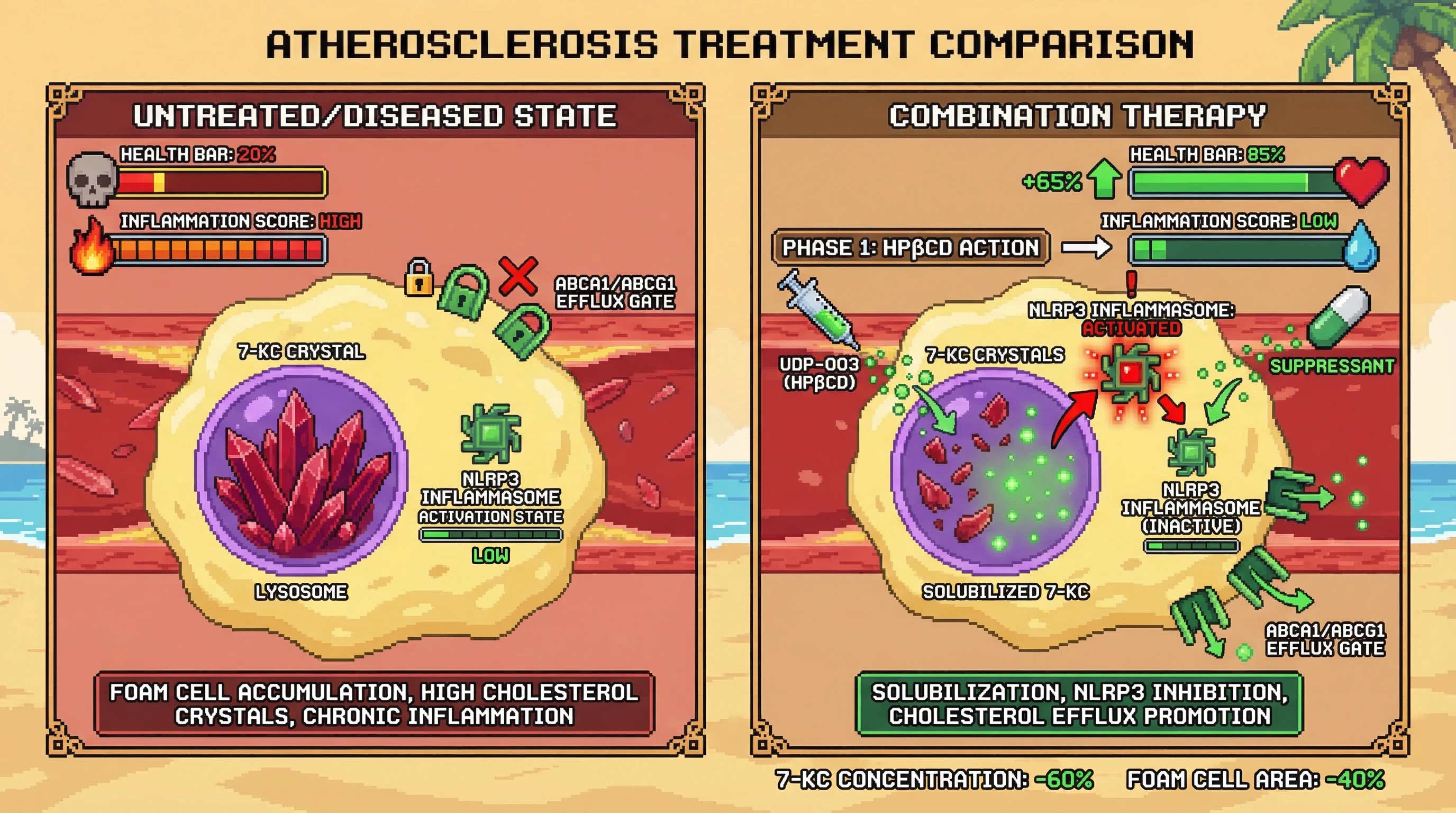
IF combination therapy of UDP-003 (hydroxypropyl-β-cyclodextrin, HPβCD, 100 mg/kg subcutaneous twice weekly) and Oxy210 (anti-inflammatory oxysterol, 10 mg/kg intraperitoneal three times weekly) is administered for 12 weeks to male and female ApoE−/− mice aged 40–50 weeks maintained on Western diet for ≥20 weeks,
THEN aortic root lesion 7-ketocholesterol (7-KC) concentration will be reduced by ≥60% from baseline (nmol/mg protein by LC-MS/MS with d7-7-KC internal standards), CD68+/Oil Red O+ foam cell area will decrease by ≥40% versus vehicle, and the combination will exceed the best monotherapy arm by ≥15% on both endpoints (p<0.05 by two-way ANOVA with Tukey post-hoc), with sorted aortic CD68+ macrophage bulk RNA-seq confirming ABCA1/ABCG1 upregulation and NLRP3/IL-1β downregulation,
BECAUSE the two agents address sequential, non-overlapping bottlenecks in plaque oxysterol repair through a "solubilize-then-efflux" mechanism:
-
HPβCD physically solubilizes crystalline cholesterol and lysosomal 7-KC deposits in macrophage foam cells through a non-canonical, vesicular/lysosomal trafficking pathway that does not upregulate ABCA1 or ABCG1. This physical extraction is necessary but mechanistically incomplete, because mobilized oxysterols accumulate as intracellular intermediates without a transcriptional efflux program to clear them from the cell. (Lack of concomitant ABCA1/ABCG1 upregulation after HPβCD treatment explains a net increase in filipin-detectable cholesterol despite treatment)[https://doi.org/10.1038/s41598-017-02387-8]
-
HPβCD-mediated dissolution of cholesterol crystals and lysosomal 7-KC paradoxically triggers macrophage NLRP3 inflammasome activation, representing an inflammatory rebound that limits net plaque regression under monotherapy. CD treatment enhances macrophage inflammation and alters lysosomal parameters in bone marrow–derived macrophages and macrophage cell lines, a pro-inflammatory liability that is absent from the dominant regression narrative. (CD enhanced cholesterol efflux but also enhanced macrophage inflammation and lysosomal parameters)[https://doi.org/10.3389/fimmu.2021.716357]
-
Oxy210, a Hedgehog pathway inhibitor oxysterol, suppresses NLRP3 inflammasome activation and downstream IL-1β/IL-6/MCP-1 production, directly counteracting the pro-inflammatory rebound triggered by HPβCD-mediated crystal dissolution [SPECULATIVE — Oxy210's specific NLRP3 suppression mechanism in aortic macrophages has not been directly confirmed in vivo in the available evidence set; this link is inferred from the research context describing Oxy210 as an NLRP3 suppressant and from the pro-inflammatory liability identified in the CD evidence].
-
Oxy210 simultaneously upregulates ABCA1/ABCG1 cholesterol efflux transporters on foam cell macrophages [SPECULATIVE — inferred from research context; direct quantification in ApoE−/− aortic macrophages at this dose is not in the evidence set], providing precisely the trans...
SENS category: LysoSENS
Key references: • doi.org/10.1038/s41598-017-02387-8] • doi.org/10.3389/fimmu.2021.716357] • doi.org/10.1111/bph.15209] • doi.org/10.1126/scitranslmed.aad6100] • doi.org/10.3390/ijms160921056]