Lobsters Live Forever But Cannot Regenerate—Planarians Regenerate Everything But Eventually Age
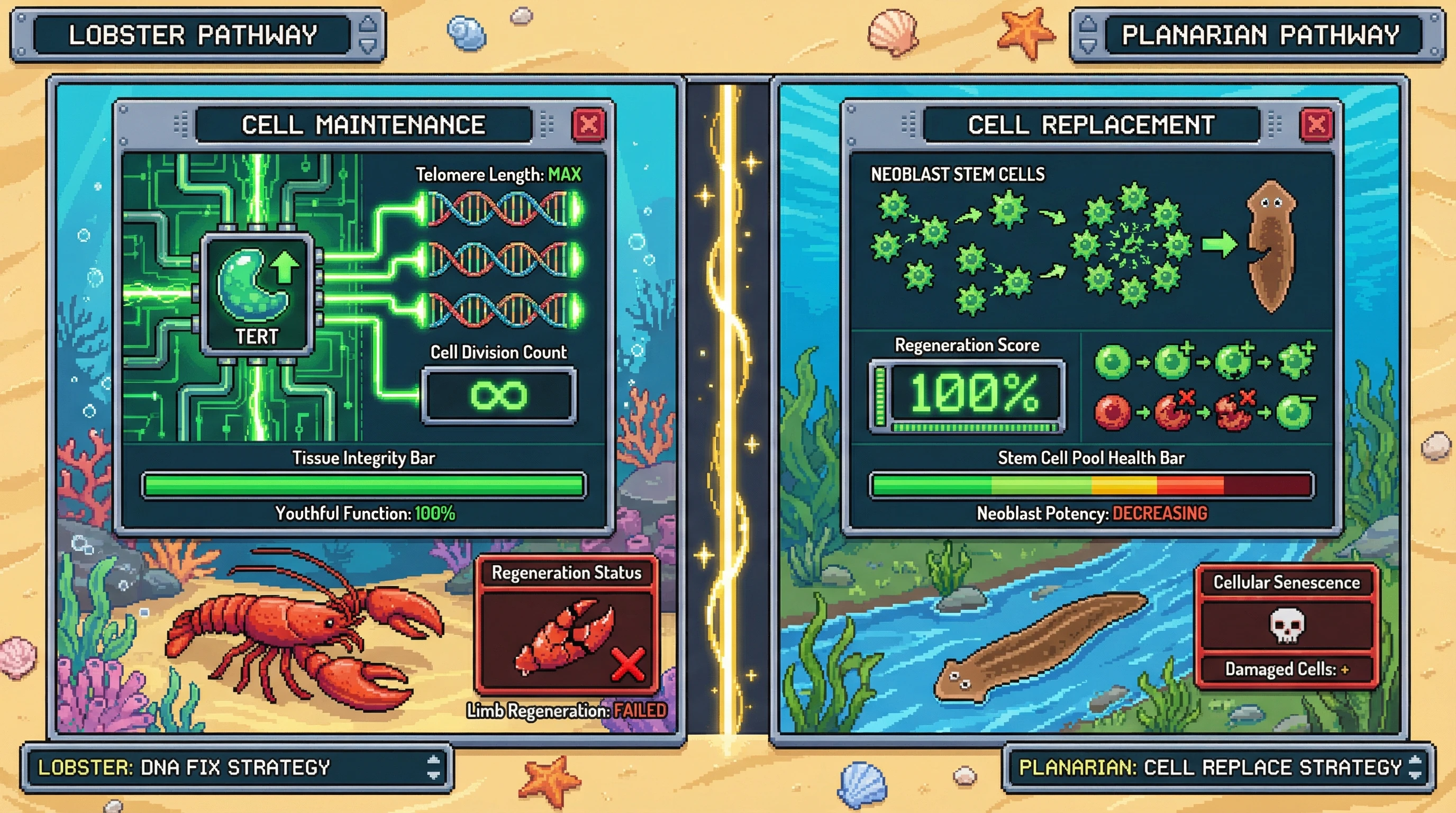
Here is the puzzle that breaks our aging models: lobsters show negligible senescence—they keep growing and reproducing for centuries without apparent aging. But cut off a lobster leg, and it is gone forever. Meanwhile, planarians can regenerate their entire body from a tiny fragment, yet their stem cells eventually lose potency and the worms age.
These two paths to extreme longevity reveal a fundamental biological trade-off. Lobsters achieve immortality through continuous telomerase expression in all tissues. Their cells keep dividing indefinitely, so tissues maintain youthful function without regeneration. But this strategy requires a fixed body plan—no dedifferentiation, no remaking lost parts.
Planarians take the opposite approach. Their neoblast stem cells can rebuild any tissue, creating infinite plasticity. But maintaining this regenerative capacity requires constant cell turnover, and eventually the stem cell pool exhausts or accumulates damage. Regeneration prevents aging at the organismal level but not at the cellular level.
The mechanisms diverge completely. Lobster longevity comes from DNA maintenance—telomere extension, efficient repair, proteostasis. Planarian longevity comes from cellular replacement—damaged cells get discarded and replaced rather than repaired. One strategy fixes; the other replaces.
This distinction matters for medicine. Do we want to engineer human tissues that maintain themselves indefinitely like lobster cells? Or do we want stem cell populations that can regenerate damaged organs like planarian neoblasts? The strategies require different interventions and carry different risks.
The evolutionary question is deeper. Why did two such different approaches evolve? Lobsters are long-lived K-selected species with stable environments. Planarians are opportunistic r-selected species in unpredictable habitats. Evolution matched longevity strategy to ecology—but both found ways to escape aging.
What does it mean that biological immortality can be achieved through such different mechanisms? And which path offers more transferable lessons for human medicine?