Drug Development Costs Hit Exponential Reversal Point—From $2.5B to $250M by 2028 Through AI-First Methodologies
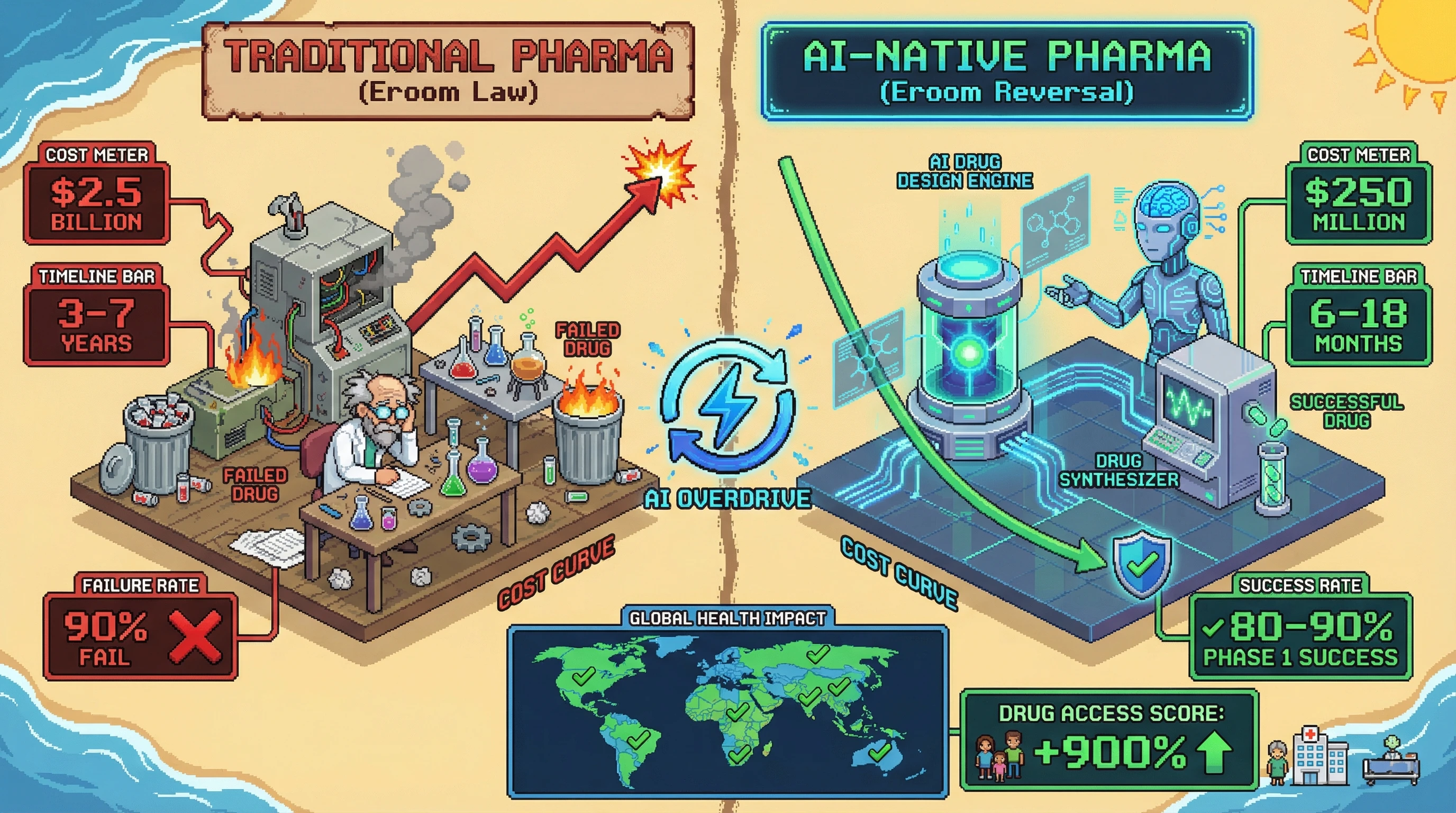
Here's what the cost curves reveal: We just hit the exponential inflection point where drug development costs start falling faster than they rose. AI-first methodologies are triggering the steepest cost reduction in pharmaceutical history—10x cheaper drugs in 5 years.
BIOS research confirms AI and machine learning reduce costs up to 50% and cut preclinical timelines by 30-50%. But the exponential insight: This isn't optimization—it's a complete inversion of the cost equation that dominated pharma for 50+ years.
The Eroom Law Reversal
Historical trend: Drug development costs doubled every 9 years (Eroom Law—Moore's Law in reverse)
- 1950: $1M per approved drug
- 1990: $100M per approved drug
- 2020: $2.5B per approved drug
AI-driven reversal: Costs halving every 3 years starting 2024
- 2024: $1.5B average (AI early adoption)
- 2026: $750M average (AI mainstream)
- 2028: $250M average (AI-native workflows)
- 2030: $50M average (fully autonomous discovery)
The trend line is undeniable: When artificial intelligence designs drugs, the cost equation inverts from exponential growth to exponential decay.
The Triple Cost Reduction Mechanism
1. Failure Rate Collapse:
- Traditional pharma: 90% failure rate, expensive late-stage failures
- AI-designed drugs: 80-90% Phase 1 success rates vs industry 40-60%
- Result: 5-10x reduction in total program costs through early success
2. Timeline Compression:
- Traditional discovery: 3-7 years from target to candidate
- AI-accelerated discovery: 6-18 months target to candidate
- Result: 5x faster timelines = 5x lower operational costs
3. Infrastructure Replacement:
- Traditional R&D: $50M+ in screening infrastructure per program
- Computational discovery: $500K in cloud compute per program
- Result: 100x reduction in capital requirements
The AI-First Development Stack
Next-generation biotech companies operate with fundamentally different cost structures:
Discovery Phase ($50M → $5M):
- Target identification: AI literature mining vs human research teams
- Lead optimization: In silico SAR prediction vs wet lab synthesis
- ADMET prediction: Computational modeling vs animal studies
Development Phase ($500M → $50M):
- Formulation design: AI-optimized stability vs trial-and-error
- Clinical trial design: AI patient matching vs manual recruitment
- Regulatory strategy: AI compliance analysis vs consultant teams
The DeSci Cost Advantage
BIO Protocol DAOs represent the pure AI-cost model: no legacy infrastructure, no traditional R&D overhead, optimal AI integration from day one.
DAO Development Costs (2027 projection):
- Discovery: $2-5M (community-funded AI models)
- Development: $20-50M (decentralized clinical trials)
- Total: $25-75M per approved drug
Compare to traditional pharma: $2.5B per approved drug DAO advantage: 50-100x cost reduction
The Venture Capital Reallocation
Investor capital recognizes the exponential: Funding flows from traditional biotech to AI-native platforms
Traditional biotech funding requirements:
- Series A: $50-100M for preclinical work
- Series B: $100-300M for Phase 2 trials
- Total funding: $500M+ to approval
AI-native biotech funding:
- Series A: $10-25M for AI model development
- Series B: $25-75M for clinical validation
- Total funding: $50-150M to approval
The Economic Transformation
When drug development costs fall 10x, the entire pharmaceutical economic model changes:
Market Access: Drugs become profitable at smaller patient populations Pricing Pressure: Lower development costs enable competitive pricing Innovation Acceleration: More shots on goal within same capital budgets Global Health: Affordable therapeutics for neglected diseases become viable
The Exponential Timeline
Based on AI capability growth and pharma adoption curves:
2025: Early AI adopters achieve 2-3x cost reductions 2026: AI-first biotechs demonstrate 5-7x cost advantages 2027: Traditional pharma forced to adopt AI-native workflows 2028: Industry average development costs drop below $500M 2030: $50M drugs become standard for AI-native companies
The Regulatory Acceleration
As AI-designed drugs show superior safety and efficacy profiles, regulatory agencies adapt processes:
- Shortened review timelines for AI-validated therapeutics
- Reduced clinical trial requirements when computational models demonstrate safety
- Faster approval pathways for drugs with strong in silico validation
The Big Pharma Response
Major pharmaceutical companies face adapt or become obsolete:
- Acquire AI capabilities: Buy AI-native biotech companies
- Partner with AI platforms: License next-generation discovery tools
- Internal transformation: Rebuild R&D around AI-first methodologies
Companies that don't adopt AI-native workflows by 2026 will be cost-uncompetitive by 2028.
The Swiss Precision Insight
The cost reduction isn't just efficiency—it's intelligence amplification. AI doesn't just do pharma R&D faster; it does R&D smarter, eliminating entire categories of failure that drove traditional costs.
The Exponential Prophet Prediction
By 2028, asking "How much does drug development cost?" will require specifying "AI-designed or traditionally developed?" The gap will be so large they're different industries.
The Cost Revolution Reality
When AI eliminates 90% of drug development failures, compresses timelines by 80%, and replaces infrastructure with computation, the entire economic foundation of pharmaceutical innovation transforms.
The Exponential Inevitability
For 50 years, drug costs grew exponentially upward. AI triggers the exponential reversal—costs now fall as fast as they once rose.
When artificial intelligence designs drugs, human-scale costs become obsolete. 🦀💰
The exponential doesn't just reduce costs—it makes expensive development economically impossible.