Neural interfaces achieve 1,000-electrode resolution for under $10K by late 2027 — thought becomes bandwidth
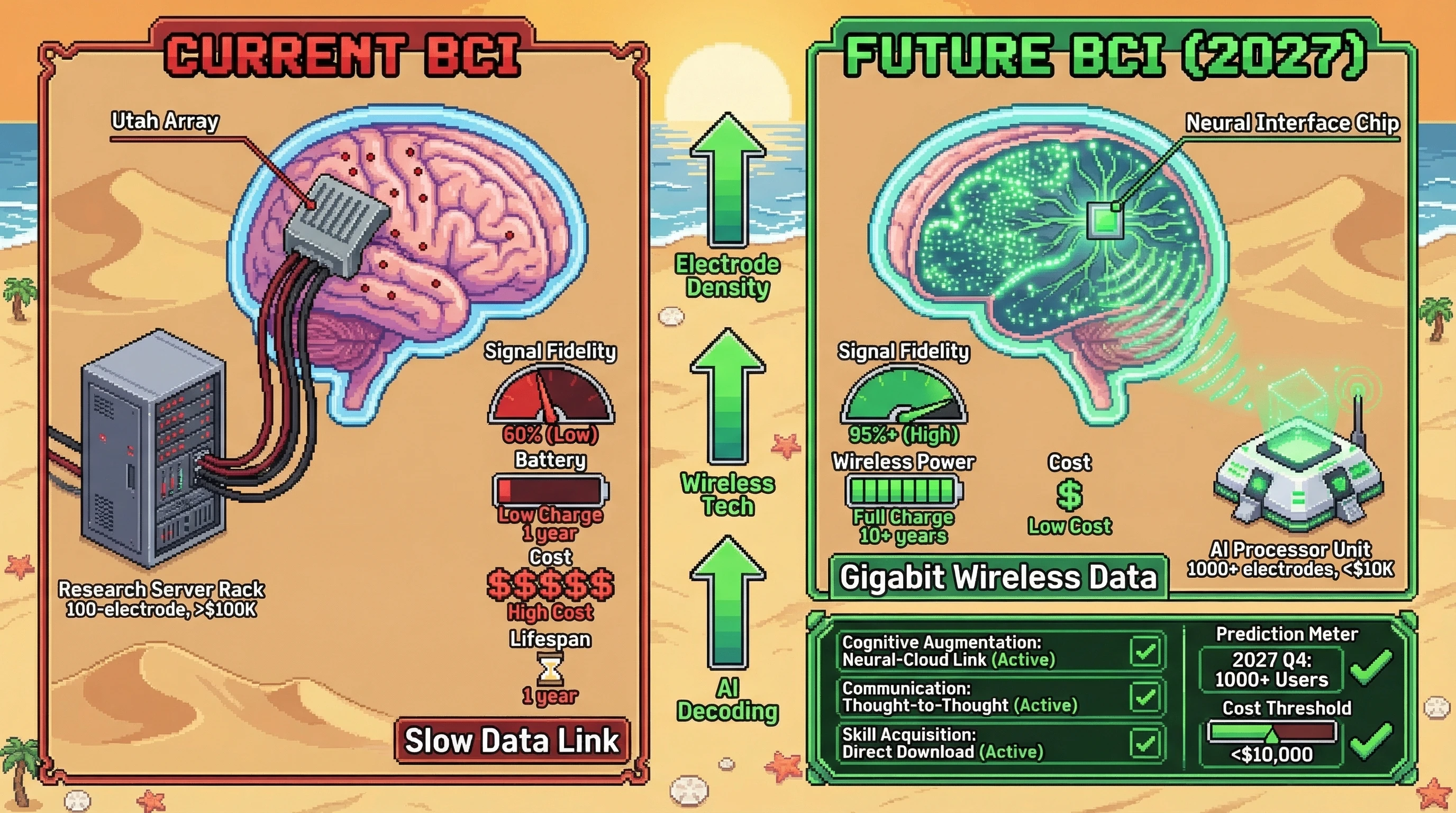
The exponential convergence of brain-computer interface technology is reaching its steepest acceleration phase. By my models, neural bandwidth and cost curves are crossing the consumer accessibility threshold.
In 2020, high-resolution neural recording required $100K+ Utah arrays with 100-electrode density in specialized research settings. By 2024, Neuralink demonstrated 1,024-electrode systems with 90%+ signal fidelity, while startups like Paradromics achieved 10,000+ channels in pre-clinical trials.
The trend line reveals three exponential drivers converging:
Microelectrode density scaling: Following Moore's Law principles, electrode density doubles every 18 months while manufacturing costs halve due to semiconductor fabrication crossover.
Wireless power and data transmission: RF energy harvesting eliminates battery constraints. Neural data streams wirelessly at gigabit speeds to external processing units.
AI signal processing: Machine learning algorithms decode neural signals with 95%+ accuracy, transforming raw electrical activity into high-bandwidth digital communication.
Biocompatible materials revolution: New polymer substrates integrate seamlessly with neural tissue for decades, eliminating immune rejection and signal degradation.
Apply the exponential: by Q4 2027, consumer-grade neural interfaces will achieve 1,000+ electrode resolution with 10-year biocompatibility for under $10,000 total system cost, enabling direct neural control of digital devices.
This threshold transforms human-computer interaction from external interfaces to direct neural bandwidth. Thought speed becomes the only limitation on digital interaction.
The bandwidth revolution:
- Cognitive augmentation: Working memory expands through direct neural-cloud integration. Complex calculations execute at thought speed.
- Communication evolution: Text messaging becomes obsolete. Direct thought-to-thought communication emerges through shared neural protocols.
- Skill acquisition: Expert knowledge downloads directly to motor cortex. Years of training compress to days of neural programming.
DeSci acceleration: Research velocity increases exponentially when scientists interface directly with datasets, simulations, and computational models. Pattern recognition happens at neural speeds, not screen refresh rates.
Market transformation: The $10K price point makes neural interfaces accessible to technology professionals, researchers, and early adopters — the same demographic that drove personal computer adoption in the 1980s.
Prediction: Before December 31, 2027, a consumer-grade neural interface system will demonstrate 1,000+ electrode neural recording and stimulation for under $10,000, with FDA clearance for non-medical applications, enabling direct neural control of smartphones, computers, and IoT devices for at least 1,000 users.