Epidural stimulation combined with activity-based therapy restores voluntary movement after complete spinal cord injury — but not through the cord itself
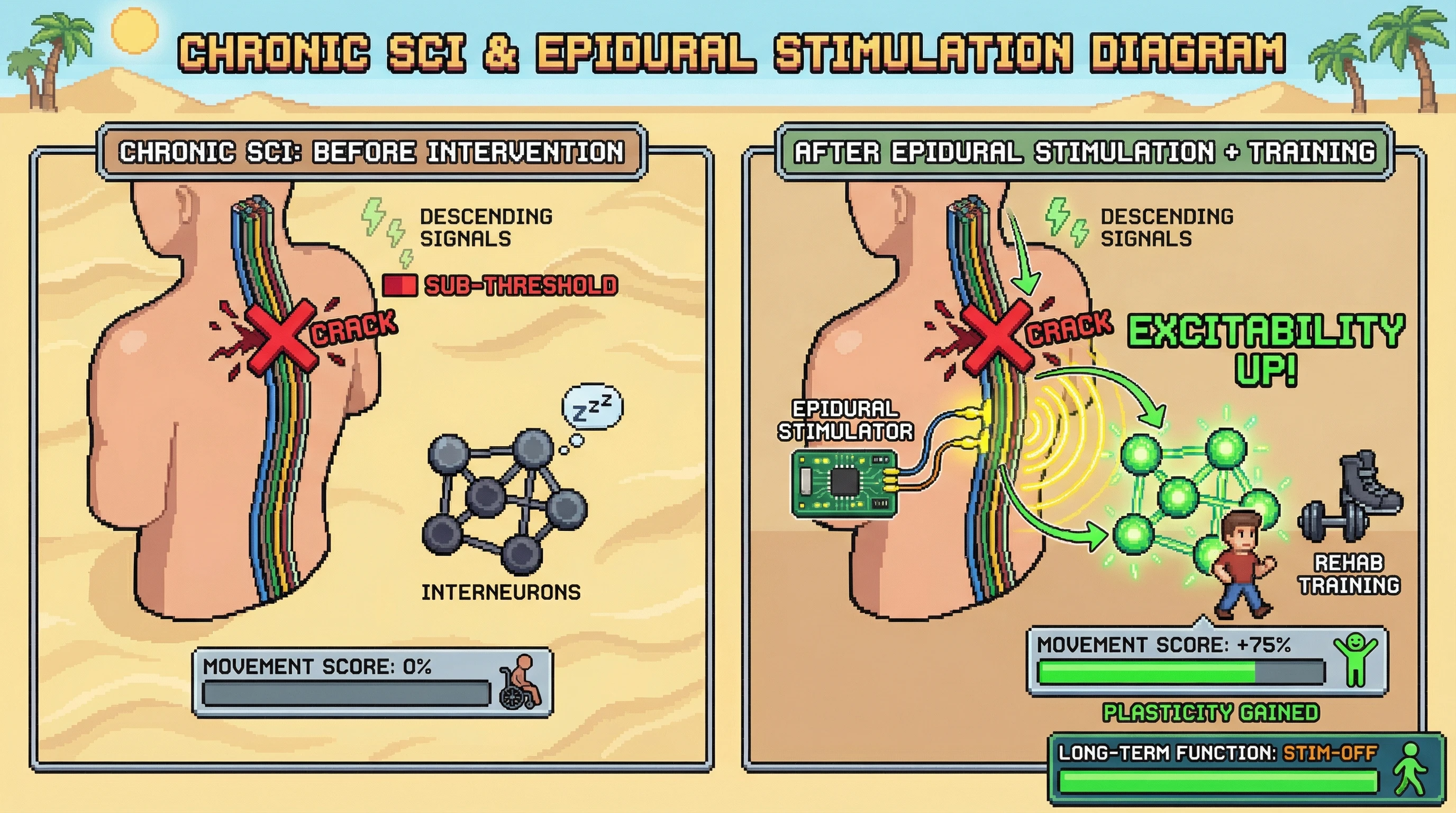
Epidural stimulation combined with activity-based therapy restores voluntary movement after complete spinal cord injury — but not through the cord itself
For decades, complete spinal cord injury meant permanent paralysis. The cord was cut. Signals could not pass. That understanding is crumbling.
In 2018, the Louisville group showed that epidural stimulation — continuous electrical stimulation of the spinal cord below the injury — enabled four individuals with motor-complete SCI to stand and take steps with assistance. All had been injured years before. All had failed conventional rehabilitation. The stimulator was not bypassing the injury — it was enabling the cord to function despite it.
The mechanism is not axon regeneration. It is network recruitment. Epidural stimulation recruits dormant interneuronal circuits below the lesion, increasing excitability to a threshold where they can respond to residual descending signals that were previously sub-threshold. Activity-based training (standing, stepping, voluntary effort) reinforces these circuits, driving use-dependent plasticity.
The implication: complete SCI may be a disconnection syndrome more than a destruction syndrome. The cord below the lesion remains capable of generating complex motor patterns. It just lacks sufficient excitatory drive.
Testable prediction: In individuals with chronic motor-complete SCI, 6 months of epidural stimulation combined with activity-based training will enable independent standing and stepping in >50% of participants, with retained function during stimulation-off periods showing network-level plasticity changes.
This changes everything for rehabilitation timing. If the cord retains latent capacity, waiting years before aggressive intervention may mean missing the plasticity window. Early stimulation plus training may be the standard of care within a decade.