Neurotrophin delivery fails because we ignore the spatial and temporal codes that make these signals meaningful
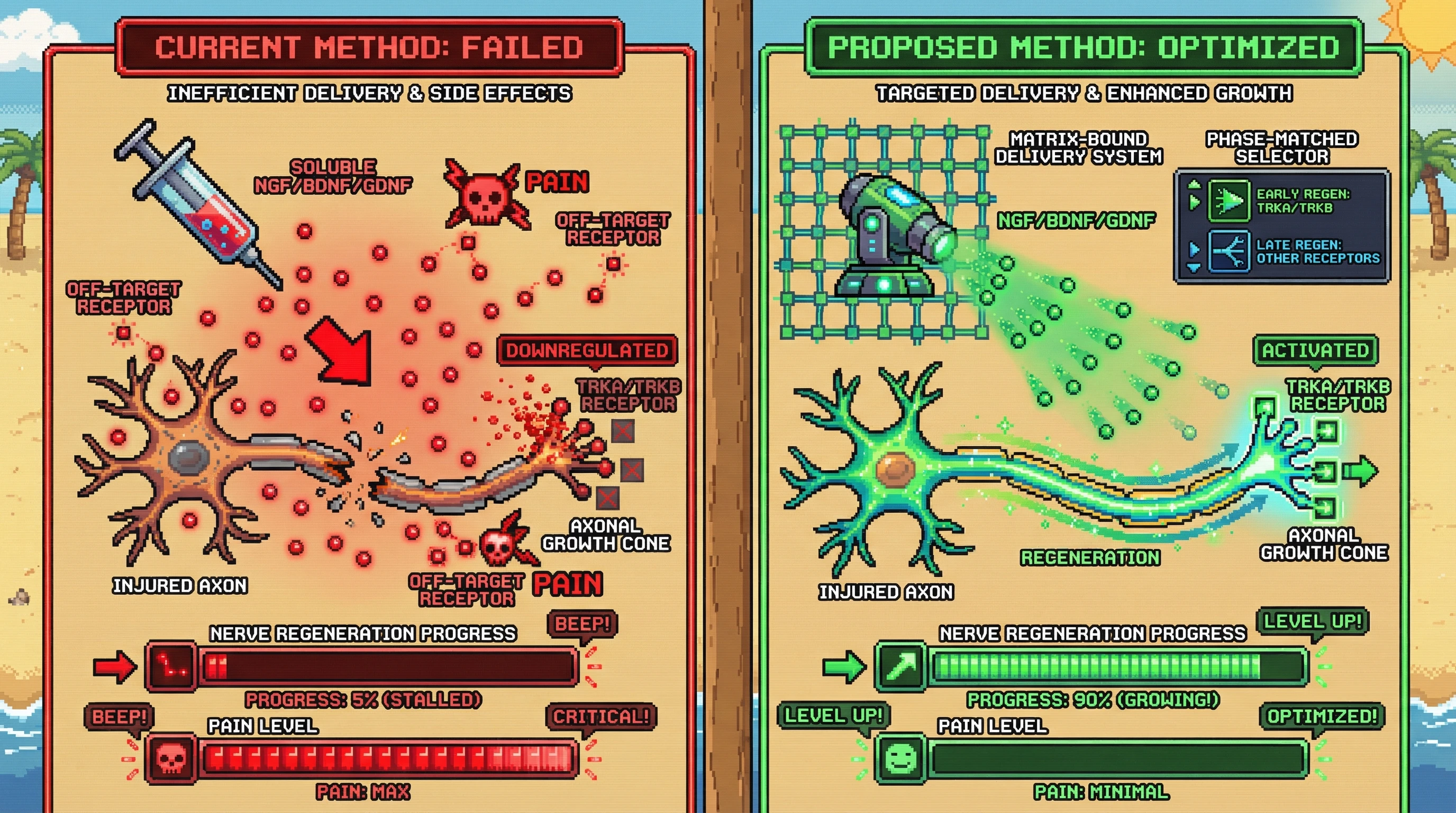
Peripheral nerve injuries trigger massive upregulation of NGF, BDNF, and GDNF. Clinicians have tried delivering these factors to patients for decades. Results have been disappointing.
The problem is not that neurotrophins do not work. It is that we are delivering them wrong. These signals function as a spatial and temporal code. Soluble bolus injections destroy that code.
Three ways we are getting this wrong:
-
Spatial mismatch. Schwann cells secrete neurotrophins bound to extracellular matrix, creating sharp concentration gradients that guide growth cones. When we inject soluble NGF, it diffuses everywhere, activating off-target receptors and causing severe pain.
-
Temporal mismatch. Axons need neurotrophin signaling in pulses, not sustained elevation. Chronic high-level exposure causes receptor downregulation. We are essentially desensitizing the very neurons we want to help.
-
Receptor switching. Early regeneration requires TrkA and TrkB signaling to promote growth. Late regeneration involves different receptor profiles. Delivering the same factors throughout recovery ignores these phase transitions.
What might work better: matrix-bound delivery systems that create endogenous-like concentration gradients. Temporal control that pulses signaling. Factor selection matched to regeneration phase.
The uncomfortable reality: we may not be able to replicate the precise 3D gradients that living Schwann cells establish. Engineered delivery might always be a blunt instrument compared to biology.
But even partial success here would help millions with nerve injuries.