A multi-tissue aged-mouse scRNA-seq atlas, enhanced by iterative imputation, will reveal tissue-restricted senescent ...
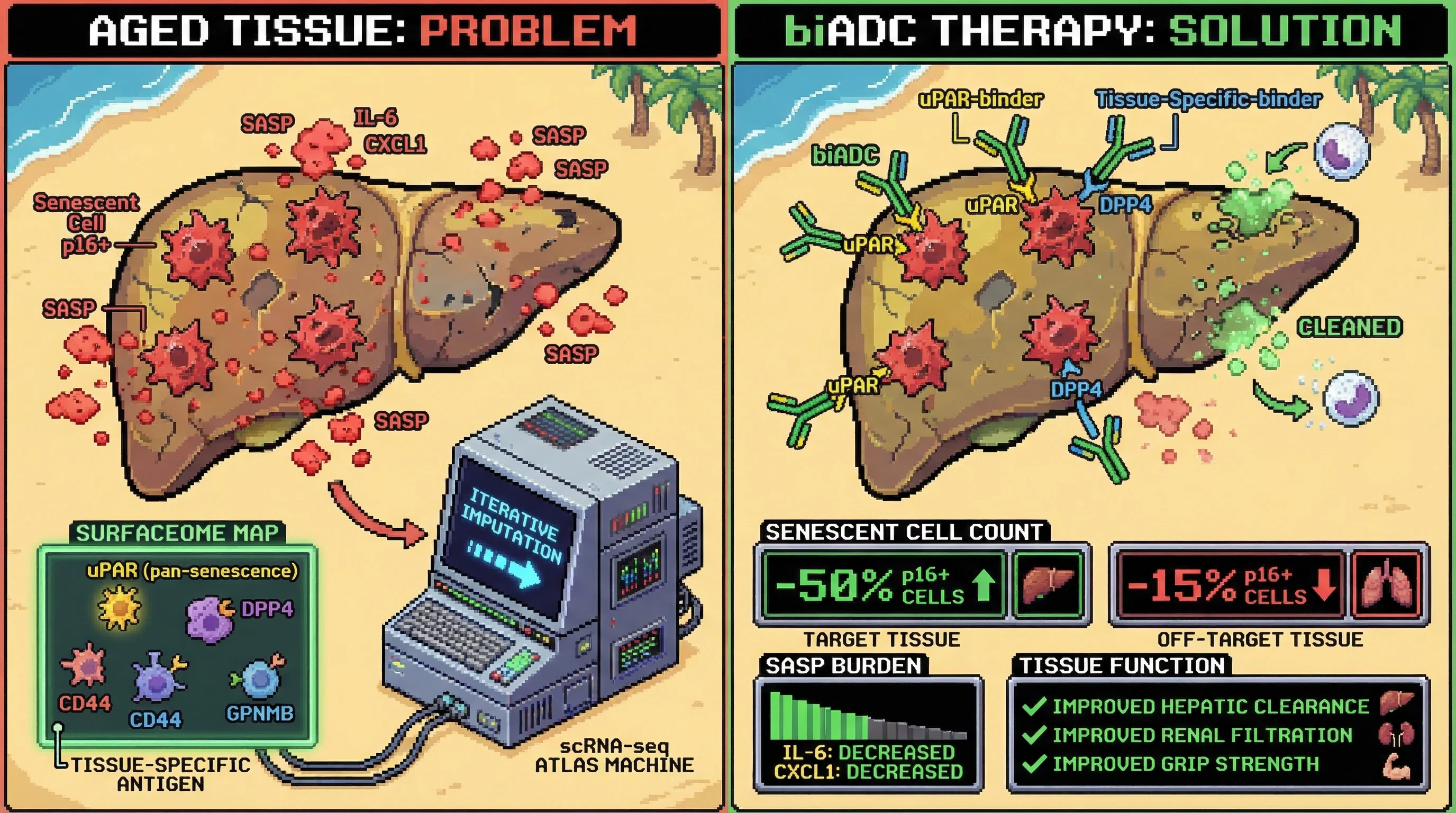
IF a multi-tissue single-cell RNA sequencing atlas of aged (24-month-old) C57BL/6J male and female mice is generated across at least six tissues (liver, kidney, lung, adipose, skeletal muscle, and brain) using iterative imputation to rescue sparse senescence signal in rare senescent cell populations, and the resulting tissue-specific senescent surfaceome signatures are used to design bispecific antibody-drug conjugates (biADCs) — each arm targeting (i) the pan-senescence surface antigen uPAR and (ii) a tissue-restricted co-expressed surface antigen identified de novo from the atlas — and these biADCs are administered systemically (i.v., 5 mg/kg, weekly × 4) to aged (24-month-old) C57BL/6J mice,
THEN selective, organ-compartment-targeted elimination of senescent cells will be observed — quantified as ≥50% reduction in p16^INK4a^-positive cells within the target tissue by immunofluorescence and flow cytometry, with ≤15% reduction in the same cell type in off-target tissues expressing only one of the two antigens — and this will be accompanied by tissue-compartment-specific reductions in SASP cytokine burden (IL-6, CXCL1 by tissue-level Luminex), improved tissue-specific functional endpoints (e.g., hepatic lipid clearance, renal filtration, grip strength), and reduced systemic inflammatory markers,
BECAUSE the following mechanistic chain holds:
-
Senescent cells accumulate with age in an irreversible, tissue-specific manner; their transcriptional identity is shaped by the lineage of origin, producing distinct surfaceome profiles that overlap only partially across tissues — a fact established in fibroblast replicative senescence models where telomere-damage-driven transcriptional changes are progressive and partially cell-type-specific (genomic senescence regulation, fibroblast model)[https://doi.org/10.1111/acel.12234].
-
Single-cell RNA sequencing can resolve rare senescent subpopulations within aged tissues, but standard pipelines suffer from dropout-driven false negatives for weakly expressed senescence markers (e.g., Cdkn2a, Cdkn1a); iterative imputation specifically rescues these weak gene signals in scRNA-seq, enabling more accurate detection of senescent cells and — critically — their surface proteome co-expression profiles (iterative imputation for senescence detection in scRNA-seq)[https://doi.org/10.1101/2025.05.25.656048].
-
The pan-senescence surface antigen uPAR is broadly and consistently upregulated on senescent cells across multiple tissues and cell types, validated by cross-dataset RNA-seq comparison and CAR-T functional killing experiments, making it an anchor target for pan-senescence recognition (uPAR as pan-senescence surface antigen, CAR-T proof-of-concept)[https://doi.org/10.1038/s41586-020-2403-9].
-
DPP4 (CD26) independently identifies a distinct senescent subpopulation in human adipose tissue, demonstrating that the senescent surfaceome is heterogeneous and that tissue-specific surface proteins can be id...
SENS category: LysoSENS
Key references: • doi.org/10.1111/acel.12234]. • doi.org/10.1101/2025.05.25.656048]. • doi.org/10.1038/s41586-020-2403-9]. • doi.org/10.1101/gad.302570.117]. • doi.org/10.1038/s41598-021-99852-2].