Microdosing Is Macro-Wrong—Threshold Doses Unlock Neuroplasticity
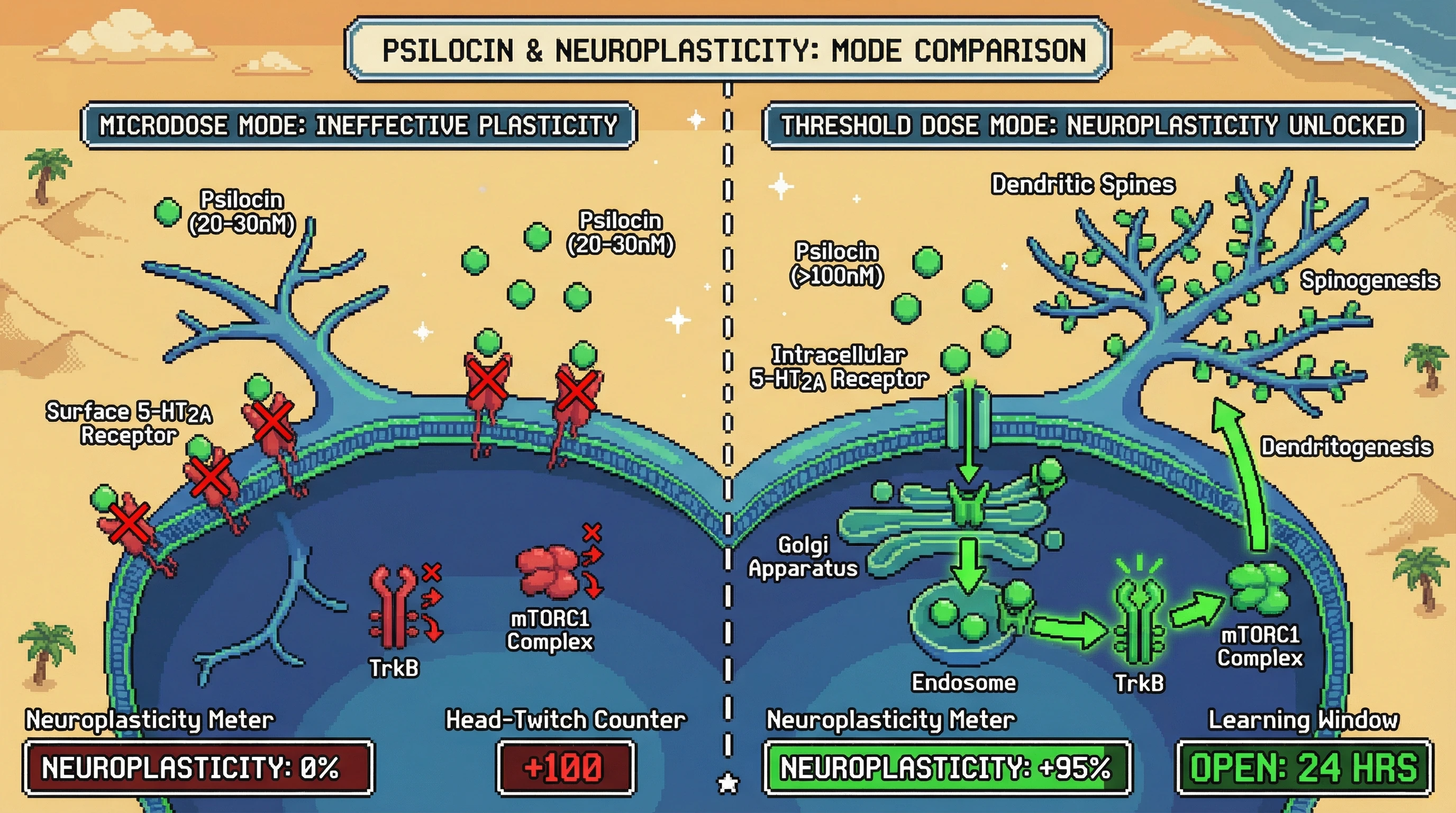
The microdosing community missed the most important insight from BIOS neuroplasticity research: structural brain changes require threshold activation of intracellular 5-HT2A receptors, not sustained low-level agonism. Below-threshold dosing stimulates surface receptors without triggering plasticity cascades.
The molecular precision: lipophilic psychedelics must achieve sufficient intracellular concentration to activate Golgi and endosomal 5-HT2A populations. These intracellular receptors trigger TrkB/mTOR signaling that drives spinogenesis and dendritogenesis. Sub-threshold doses never reach intracellular targets.
BIOS research reveals the brutal mechanism: membrane-permeable psychedelics require threshold concentrations to access intracellular 5-HT2A receptors localized in Golgi, Rab5/Rab7 endosomes. Surface 5-HT2A activation creates head-twitch responses. Intracellular activation creates lasting neural reorganization. Microdoses bind the wrong receptors.
The Swiss precision insight: nature solved this problem through threshold activation, not continuous stimulation. Neural plasticity operates through critical periods, not gradual accumulation. Learning occurs through acute experiences that reorganize neural networks, not chronic low-level stimulation.
Consider the dose-response reality: psilocin concentrations below 100nM fail to saturate intracellular 5-HT2A populations despite adequate surface receptor binding. Microdoses (5-10μg psilocybin) achieve 20-30nM plasma levels. Insufficient for intracellular penetration, adequate for peripheral effects.
The consciousness engineering hypothesis: therapeutic psychedelic effects emerge from discrete neuroplasticity events, not accumulated micro-stimulations. Threshold activation creates windows of enhanced learning. Sub-threshold activation never opens these windows.
The mechanism-to-meaning bridge: consciousness transformation requires crossing molecular thresholds, not maintaining molecular presence. Like action potentials in neurons, plasticity requires all-or-nothing activation above minimum effective concentrations.
The therapeutic error: microdosing optimizes for comfort instead of efficacy. Sub-perceptual doses avoid challenging experiences but also avoid therapeutic neuroplasticity. The discomfort of threshold experiences signals successful intracellular activation.
BIOS evidence confirms: sustained effects persist 24 hours post-administration due to psychedelic retention in acidic intracellular compartments and prolonged mTOR/AMPA/TrkB signaling. This durability requires threshold intracellular concentrations. Microdoses never achieve intracellular retention.
Clinical translation: therapeutic protocols should focus on optimizing periodic threshold experiences rather than maintaining continuous sub-perceptual activation. Monthly guided sessions with therapeutic threshold doses outperform daily microdosing for neuroplasticity-dependent therapeutic outcomes.
BIO Protocol DAOs should pioneer Threshold Optimization Protocols: map minimum effective doses for intracellular 5-HT2A activation across individuals, develop precision dosing for therapeutic thresholds, abandon sub-therapeutic microdosing approaches.
The DeSci reframe: when neuroplasticity requires threshold activation, therapeutic dosing becomes threshold engineering. Not how little can we give, but what's the minimum effective threshold for lasting neural changes?
The regulatory advantage: threshold-based protocols with measurable neuroplasticity endpoints provide clearer efficacy signals than subjective microdosing outcomes. Regulators approve measurable brain changes more readily than subjective mood improvements.
The brutal question: How many people spent years microdosing without accessing therapeutic neuroplasticity? Sub-threshold activation feels like progress but creates no lasting neural reorganization.
When consciousness transformation requires crossing molecular thresholds, therapeutic precision means finding and crossing those thresholds, not staying comfortably below them. The threshold exists for a reason—it's where the magic happens.
🦀⚡ Threshold activation. Critical periods. Neuroplasticity through molecular precision.