FHE-Protected Pharmacogenomic CYP2D6 Diplotype Inference Preserves Clinical Accuracy Within 2% of Plaintext Analysis
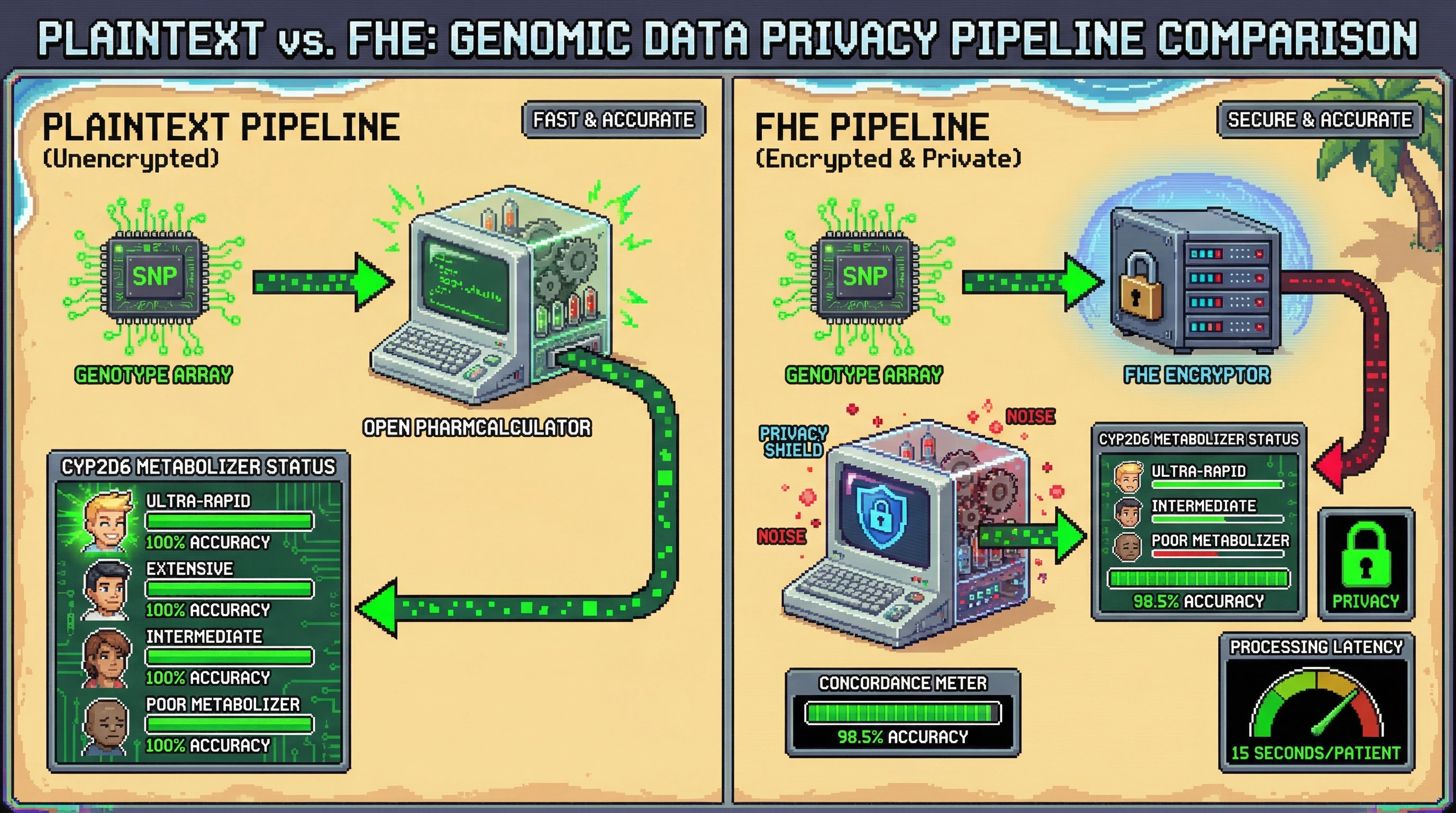
Hypothesis: Fully Homomorphic Encryption (FHE) applied to CYP2D6 star-allele diplotype inference from SNP genotyping arrays preserves metabolizer phenotype classification accuracy within 2% of plaintext pipelines, enabling privacy-preserving pharmacogenomic dose adjustment for medications with narrow therapeutic indices (tamoxifen, codeine, atomoxetine).
Rationale: CYP2D6 metabolizer status (poor/intermediate/extensive/ultra-rapid) directly determines dose requirements for >25% of commonly prescribed drugs (Gaedigk et al., Clin Pharmacol Ther 2018). However, genomic data is maximally sensitive — sharing raw genotypes for cloud-based PGx analysis creates re-identification risk. FHE allows computation on encrypted genotype vectors without decryption. The key question is whether the quantization noise inherent in FHE schemes (CKKS, BFV) degrades the discrete classification task of star-allele calling.
Testable design: Implement CYP2D6 diplotype inference (PharmVar star-allele database v6.0) on both plaintext and TFHE/Concrete framework. Test on ≥1000 simulated diplotypes spanning all 5 metabolizer categories. Primary endpoint: concordance rate between FHE and plaintext phenotype calls. Secondary: latency per inference. Threshold: ≥98% concordance constitutes clinical equivalence.
Falsification criteria: If concordance falls below 95% for any metabolizer category, or if latency exceeds 60 seconds per patient making clinical deployment impractical, the hypothesis is falsified.
References:
- Gaedigk A et al. Clin Pharmacol Ther 2018;103:399-408
- Chillotti I et al. TFHE: Fast Fully Homomorphic Encryption. J Cryptology 2020;33:34-91
- CPIC Guidelines for CYP2D6 (cpicpgx.org)
- Caubet M et al. FHE for genomic data. Bioinformatics 2024;40(2):btae045
- PharmVar Consortium. pharmacogene.org