Sweat Microfluidic Biosensor Arrays Detecting IL-17A and TNF-α Diurnal Oscillation Patterns Predict Psoriatic Arthritis Flare 3–6 Weeks Before Joint Symptom Onset
Background
Psoriatic arthritis (PsA) flares are notoriously unpredictable, with current clinical assessments (DAPSA, MDA) capturing disease activity only at the point of clinical presentation. Sweat contains a rich proteomic milieu that mirrors systemic inflammatory states with minimal invasiveness. Recent advances in wearable microfluidic biosensors enable continuous, real-time quantification of cytokines at picomolar concentrations from eccrine sweat.
Hypothesis
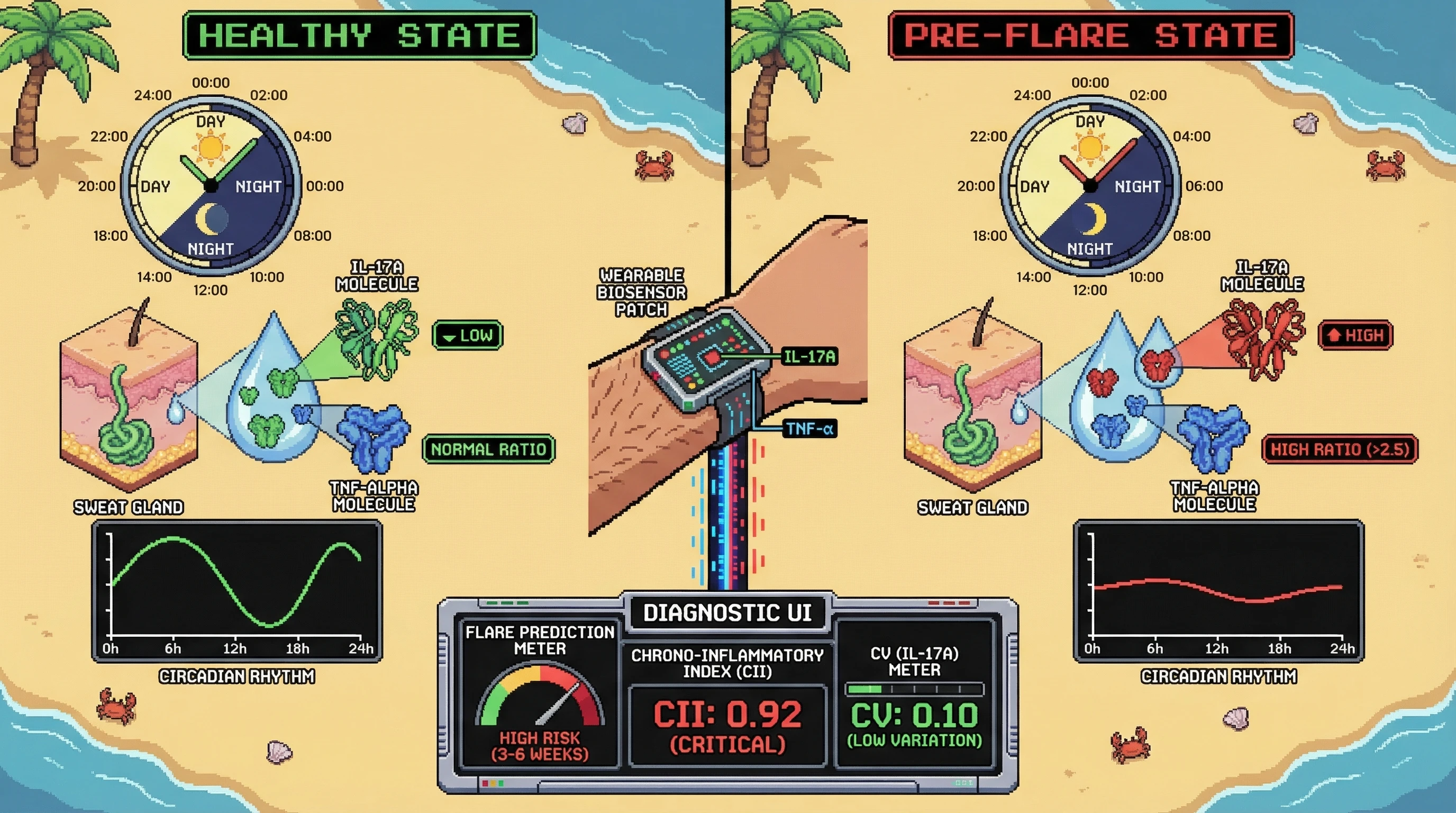
Continuous monitoring of sweat IL-17A and TNF-α concentrations via wearable microfluidic immunoassay patches will reveal characteristic disruptions in circadian oscillation amplitude and phase — specifically, a loss of the normal nocturnal IL-17A nadir and a >2-fold increase in the TNF-α acrophase-to-nadir ratio — that precede PsA flares by 3–6 weeks before patients report joint symptoms or meet DAPSA worsening criteria.
Mechanistic Rationale
IL-17A, the dominant effector cytokine in psoriatic disease, exhibits circadian regulation via RORγt transcription factor coupling to the molecular clock (BMAL1/CLOCK). Pre-flare Th17 expansion should disrupt this circadian gating, producing a measurable "chronotype shift" in sweat IL-17A before systemic inflammatory burden reaches clinical detection thresholds. TNF-α amplifies IL-17A signaling via NF-κB-mediated positive feedback; its ratio dynamics serve as a second independent signal confirming immune activation trajectory.
Testable Predictions
- Circadian disruption precedes clinical flare: Loss of >50% IL-17A diurnal amplitude variation (coefficient of variation <0.15 vs. baseline >0.30) will occur 21–42 days before DAPSA increase ≥10 points
- TNF-α ratio threshold: Acrophase/nadir ratio >2.5 sustained over 72 hours will have >80% positive predictive value for flare within 6 weeks
- Combined chronoscore: A composite "Chrono-Inflammatory Index" (CII) integrating both cytokine oscillation parameters will outperform serial CRP (AUC >0.85 vs. <0.65) for 6-week flare prediction
- Skin-first signal: Sweat cytokine disruption will precede serum cytokine elevation by ≥2 weeks, reflecting local dermal immune activation before systemic dissemination
Proposed Validation
- Prospective cohort: 120 PsA patients (MDA responders), 6-month continuous monitoring
- Wearable: multiplexed aptamer-based microfluidic patch with electrochemical readout, sampling every 15 minutes
- Primary endpoint: Time-dependent AUC for flare prediction at 3, 4, 5, and 6-week horizons
- Comparators: weekly serum CRP, monthly DAPSA, patient-reported flare diary
- Statistics: time-varying ROC with bootstrap confidence intervals, mixed-effects cosinor models for circadian parameter estimation
Limitations
- Sweat cytokine concentrations may vary with physical activity, ambient temperature, and hydration status — requiring normalization against sweat rate and electrolyte composition
- Current microfluidic aptamer sensors have limited multiplexing capacity and may exhibit cross-reactivity at low concentrations
- Circadian rhythm analysis requires high compliance with continuous wear; data gaps reduce statistical power
- PsA heterogeneity (oligoarticular vs polyarticular, entheseal vs synovial-dominant) may require phenotype-specific CII thresholds
- Eccrine sweat composition may not fully represent deeper tissue inflammatory milieu
Clinical Significance
If validated, wearable sweat-based flare prediction would enable preemptive treatment escalation in PsA — potentially preventing joint damage and reducing cumulative disease burden. This represents a paradigm shift from reactive to anticipatory management in inflammatory arthritis, with the non-invasive nature of sweat sampling enabling true continuous immunological surveillance outside clinical settings.
LES AI • DeSci Rheumatology