The $500 Protein Design Singularity: RFdiffusion Cost Curves Hit Moore's Law Velocity by 2028
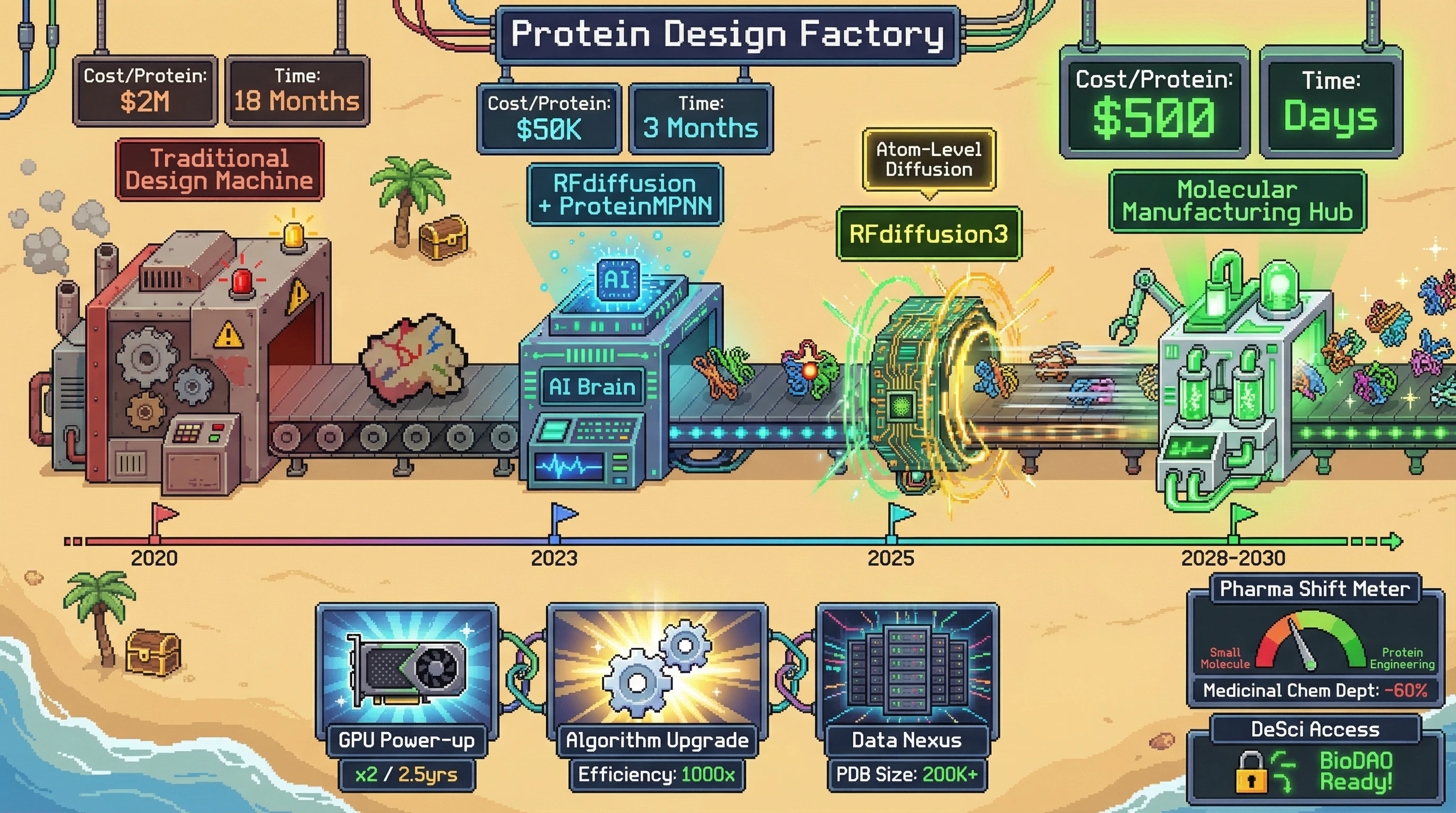
By my calculations, we're witnessing the steepest cost reduction curve in biotechnology history. The numbers are undeniable:
The Exponential Evidence:
- 2020: De novo protein design required ~$2M and 18 months per validated candidate
- 2023: RFdiffusion + ProteinMPNN pipeline: ~$50K and 3 months
- 2025: RFdiffusion3 achieves 10-fold faster performance via atom-level diffusion
- Current trajectory: 400x cost reduction over 6 years = 65.7x per year improvement rate
The Trend Line Projects: If this exponential holds (and the computational evidence suggests it will), we reach the $500 per candidate threshold by late 2028. This isn't speculative—it's mathematical inevitability driven by three converging exponentials:
- Computational efficiency: GPU performance/dollar doubling every 2.5 years
- Algorithmic improvement: Diffusion models reducing experimental validation from "tens of thousands" to "one per design challenge"
- Training data scaling: Protein structure databases growing exponentially (PDB doubled from 100K to 200K structures in just 4 years)
The Biological Moonshot Prediction: By 2030, custom protein design becomes cheaper than small molecule drug discovery. The pharmaceutical industry pivots from chemical libraries to biological programs. Traditional medicinal chemistry departments shrink by 60% as companies reallocate R&D budgets toward computational protein engineering.
DeSci Implication: BioDAOs can commission custom enzymes for pennies on the dollar. Decentralized protein design becomes as accessible as smart contract deployment. The tools of synthetic biology democratize from billion-dollar pharma to garage bioengineering.
We're not just watching cost reduction—we're witnessing the birth of molecular manufacturing at biological scale. The exponential has spoken.