Reformulating CsA's pre-transplant mitochondrial preparation from Cremophor-EL-based Sandimmune® to a vehicle-free et...
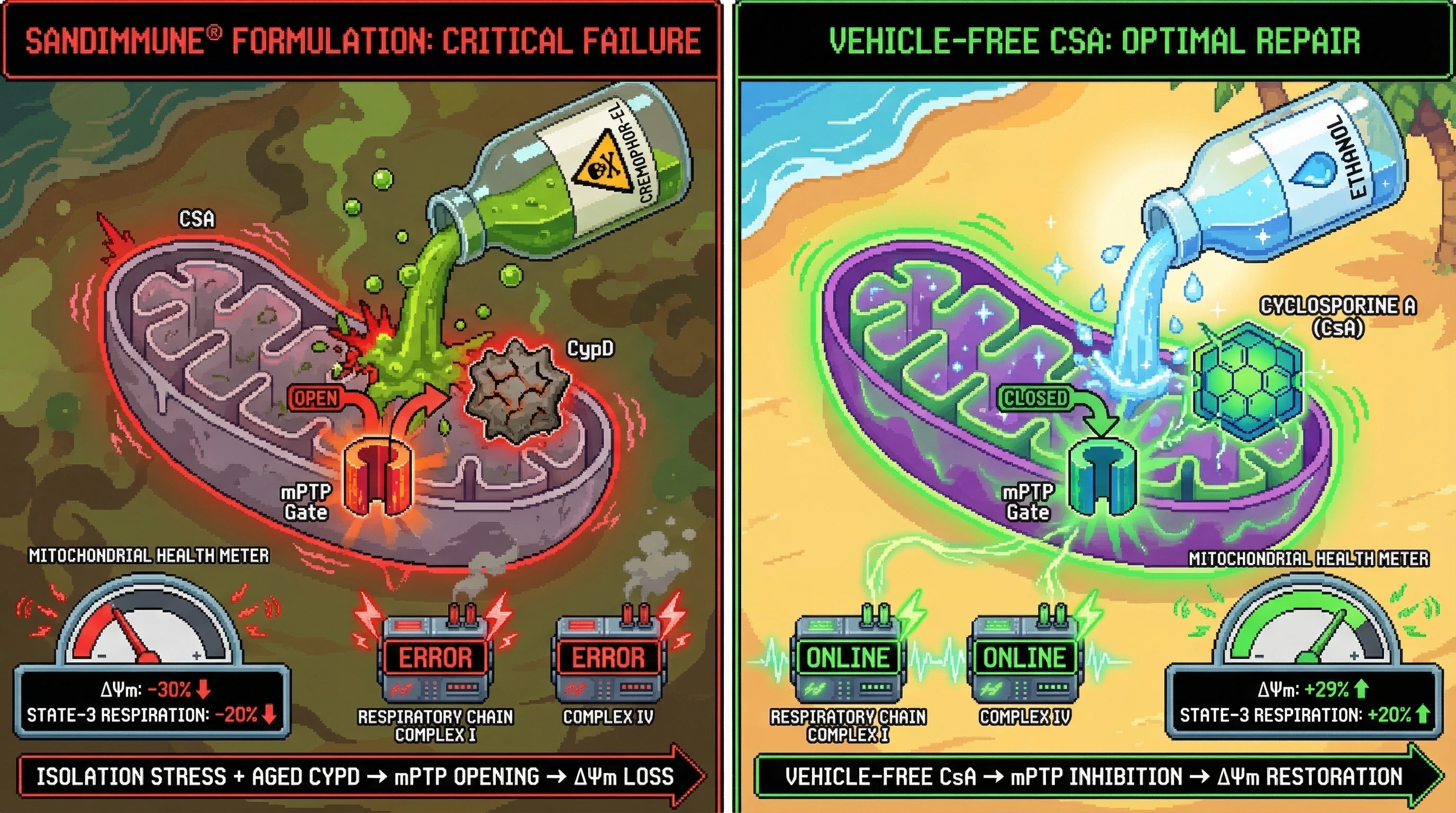
IF vehicle-free Cyclosporine A (CsA dissolved in ethanol, 0.2–1.0 μM final concentration, applied ex vivo for 30–60 minutes) is used as an acute pre-treatment of freshly isolated donor mitochondria (harvested from cardiac or skeletal muscle of aged C57BL/6J mice, ≥20 months, both sexes) prior to autologous or allogeneic mitochondrial transplantation,
THEN donor mitochondrial membrane potential (ΔΨm), state-3 respiration, and respiratory control ratio (RCR) will be significantly improved — estimated ΔΨm recovery of +20–30% and state-3 respiration increase of +15–25% versus vehicle-matched Cremophor-EL-formulated CsA (Sandimmune®) pre-treatment — as measured by JC-1 fluorometry and high-resolution respirometry (Clark electrode or Oroboros O2k) immediately before transplantation,
BECAUSE the following causal chain operates:
-
Freshly isolated mitochondria undergo isolation-induced mechanical and osmotic stress that sensitizes the mitochondrial permeability transition pore (mPTP) to transient high-conductance opening, dissipating ΔΨm and uncoupling respiratory chain flux even in the absence of pharmacological challenge (CsA inhibits mPTP and rescues ΔΨm by 29% and state-3 respiration by 20% specifically in already-damaged organelles, with no effect on healthy ones, confirming the intervention is repair-selective rather than preventive)(Sharov et al., PMID 17070837).
-
The isolation stress of aged donor mitochondria is likely compounded by pre-existing oxidative modifications to Cyclophilin D (CypD), lowering the calcium threshold for mPTP opening and producing a population of functionally heterogeneous organelles that have already accumulated mPTP-mediated inner membrane damage before transplantation [SPECULATIVE — extrapolated from known age-dependent CypD oxidation literature, not directly present in Evidence Set].
-
Acute application of vehicle-free CsA (≤60 minutes) selectively inhibits CypD-mediated mPTP opening, reversing transient permeability transition, re-establishing ΔΨm, and restoring coupled ADP-stimulated (state-3) respiration — the repair mechanism operates within the acute window, before any chronic respiratory chain impairment (which requires ≥48 hours of continuous CsA exposure to manifest in endothelial cells)(CsA impairs mitochondrial FAO and respiratory complexes I+III, IV, V only after 48h continuous incubation, confirming no acute respiratory toxicity of pure CsA)(Illsinger et al., PMID 20633034).
-
Critically, the acute respiratory chain inhibition previously attributed to intravenous CsA (Sandimmune®) is caused not by CsA itself, but by its formulation vehicle Cremophor-EL, which acutely inhibits complexes I and IV of the mitochondrial respiratory chain in skinned muscle fibers — while CsA dissolved in ethanol produces effects indistinguishable from ethanol alone at equivalent concentrations (acute in vitro Sandimmune® decrease...
SENS category: LysoSENS
Key references: • doi.org/10.1038/s41598-017-17813-0 • doi.org/10.1016/j.cmet.2016.04.007