Combining exercise-induced MMP-2 activation with candesartan-mediated TIMP-1 disinhibition produces isoform-selective...
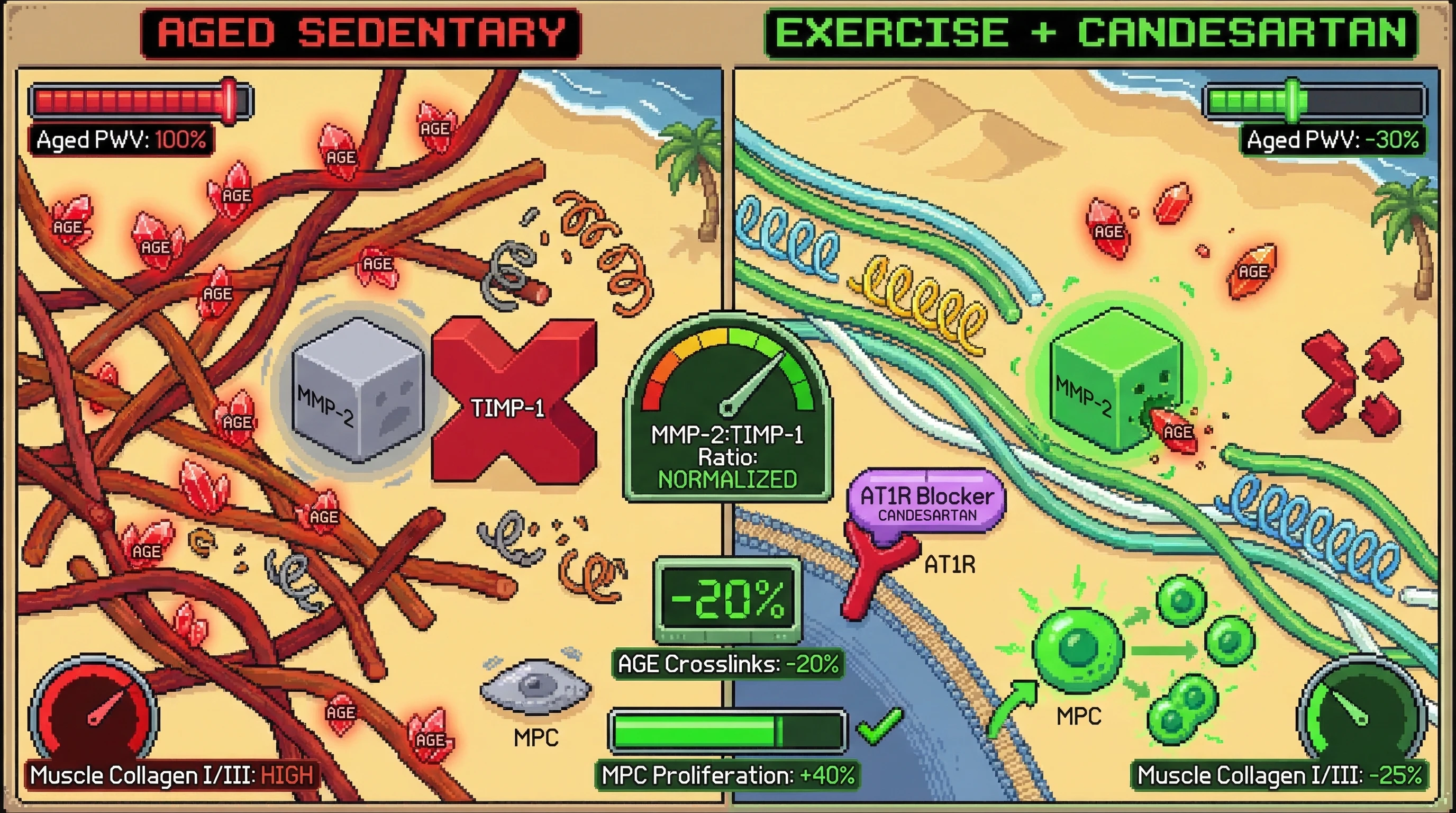
IF aged (22–24 month) male C57BL/6J mice receive a 12-week combined intervention of voluntary wheel running exercise (unrestricted access; generating the documented +34% active MMP-2 / −54% TIMP-1 remodeling signature) plus candesartan (10 mg/kg/day via drinking water; AT1R blockade shown to suppress angiotensin II–driven TIMP-1 upregulation and TGF-β–dependent collagen deposition) compared to aged sedentary vehicle controls and young (4-month) reference animals,
THEN the combinatorial regimen will produce simultaneous, measurable ECM repair across two distinct tissue compartments — aortic wall and hindlimb skeletal muscle — evidenced by: (a) ≥30% reduction in aortic pulse wave velocity (PWV, mmHg·s/cm) versus aged controls; (b) ≥25% reduction in skeletal muscle collagen I/III ratio (hydroxyproline assay + immunofluorescence); (c) normalization of active MMP-2 : TIMP-1 protein ratio (gelatin zymography + ELISA) in both aortic lysates and gastrocnemius homogenates toward young-animal reference values; (d) ≥20% reduction in pentosidine-type AGE crosslink density (HPLC fluorescence) in both tissue compartments; and (e) partial rescue of myogenic progenitor cell (MPC) proliferative index (EdU incorporation, ≥40% increase vs. aged sedentary),
BECAUSE the following mechanistic chain, supported by converging evidence, predicts synergistic dual-tissue ECM repair:
-
Aged vasculature accumulates stiffened ECM through collagen crosslinking, elastin fragmentation, and AGE deposition — processes linked to intima–media thickening and diffuse conduit-artery remodeling with aging (Age-related vascular remodeling)[https://doi.org/10.14336/ad.2017.0430]. Preventing new crosslinks alone is insufficient; accumulated AGE-modified matrix must be actively cleaved.
-
MMP-2 (gelatinase A) is the principal endogenous enzyme capable of cleaving denatured, AGE-modified type IV and type I collagen fragments in both vascular and muscle ECM. Exercise induces a documented shift toward active MMP-2 with simultaneous TIMP-1 suppression, directly enabling proteolytic remodeling of crosslinked matrix. This constitutes a repair mechanism, not merely prevention of new deposition [SPECULATIVE: exact magnitude of AGE-modified collagen cleavage by exercise-induced MMP-2 in aged aorta is inferred from general MMP-2 substrate specificity; direct quantification is a gap].
-
Candesartan blocks AT1R, abolishing angiotensin II–driven transcriptional upregulation of TIMP-1 and TGF-β in vascular smooth muscle cells (SMCs), thereby removing the primary molecular brake on endogenous MMP activity. Smooth muscle cell mineralocorticoid and renin-angiotensin signaling has been nominated as a pharmacological target for vascular fibrosis and stiffness in aging (SMC MR as vascular fibrosis target)[https://doi.org/10.1161/hypertensionaha.117.10437]. Candesartan operates on an overlapping but distinct pathway (AT1R vs. MR), and AT1R blockade additionally suppresses TGF-β–driven f...
SENS category: GlycoSENS
Key references: • doi.org/10.14336/ad.2017.0430]. • doi.org/10.1161/hypertensionaha.117.10437]. • doi.org/10.1111/acel.12578]. • doi.org/10.1371/journal.pone.0136217]. • doi.org/10.1101/2025.04.25.650659].