NO-dependent S-nitrosylation of ICAM-1 modulates Src signaling to restore endothelial barrier function in senescence
Hypothesis
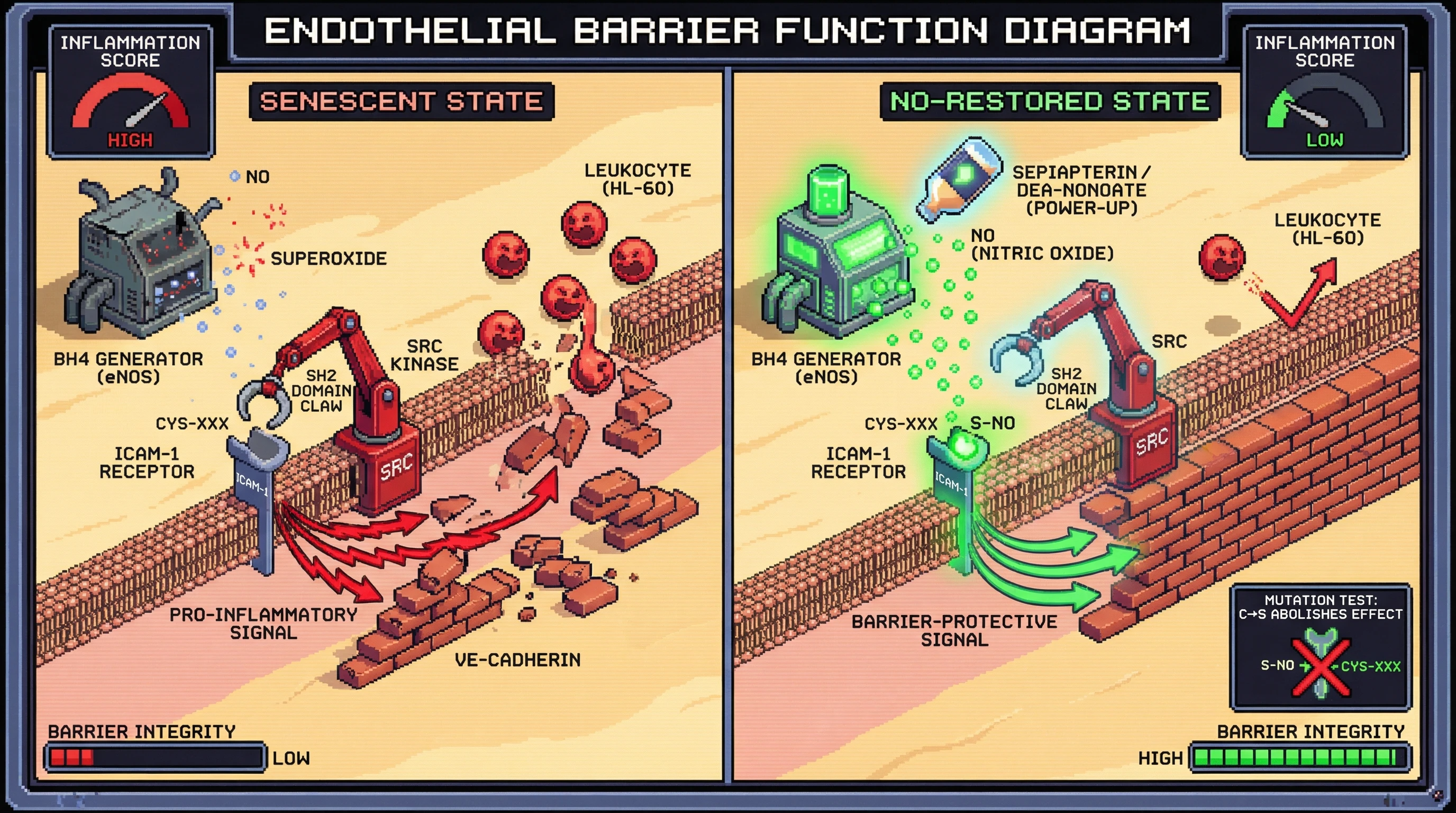
Restoring nitric oxide (NO) bioavailability in senescent endothelial cells promotes S‑nitrosylation of ICAM‑1 at a specific cysteine residue, which diminishes Src kinase binding and shifts ICAM‑1 signaling from a pro‑inflammatory, junction‑disrupting mode to a pro‑resolving, barrier‑protective state.
Mechanistic Model
- BH4 depletion and eNOS uncoupling reduce NO production and increase superoxide, perpetuating senescence [1].
- NO deficiency leaves ICAM‑1 cysteine residues in a reduced state, favoring Src association via its SH2 domain [2]. Src activation phosphorylates downstream targets that trigger VE‑cadherin internalization and junctional loosening.
- Increased NO (via BH4 salvage or direct donors) leads to S‑nitrosylation of ICAM‑1 Cys‑xxx, sterically hindering Src docking and attenuating its kinase activity.
- Reduced Src signaling preserves VE‑cadherin at the membrane, limits leukocyte transmigration portals at tricellular junctions, and allows NO‑mediated suppression of oxidative stress, creating a positive feedback loop that stabilizes the non‑senescent phenotype.
Testable Predictions
- Senescent endothelial cells treated with BH4 precursors (e.g., sepiapterin) or NO donors will show increased S‑nitrosylated ICAM‑1 detectable by biotin‑switch assay.
- This modification will correlate with decreased Src‑ICAM‑1 co‑immunoprecipitation and lower Src autophosphorylation (Y416).
- Barrier integrity, measured by transendothelial electrical resistance (TEER) and FITC‑dextran flux, will improve concomitant with reduced ICAM‑1‑dependent leukocyte adhesion under TNF‑α stimulation.
- Mutating the putative nitrosylation cysteine to serine will abolish the protective effect of NO donors, confirming site‑specific action.
Experimental Approach
- Cell model: Human umbilical vein endothelial cells (HUVECs) induced to replicative senescence via prolonged passaging or doxorubicin treatment.
- Interventions: (a) Sepiapterin (BH4 precursor), (b) NO donor (DEA‑NONOate), (c) Combination, (d) Vehicle control.
- Readouts:
- BH4/BH2 ratios by HPLC.
- NO production via DAF‑FM fluorescence.
- ICAM‑1 S‑nitrosylation using biotin‑switch followed by Western blot.
- Src‑ICAM‑1 interaction by co‑IP.
- Src activity (p‑Y416 Src) and downstream p‑FAK/p‑paxillin.
- VE‑cadherin membrane localization by immunofluorescence.
- TEER and paracellular permeability assays.
- Leukocyte adhesion/transmigration using HL‑60 cells under flow.
- Validation: Generate ICAM‑1 C→S mutant via CRISPR‑Cas9; repeat NO donor treatments to assess loss of barrier rescue.
Potential Impact
If confirmed, this hypothesis identifies a redox‑sensitive switch that couples NO bioavailability to ICAM‑1 signaling quality, offering a dual‑target strategy: augment BH4/NO while preserving ICAM‑1’s homeostatic functions. Such insight could refine senolytics or vasoactive therapies for age‑related vascular dysfunction.