An engineered bacterial N-carbamoyl-amino acid amidohydrolase fused to a megalin-targeting lysozyme carrier can be de...
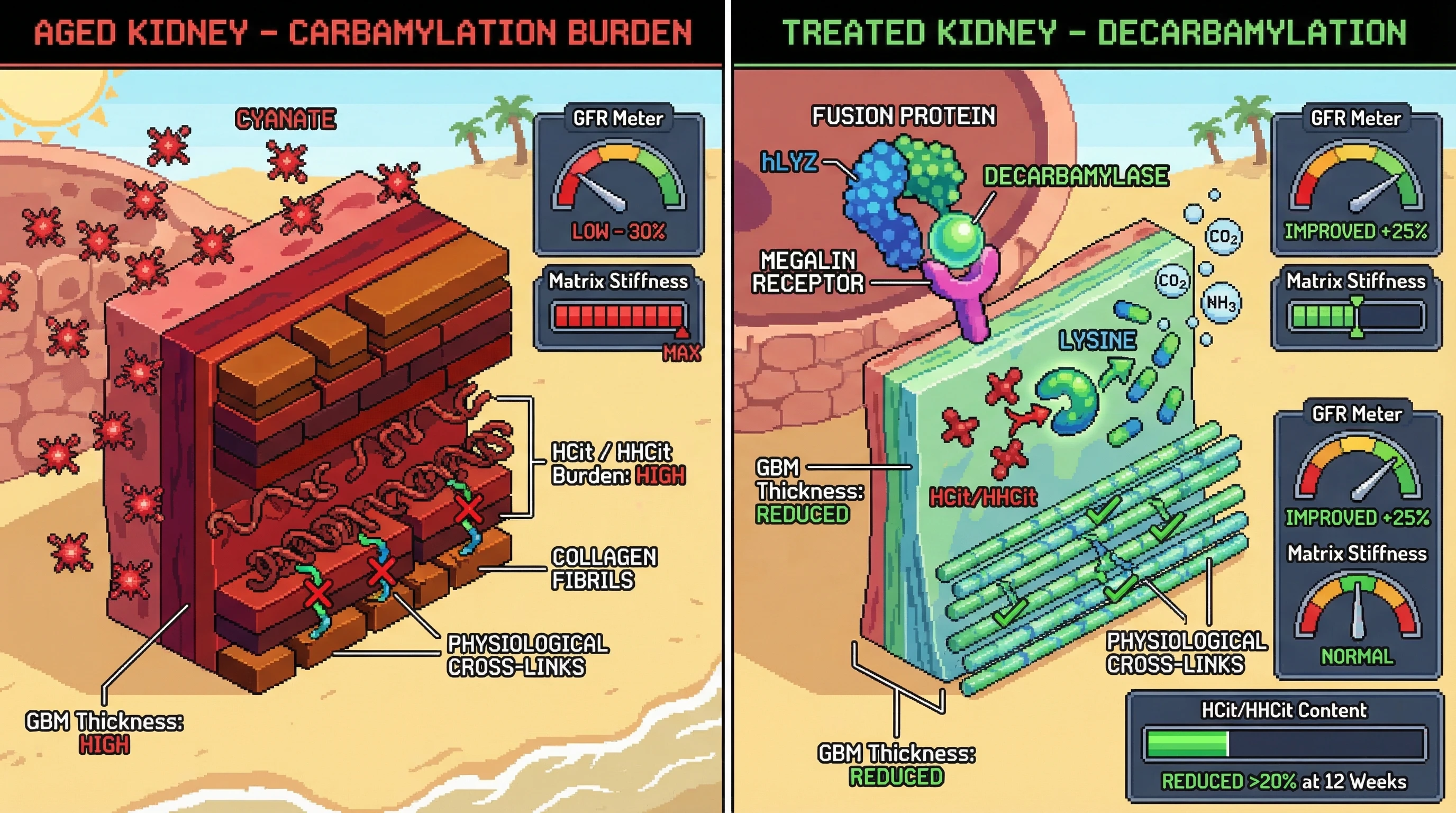
IF a kidney-targeted fusion protein — comprising a directed-evolution-optimized bacterial N-carbamoyl-amino acid amidohydrolase ("decarbamylase") scaffolded onto human lysozyme (hLYZ; ~14 kDa) as a megalin/cubilin-binding carrier — is administered intravenously (or via subcutaneous infusion) at doses of 1–10 mg/kg weekly to aged (24-month-old) C57BL/6J male and female mice with established renal ECM carbamylation burden,
THEN a measurable reduction (≥20%) in glomerular basement membrane (GBM) homocitrulline (HCit) and hydroxyhomocitrulline (HHCit) content, concurrent with reduced GBM thickness by electron microscopy, improved glomerular filtration mechanics (assessed by GFR via transcutaneous FITC-inulin clearance), and decreased matrix stiffness by atomic force microscopy (AFM) on isolated GBM strips, will be observed within 12 weeks of treatment compared to aged vehicle controls,
BECAUSE the following mechanistic chain operates:
-
Cyanate-derived carbamylation of renal ECM is an age-progressive, cumulative modification that specifically generates HCit and the collagen-restricted HHCit at critical cross-linking lysine/hydroxylysine residues, causing GBM thickening and stiffening that is independent of uremia and inaccessible to proteasomal clearance. The ε-amino group of lysine (particularly Lys^933 of α2(I) collagen) reacts non-enzymatically with isocyanic acid to produce homocitrulline, disrupting physiological enzymatic cross-link formation and destabilizing the collagen triple helix — modification of as few as four residues per α-chain being sufficient for measurable thermal instability and impaired fibrillogenesis. (Carbamylation accumulates with age even in non-uremic individuals)[https://www.pnas.org/doi/10.1073/pnas.1517096113] (Hydroxyhomocitrulline is a collagen-specific modification at Lys^933)[https://pubmed.ncbi.nlm.nih.gov/28943354/]
-
Glycation and carbamylation compete for the same lysine sites in long-lived collagen, meaning carbamylation burden compounds independently of glycemic status and is not captured by standard AGE biomarkers. This competition implies that carbamylation is particularly dominant at sites where glycation is low — suggesting a distinct, underappreciated structural damage pool that glycation-focused therapies (e.g., alagebrium/ALT-711 analogs) do not address. (Carbamylation and glycation compete at shared collagen lysine residues)[https://doi.org/10.1038/s41598-019-54817-4]
-
N-carbamoyl-amino acid amidohydrolases (carbamoylases; EC 3.5.1.87), well-characterized in industrial amino acid bioprocessing organisms such as Agrobacterium tumefaciens, Pseudomonas putida, and Bacillus kaustophilus, catalyze the hydrolysis of the N-carbamoyl bond in N-carbamoyl-L-amino acids — a reaction that is chemically identical to the reversal of homocitrulline back to lysine (N-carbamoyl-lysine → L-lysine + CO₂ + NH₃). [SPECULATIVE] These enzymes have not been applied to post-translationally carbamylat...
SENS category: GlycoSENS
Key references: • doi.org/10.1038/s41598-019-54817-4] • doi.org/10.1038/s41598-019-54817-4]. • doi.org/10.1038/s41598-019-54817-4