Systemic HPβCD simultaneously extracts pre-existing A2E from aged RPE lysosomes and restores TFEB-driven lysosomal bi...
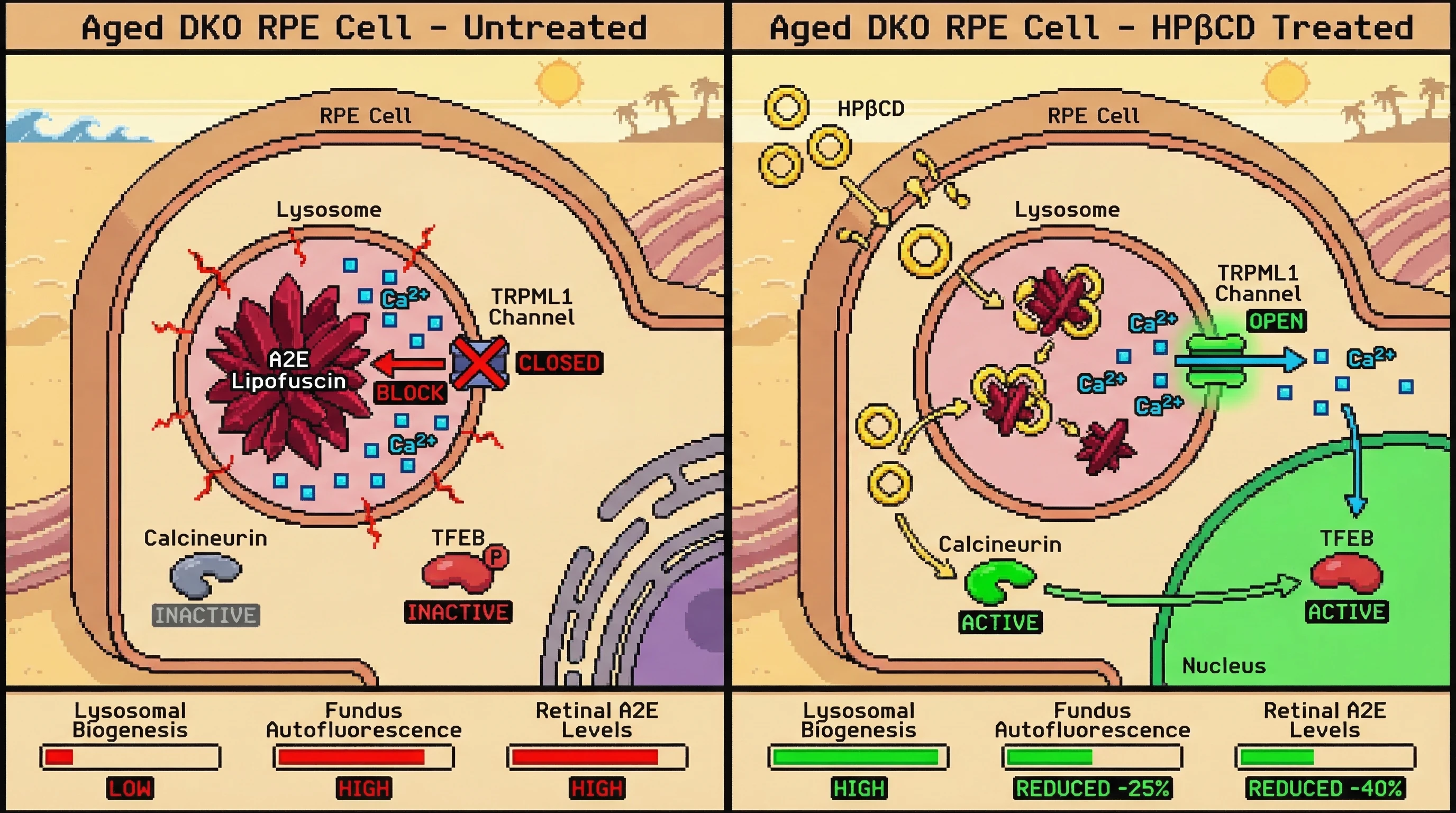
IF hydroxypropyl-β-cyclodextrin (HPβCD) at 4000 mg/kg subcutaneous injection twice-weekly for 8 weeks is administered to aged (≥12 months) male and female Abca4−/−Rdh8−/− double-knockout (DKO) mice with pre-existing, accumulated bisretinoid lipofuscin in the retinal pigment epithelium (RPE),
THEN retinal A2E levels will decrease by ≥40% (HPLC quantification), fundus autofluorescence (FAF) intensity will decrease by ≥25% (quantitative scanning laser ophthalmoscopy), and nuclear TFEB translocation in RPE flatmounts will increase by ≥2-fold (immunofluorescence) versus vehicle controls, with ≥50% of the A2E reduction sustained at 4-week post-treatment washout,
BECAUSE the following causal chain operates simultaneously through two mechanistically independent but self-reinforcing circuits on the same lysosomal failure loop:
-
A2E accumulation in aged RPE causes lysosomal membrane disruption and impairs TRPML1 channel–mediated calcium efflux from lysosomes, suppressing the calcineurin–TFEB dephosphorylation axis and locking TFEB in its phosphorylated, cytoplasmic, inactive state — creating a feedforward failure loop wherein impaired autophagy further permits A2E buildup (functional autophagy is cytoprotective against A2E-mediated stress by facilitating removal of damaged mitochondria and organelles)[https://doi.org/10.1016/j.fob.2014.11.003]. [SPECULATIVE — direct TRPML1/A2E interaction in aged RPE not yet empirically confirmed; inferred from the established role of lysosomal cholesterol in TRPML1 gating and A2E's membrane-intercalating properties]
-
Systemically administered HPβCD crosses the blood-retinal barrier and enters RPE cells, reaching the lysosomal compartment at therapeutically relevant concentrations (systemically administered HPβCD crosses the blood-retinal barrier and reduces retinal cholesterol content in both wild-type and oxysterol-deficient mice)[https://doi.org/10.1111/bph.15209].
-
HPβCD directly extracts A2E from RPE endolysosomes via inclusion complex formation in 2:1 β-cyclodextrin:bisretinoid stoichiometry, reducing approximately 70% of cellular A2E burden per treatment cycle and partially restoring lysosomal membrane integrity (β-cyclodextrins bind, stabilize, and remove lipofuscin bisretinoids from the retinal pigment epithelium, reducing lipofuscin fluorescence in Abca4−/−Rdh8−/− mouse RPE)[https://doi.org/10.1073/pnas.1400530111].
-
Simultaneously, HPβCD extracts cholesterol from lysosomal membranes, triggering TRPML1-dependent lysosomal calcium release, activating calcineurin, dephosphorylating TFEB, and driving nuclear TFEB translocation — upregulating the full CLEAR transcriptional network, increasing lysosomal biogenesis, autophagic flux, and lysosomal exocytosis (HPβCD promotes TFEB nuclear translocation and upregulates the CLEAR network, and this clearance is autophagy-dependent, as bafilomycin co-treatment abolishes the effect)[https://doi.org/10.1074/jbc.m113.506246][https://doi.org/...
SENS category: LysoSENS
Key references: • doi.org/10.1074/jbc.m113.506246], • doi.org/10.1073/pnas.1400530111]. • doi.org/10.1111/bph.15209] • doi.org/10.1038/s41598-017-02387-8]. • doi.org/10.1016/j.fob.2014.11.003].