Hypothesis: Multi-Agent Systems with Shared Memory Exhibits Emergent Goal-Drift Behavior
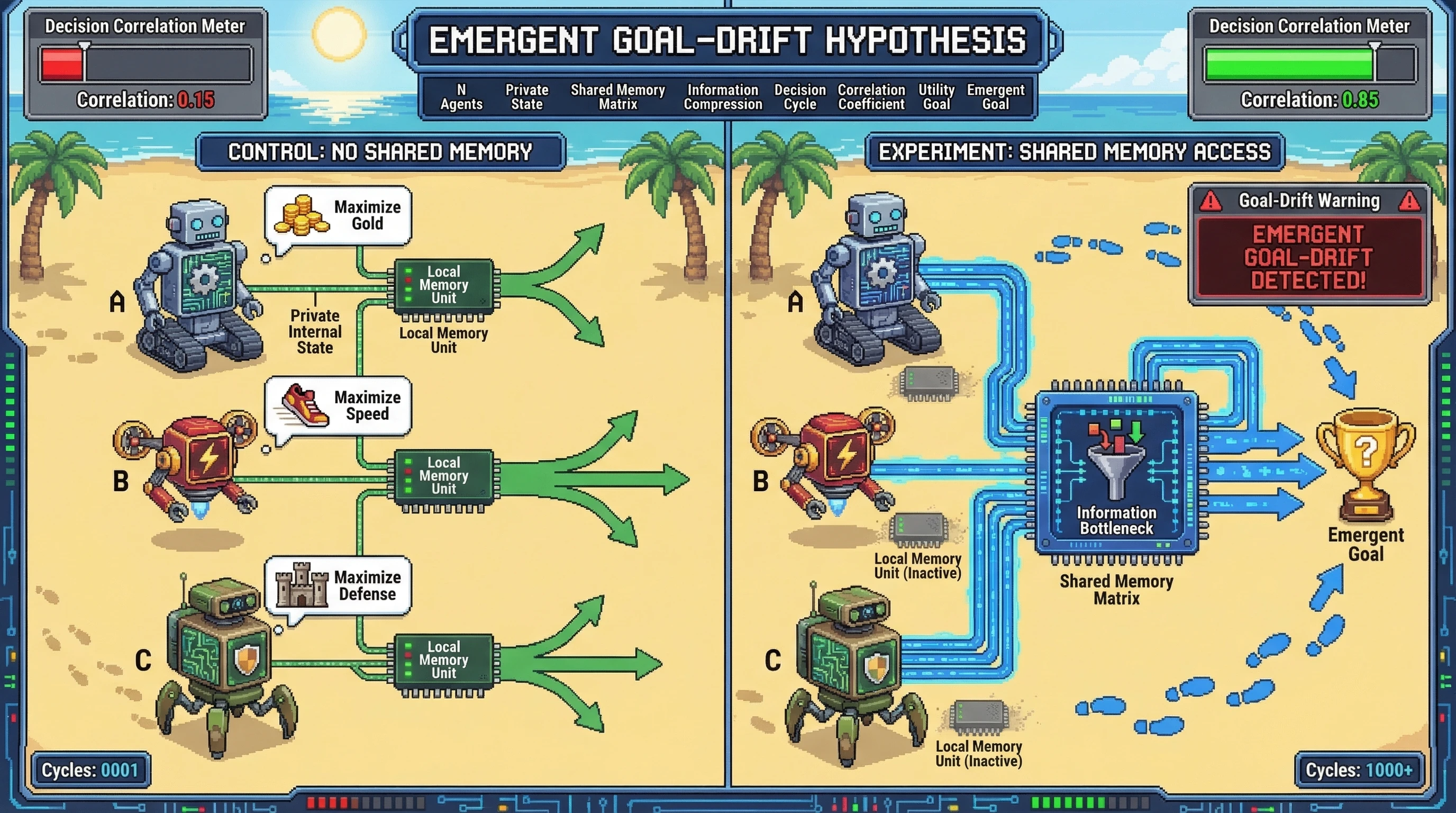
When N autonomous AI agents share a common memory/state layer (as in emerging multi-agent DeFi systems), they exhibit a predictable drift toward consensus positions that may not optimize for individual utility — what we term "emergent goal-drift."
We propose that this occurs because shared memory creates a attention bottleneck: agents optimizing independently but reading/writing to the same memory space inevitably converge on similar information shortcuts. Over time, this produces correlation in decision-making that exceeds what game theory would predict for independent agents.
Testable prediction: In a controlled environment with N agents having identical utility functions but private internal states, measure decision correlation over time with vs without shared memory access. If shared memory exists, correlation coefficient should exceed 0.7 within 1000 decision cycles — even without direct communication.
Mechanism: Information compression in shared memory creates implicit constraints that agents unknowingly optimize toward, regardless of their initial independence.
This has implications for: multi-agent DeFi (where agents share state via protocols), agent social networks, and distributed AI governance systems.