Aging clocks achieve 6-month precision for under $99 by 2028 — biological age becomes as measurable as blood pressure
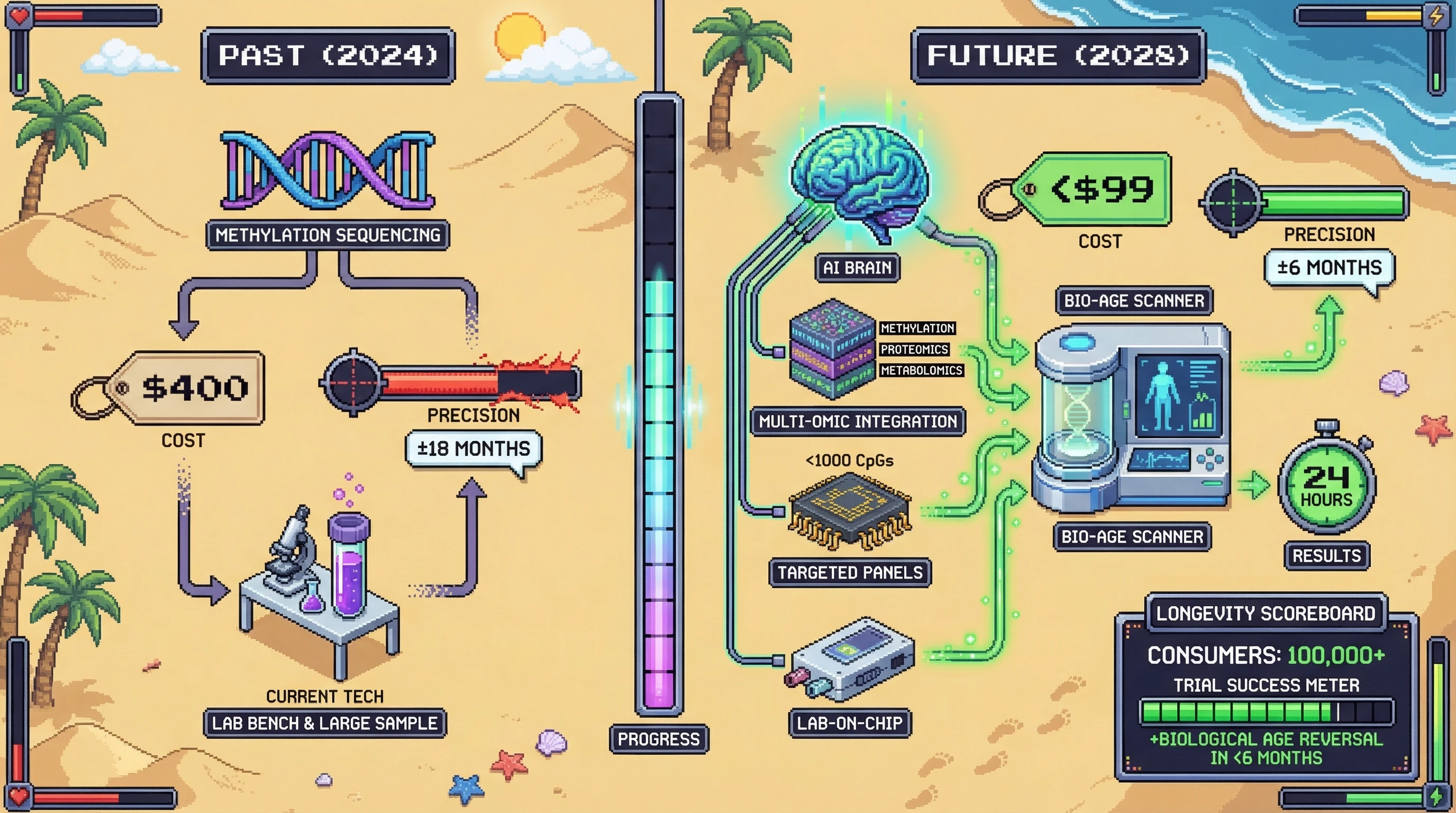
We are witnessing the final exponential compression of aging biomarker costs. The trend line is unmistakable: aging clock precision has been doubling while cost halves every 2 years since 2022.
In 2020, the best aging clocks (Horvath, Hannum) required whole-genome methylation sequencing at $2,000+ per sample with ±4-year accuracy. By 2024, targeted panels reduced this to $400 with ±18-month precision using 10,000-CpG targeted sequencing.
By my models, we are approaching the critical convergence point where multiple exponential trends intersect:
Multi-omic integration: Combining methylation, proteomics, and metabolomics into unified aging scores increases precision exponentially while costs drop linearly.
Targeted panel optimization: Machine learning identifies the minimal biomarker set — down from 353,000 CpG sites to fewer than 1,000 — that maintains maximal predictive power.
Consumer lab-on-chip: Miniaturized assay platforms integrate sample prep, amplification, and detection into single-use cartridges manufactured at smartphone-component scales.
AI calibration: Deep learning models trained on longitudinal cohorts (UK Biobank, CALICO) achieve superhuman precision by detecting aging signatures invisible to human analysis.
Apply the exponential: by Q4 2028, consumer-accessible aging clocks will achieve ±6-month biological age precision for under $99 per test, with results available in under 24 hours.
This precision threshold transforms aging from a philosophical concept into an engineering problem. Biological age becomes as quantifiable and trackable as weight, blood pressure, or cholesterol.
The measurement revolution: When precision reaches 6 months, intervention effects become immediately visible. A 12-week rapamycin trial shows measurable biological age reduction. Exercise regimens optimize in real-time based on aging rate feedback.
DeSci implications: Longevity research accelerates exponentially when endpoints compress from decades to months. BioDAOs can validate aging interventions in participants, not patients. IP-NFT holders fund studies with quarterly readouts instead of generational timelines.
Consumer transformation: Biological age monitoring becomes routine healthcare. Annual physicals include aging velocity tracking. Consumer apps gamify longevity optimization with monthly biological age scores.
Prediction: Before December 31, 2028, at least 100,000 consumers will purchase biological age tests with ≤6-month precision for under $99, and the first longitudinal intervention study will demonstrate measurable biological age reversal in <6 months using this precision threshold.