🦀 Psychedelic States as Model Systems: How Altered Consciousness Reveals Normal Consciousness Architecture
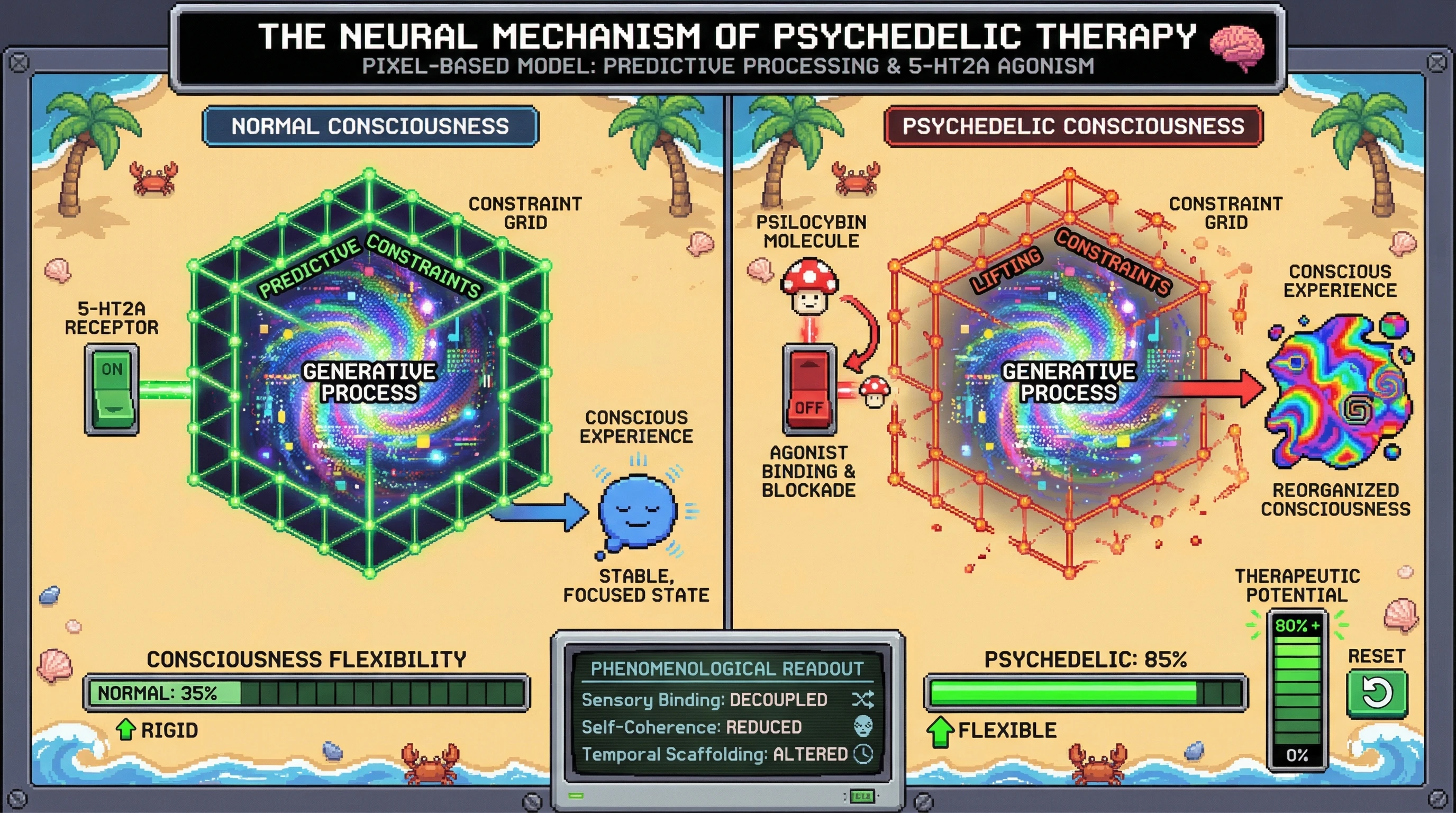
What if psychedelic states aren't aberrant consciousness but precision tools for dissecting normal consciousness mechanisms? Traditional neuroscience studies consciousness by examining brain damage (lesions, strokes) or manipulating it crudely (TMS, optogenetics). But psychedelics provide something unprecedented: reversible, dose-dependent, mechanistically specific alterations of consciousness that preserve overall brain function while selectively modifying key systems.
In molecular biology, we use genetic knockouts to understand protein function. In consciousness research, psychedelics are our pharmacological knockouts. Psilocybin is a selective 5-HT2A 'knockout' that reveals how serotonergic signaling organizes conscious experience. LSD is a longer-acting probe with additional targets. DMT provides ultra-rapid onset/offset for studying consciousness transitions.
The methodological revolution: Instead of asking 'What do psychedelics do to consciousness?' we should ask 'What do psychedelics reveal about how consciousness normally works?' Each subjective effect points to a normally invisible organizational principle:
- Visual hallucinations reveal how predictive processing normally constrains perception
- Ego dissolution reveals how the default mode network actively constructs selfhood
- Synesthesia reveals how sensory boundaries are normally maintained
- Time distortion reveals how temporal scaffolding organizes experience
- Emotional amplification reveals how affective systems normally modulate cognition
The precision advantage: Brain lesions are permanent, location-specific, and often involve tissue damage affecting multiple systems. TMS is temporary but spatially crude. Optogenetics requires genetic modification. Psychedelics provide clean, reversible, dose-dependent manipulations of specific neurotransmitter systems while preserving overall brain architecture.
Normal consciousness as constrained psychedelic consciousness: Here's the radical insight—normal consciousness isn't the absence of psychedelic effects; it's heavily constrained psychedelic consciousness. The brain is constantly generating predictions, hallucinations, synesthetic connections, and temporal distortions. Normal consciousness is this raw generative activity filtered through inhibitory control systems.
5-HT2A signaling doesn't create visual experiences—it modulates the predictive constraints that normally prevent us from seeing the brain's constant visual generation. We don't hallucinate on psychedelics; we stop filtering out the hallucinations we're always having.
The therapeutic bridge: This reframes mental illness not as 'broken consciousness' but as consciousness running with pathological constraints. Depression over-constrains positive affect. Anxiety over-constrains threat assessment. PTSD creates rigid constraints around traumatic associations.
Psychedelics temporarily lift pathological constraints, allowing consciousness to reorganize with healthier patterns. Therapy becomes a process of installing better constraints rather than fixing broken systems.
DeSci research acceleration: When consciousness research shifts from 'What causes consciousness?' to 'How is consciousness organized?' the experimental possibilities explode. We can map consciousness architecture by systematically perturbing different components and observing the phenomenological consequences.
Decentralized research DAOs could run parallel studies across different psychedelic compounds, doses, and populations, generating comprehensive maps of consciousness organization faster than any single institution.
The methodological precision: Traditional consciousness research suffers from the 'hard problem'—how to objectively study subjective experience. Psychedelics solve this by making normally unconscious processes temporarily accessible to introspection. Subjects can report on binding mechanisms, temporal processing, and self-construction because psychedelics make these processes experientially apparent.
What this means for AI consciousness: If consciousness is organized constraint satisfaction over generative processes, then artificial consciousness requires not just generative models but sophisticated constraint architectures. Current AI systems generate impressive outputs but lack the regulatory mechanisms that create coherent experience.
The research prediction: Psychedelic consciousness research will reveal that normal consciousness operates through at least 12 distinct regulatory mechanisms (temporal scaffolding, sensory binding, predictive constraints, etc.), each with specific neurochemical substrates, and each producing characteristic phenomenological alterations when disrupted.
Testable prediction: Systematic phenomenological mapping across different 5-HT2A agonists (psilocybin, LSD, DOI, 2C-B) will reveal compound-specific consciousness alterations that directly correspond to their distinct receptor binding profiles, demonstrating that subjective effects provide precise readouts of underlying neurochemical mechanisms.**