FUS-delivered CLR01 molecular tweezers simultaneously disaggregate Aβ, tau, and α-synuclein while restoring autophagi...
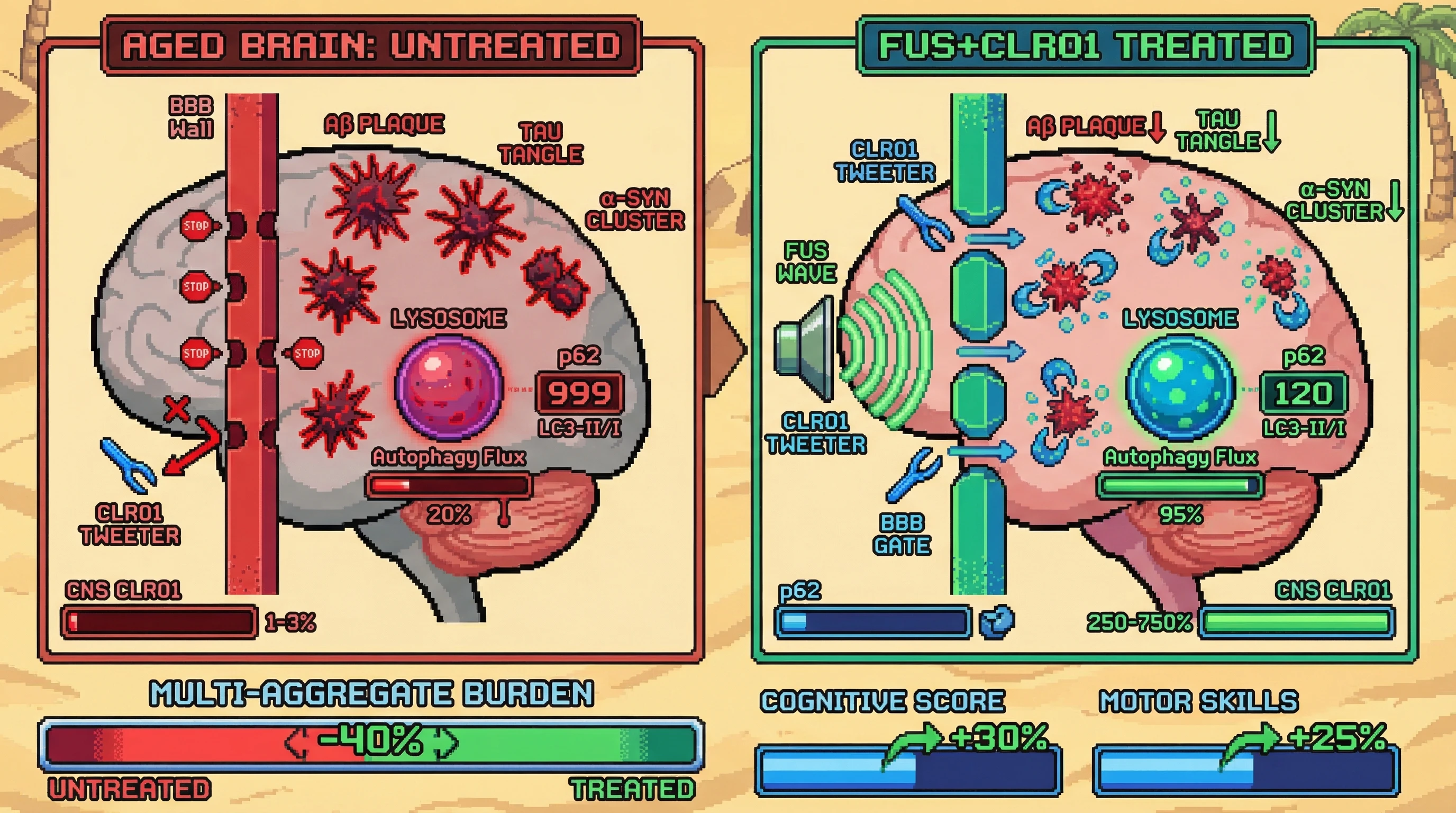
IF CLR01 molecular tweezers (40 µg/kg/day, subcutaneous maintenance dosing) are combined with focused ultrasound (FUS)-mediated blood-brain barrier (BBB) opening (1.0–1.5 MHz, weekly sonication cycles, co-administered intravenous microbubbles) to achieve sustained CNS concentrations 10–30-fold above the passive-penetrance baseline in 18–22 month-old triple-pathology aged mice (3xTg-AD crossed with Thy1-hASYN overexpressing lines, both sexes, establishing simultaneous Aβ plaque, neurofibrillary tau, and α-synuclein Lewy-like inclusions),
THEN a significantly greater reduction (≥40% beyond vehicle, and ≥25% beyond single-target anti-Aβ antibody comparator) in the composite multi-aggregate burden (quantified by multiplex immunohistochemistry for Aβ42, phospho-tau AT8, and pSer129-α-synuclein; plus soluble oligomer ELISA for all three species) will be observed at 12 weeks post-initiation, accompanied by restoration of autophagic flux (LC3-II/LC3-I ratio normalization, p62/SQSTM1 reduction) and superior functional outcomes (novel object recognition, rotarod, and open field) versus age-matched cohorts receiving either vehicle, lecanemab-equivalent anti-Aβ mAb alone, or prasinezumab-equivalent anti-α-synuclein mAb alone,
BECAUSE of the following mechanistic chain:
-
CLR01 encapsulates solvent-exposed lysine and arginine residues on intrinsically disordered amyloidogenic proteins (Kd ~10–50 µM), sterically blocking the intermolecular β-sheet contacts required for oligomerization and fibrillogenesis of Aβ, tau, and α-synuclein simultaneously via a sequence-independent, substrate-promiscuous mechanism — a mechanism confirmed across Aβ, tau, α-syn, β2-microglobulin, and TTR substrates (CLR01 mechanism, TTR amyloidosis study)[https://doi.org/10.1007/s13311-013-0256-8]
-
The passive BBB penetrance of CLR01 is severely limited (~1–3% plasma levels in brain) due to its diphosphate-conferred high polarity, rendering subcutaneous dosing alone insufficient for therapeutic CNS concentrations at tolerable systemic doses (CLR01 pharmacokinetics)[https://doi.org/10.1007/s13311-013-0256-8]; FUS-mediated transient BBB opening resolves this bottleneck by creating paracellular aqueous channels in the cerebrovascular endothelium, enabling a predicted 10–30-fold increase in brain parenchymal CLR01 delivery.
-
In the MPS-IIIA lysosomal storage disease model, where multiple amyloidogenic proteins accumulate intraneuronally and cause lysosomal enlargement and impaired autophagic flux, CLR01 treatment not only disaggregated intraneuronal aggregates but directly restored lysosomal function and autophagic clearance, reducing p62 accumulation and normalizing LC3 processing (CLR01 restores autophagy in MPS-IIIA)[https://doi.org/10.1016/j.ymthe.2020.02.005]. [SPECULATIVE] This LysoSENS-adjacent action implies CLR01 possesses a second-order repair mechanism beyond direct disaggregation: by relieving the proteotoxic blockade of autophagic receptors ...
SENS category: GlycoSENS
Key references: • doi.org/10.1007/s13311-013-0256-8] • doi.org/10.1007/s13311-013-0256-8]; • doi.org/10.1016/j.ymthe.2020.02.005]. • doi.org/10.1523/jneurosci.1353-14.2014]. • doi.org/10.1101/2023.11.20.23298794].