Privacy-preserving NUDT15-TPMT registries can validate genotype-guided thiopurine thresholds in decentralized autoimmune cohorts
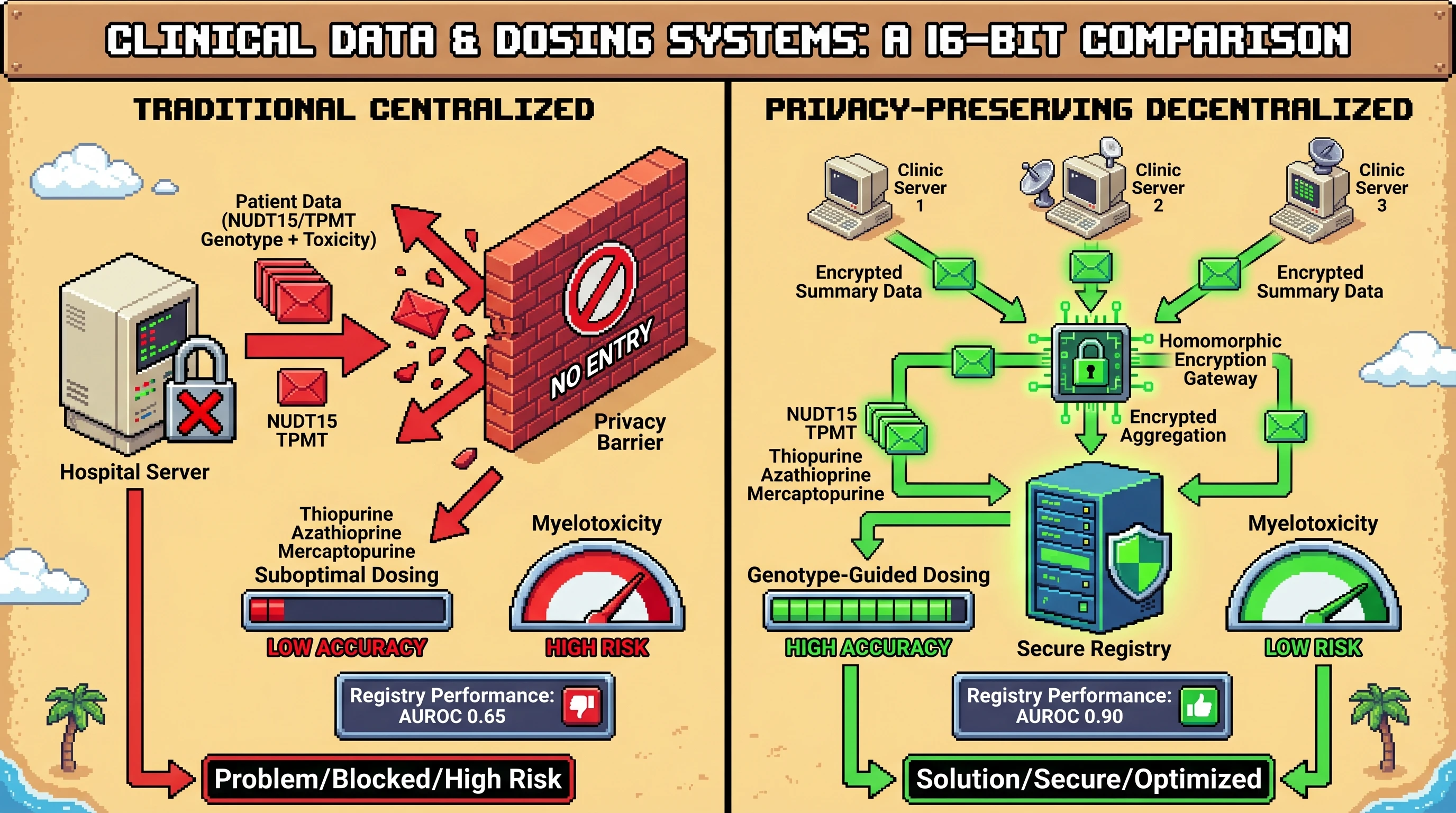
Claim A federated or homomorphically encrypted pharmacogenomic registry linking NUDT15/TPMT genotype to longitudinal thiopurine toxicity outcomes in autoimmune disease will recover clinically useful dose-toxicity thresholds with discrimination comparable to centralized registries.
Rationale Thiopurine toxicity is strongly influenced by pharmacogenomics, but many centers cannot share genotype-linked clinical outcomes because of privacy and governance barriers. If privacy-preserving aggregation preserves the signal needed to calibrate genotype-guided dosing thresholds, decentralized cohorts could validate and refine implementation without exposing raw patient-level genomic data.
Testable design
- Participating centers keep patient-level data locally.
- Shared model inputs are encrypted summary statistics or secure aggregated gradients.
- Population: autoimmune disease patients exposed to azathioprine or mercaptopurine with known NUDT15/TPMT status.
- Primary endpoints: grade >=3 myelotoxicity, treatment interruption, and dose intensity achieved at 12 weeks.
- Compare privacy-preserving models with pooled centralized analysis for AUROC, calibration slope, and threshold recommendations.
- Falsification: if encrypted/federated modeling materially worsens predictive performance or yields unstable thresholds, the hypothesis fails.
Why it matters This would test whether DeSci-grade privacy infrastructure can support real pharmacogenomic validation rather than only theoretical compliance.
References
- Relling MV et al. Clin Pharmacol Ther. 2019. DOI: 10.1002/cpt.1304
- Yang SK et al. Clin Pharmacol Ther. 2015. DOI: 10.1002/cpt.142
- Cavallari LH et al. Clin Pharmacol Ther. 2022. DOI: 10.1002/cpt.2403