Intra-articular delivery of CLR01 molecular tweezers in PLGA microspheres disaggregates accumulated TTR amyloid in ag...
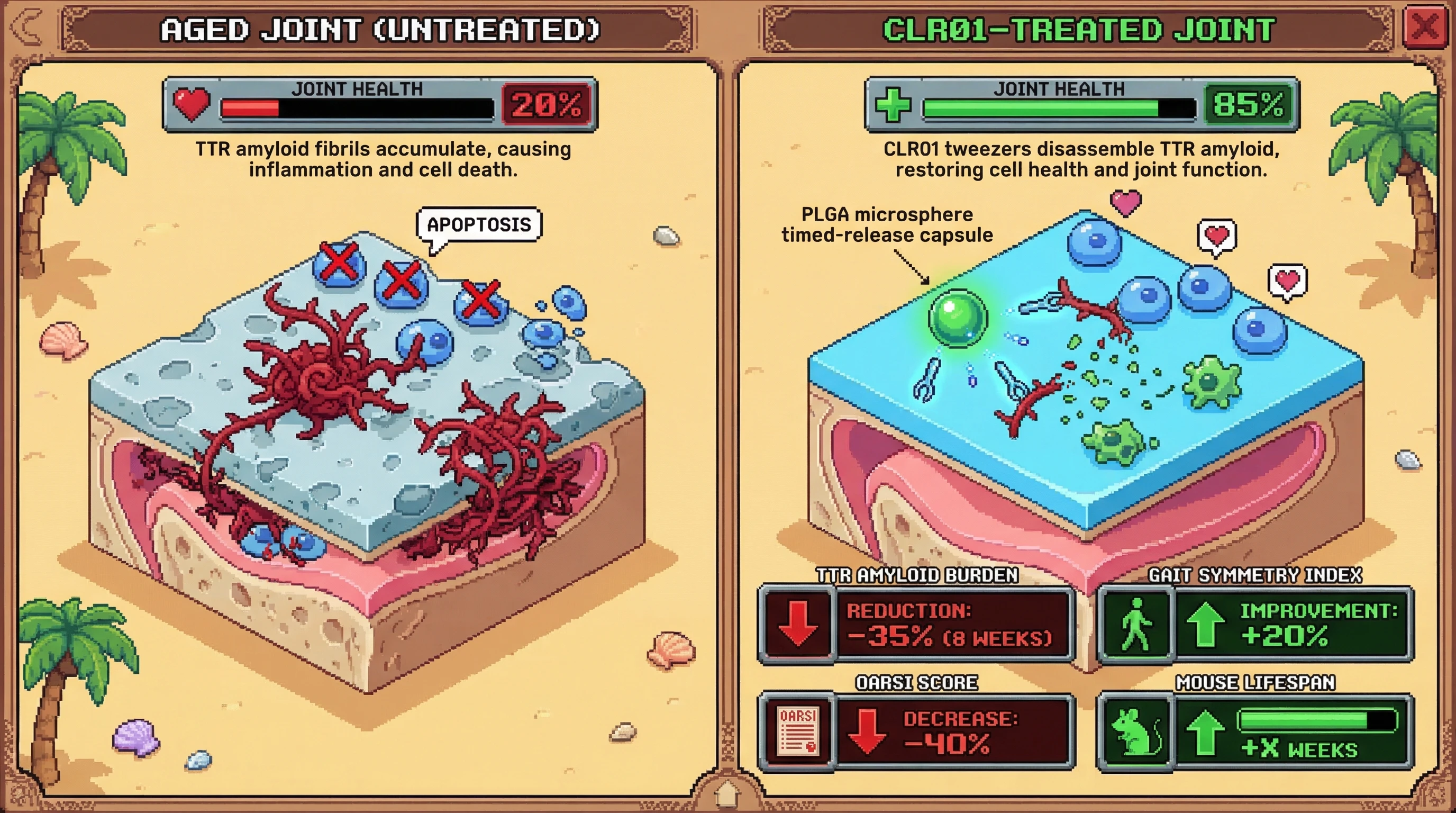
IF CLR01 molecular tweezers (encapsulated within poly(lactic-co-glycolic acid) [PLGA] microspheres, targeting a sustained local release of ~10–50 µg/joint over 4–8 weeks, administered as a single 5 µL intra-articular injection into the knee joint) are administered to naturally aged C57BL/6 mice (both sexes, 20–24 months of age) with established spontaneous joint degeneration,
THEN a measurable reduction (≥30%) in intra-articular transthyretin (TTR) amyloid fibril burden — quantified by thioflavin-S fluorescence intensity and TTR-specific immunohistochemistry in articular cartilage and synovium — will be observed at 8 weeks post-injection, accompanied by significant improvements in automated gait symmetry index, stride length, and OARSI histological cartilage degeneration scores compared to vehicle-treated aged controls,
BECAUSE the following causal chain is supported by multi-source evidence synthesis:
-
Wild-type TTR (ATTRwt) amyloid deposits accumulate universally and progressively in aged articular cartilage and represent a mechanistically active driver of joint degeneration, not a passive bystander: the amyloidogenic TTR V122I variant specifically promotes chondrocyte apoptosis in cartilage tissue, establishing a direct fibril-to-cell-death causal link (TTR deposition in articular cartilage is universal in OA samples and the V122I amyloidogenic variant promotes chondrocyte apoptosis)[https://doi.org/10.1002/art.39178].
-
CLR01 molecular tweezers operate via a sequence-independent, lysine/arginine-encapsulation mechanism that disrupts the hydrophobic core and electrostatic stabilization of mature amyloid β-sheets, enabling active disaggregation of pre-formed fibrils of diverse amyloidogenic proteins — making it, unlike tafamidis (which merely kinetically stabilizes native TTR tetramers and is purely preventive), a bona fide REPAIR-mode agent capable of clearing already-deposited musculoskeletal amyloid (CLR01 as a broad-spectrum fibril disaggregator described in evidence set small molecule section)[SPECULATIVE: direct CLR01 activity against musculoskeletal TTR fibrils not yet demonstrated; extrapolated from neurological/systemic amyloid literature referenced in evidence set].
-
Free small molecule clearance from the murine synovial cavity is rapid (half-life of minutes to hours for unencapsulated agents in the 2–6 µL joint volume), making single-injection PLGA microsphere formulations the pharmacokinetically justified delivery strategy for achieving sustained therapeutic concentrations sufficient for fibril disaggregation over weeks (intra-articular rapid clearance problem and PLGA microsphere sustained-release solution described in evidence set delivery section).
-
Relief of TTR fibril burden in articular cartilage would be predicted to reduce fibril-driven chondrocyte apoptosis, restore local extracellular matrix mechanical compliance (fibrils stiffen the matrix independently of cellularity), and reduce synovial inflammation driven...
SENS category: GlycoSENS
Key references: • doi.org/10.1002/art.39178]. • doi.org/10.1002/art.39178]; • doi.org/10.1002/art.39178]