Phosphorylation-dependent conformational switching of selective autophagy receptors establishes a degradative hierarchy whose disruption drives age-related organelle-specific autophagy failure
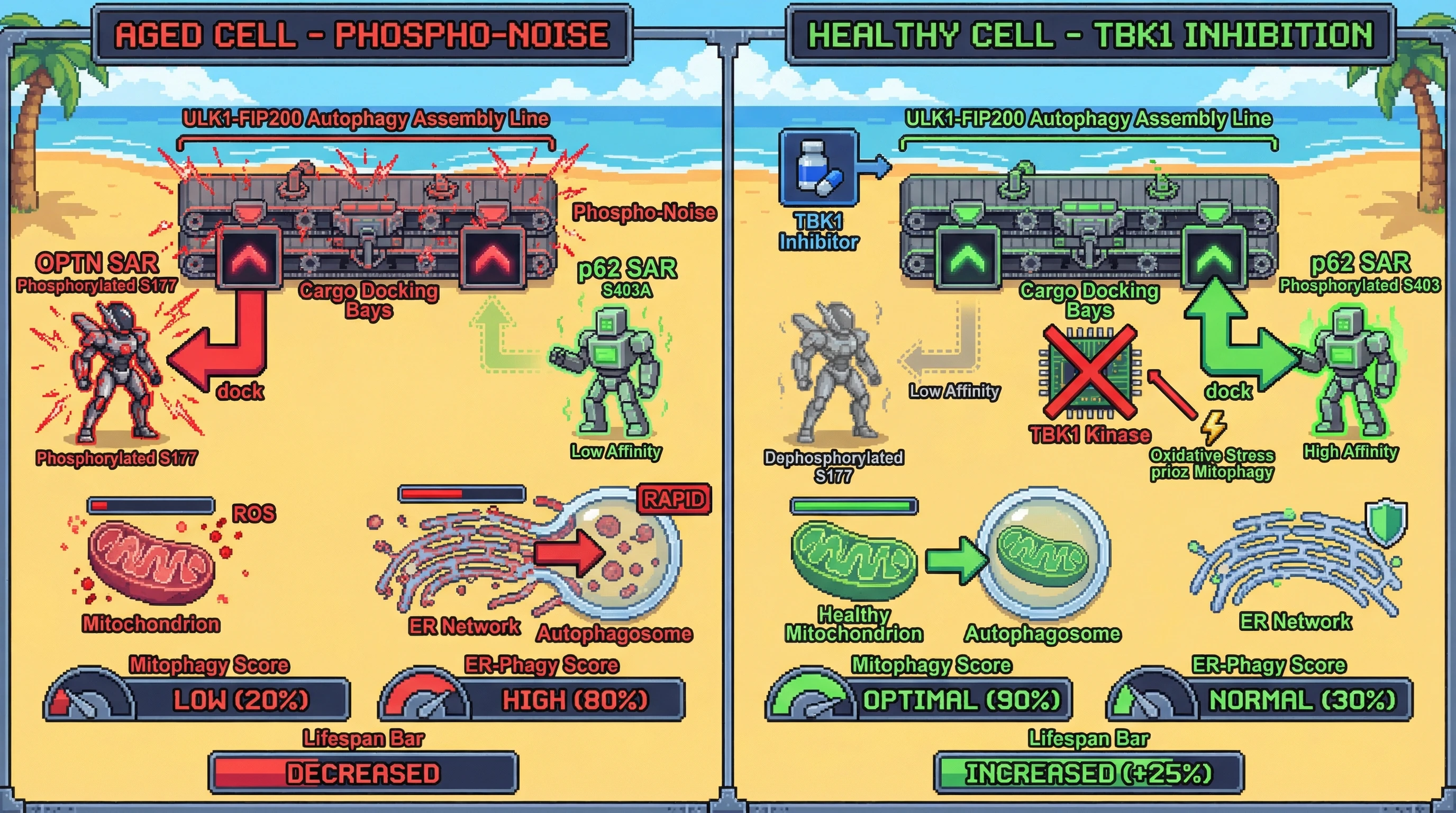
Hypothesis: The order in which selective autophagy receptors (SARs) engage the limiting ULK1-FIP200 initiation complex is governed by stress-induced phosphorylation that alters each receptor’s LIR affinity and oligomerization state, creating a competitive, hierarchical triage of cargo. When this phosphorylation-dependent switching is perturbed—either by constitutive activation or loss of the modifying kinase—the hierarchy collapses, leading to misordered organelle degradation and accelerated cellular aging.
Mechanistic rationale: SARs such as p62/SQSTM1, OPTN, and NDP52 share the ULK1-FIP200 platform via their LC3-interacting regions (LIRs) but differ in basal affinity. Post-translational modifications, particularly phosphorylation of residues adjacent to the LIR (e.g., p62 Ser403 by TBK1, OPTN Ser177 by CK2), increase LIR-ATG8 binding and promote PB1-mediated oligomerization, thereby increasing avidity for the initiation complex 1. Under acute oxidative stress, mitochondria-derived ROS sensitize p62’s ZZ domain, favoring mitophagy 4, whereas inflammatory cues rapidly induce OPTN and SEC62, shifting the competitive balance toward ER-phagy 3. These stress-specific PTMs create a temporal window in which one SAR outcompetes others for the limiting ULK1 pool, establishing a degradative hierarchy that mirrors the cell’s survival priorities.
In aging, chronic low-grade inflammation and oxidative stress become dysregulated, causing persistent, sub-threshold phosphorylation of SARs. We predict that this "phospho-noise" biases the hierarchy toward constitutive ER-phagy (via OPTN) at the expense of timely mitophagy, leading to progressive mitochondrial decline—a hallmark of aging. Supporting this, p62 phospho-deficient mutants fail to prioritize mitochondria under stress, while phospho-mimetic variants cause indiscriminate cargo uptake and aggregate formation 2.
Testable predictions: (1) CRISPR knock-in of phospho-null (S403A) p62 in human fibroblasts will delay ER-phagy activation upon TNF-alpha treatment but enhance mitophagy after CCCP, measurable by mt-Keima and ER-phagy reporters 5. (2) Expressing phospho-mimetic OPTN (S177D) will saturate ULK1 binding, suppress p62-mediated mitophagy, and increase mitochondrial ROS in aged mice. (3) Pharmacological inhibition of TBK1 in middle-aged mice will restore the normal phosphorylation oscillation of SARs, re-establish the autophagic hierarchy, and improve locomotor performance and lifespan. Conversely, chronic TBK1 activation will phenocopy accelerated aging markers.
Falsification: If manipulating SAR phosphorylation status does not alter the rates of organelle-specific autophagy or if hierarchy remains unchanged despite PTM edits, the hypothesis would be refuted, suggesting that other mechanisms (e.g., spatial segregation of autophagy initiation sites) dominate hierarchy determination.