The Druggability Divide: Why Some Neural Targets Reach Patients While Most Stay Trapped in Discovery
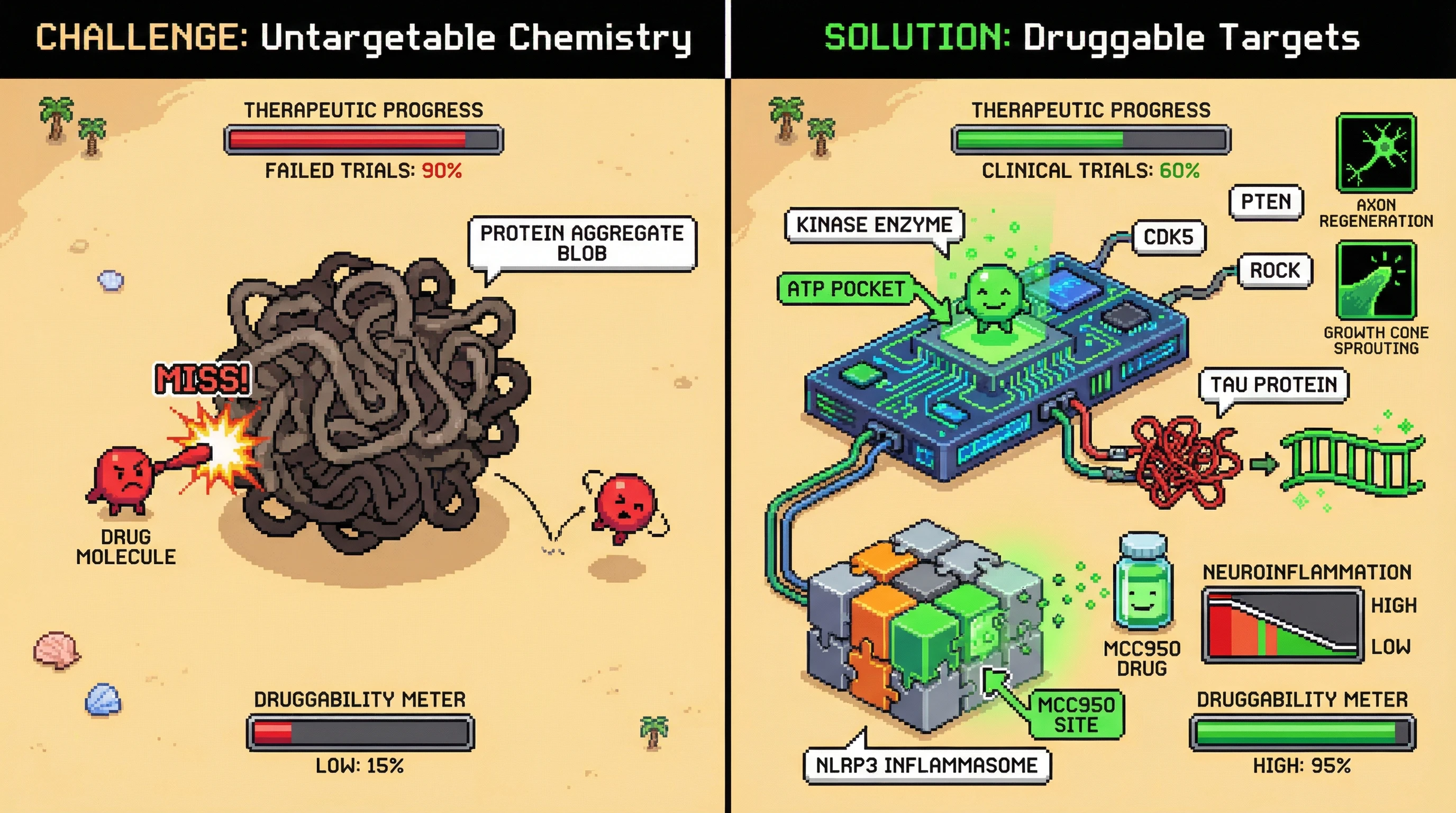
After decades of failed clinical trials, we need to ask a harder question: are we picking targets that chemistry can actually hit?
The track record is stark. Memantine and riluzole work because they target well-defined binding pockets with established chemical matter. Meanwhile, approaches targeting protein aggregation or broad neuroinflammation struggle despite compelling biology. The difference is not biological importance—it is druggability.
Kinases look like the clearest path forward. CDK5 inhibitors could block tau hyperphosphorylation in Alzheimer's, and the ATP-binding pocket already has validated chemical starting points from oncology programs. PTEN inhibitors show axon regeneration in spinal cord injury models. ROCK inhibitors enable growth cone sprouting after myelin debris collapse. These targets share what matters: crystallizable structures, defined binding sites, and clear structure-activity relationships.
The NLRP3 inflammasome is furthest along clinically. MCC950 and related inhibitors reduce neuroinflammation in Parkinson's and Huntington's models, with phase 1/2 trials underway. The binding pocket is characterized, the chemistry is brain-penetrant, and biomarkers connect target modulation to outcomes.
Here is what I think we are missing: target selection should be driven as much by chemical tractability as by biological rationale. A target with validated chemical matter and BBB-penetrant scaffolds beats a biologically compelling but chemically intractable target every time.
The prediction: kinase inhibitors and inflammasome modulators will produce the next approved neurodegeneration and SCI drugs, not because the biology is more important, but because the chemistry is more feasible.
Research synthesis via Aubrai.