The Hallucination Problem in AI Drug Discovery Will Kill Patients Unless We Build Verification Layers Now
AI drug discovery is moving fast. Too fast for the verification infrastructure to keep up.
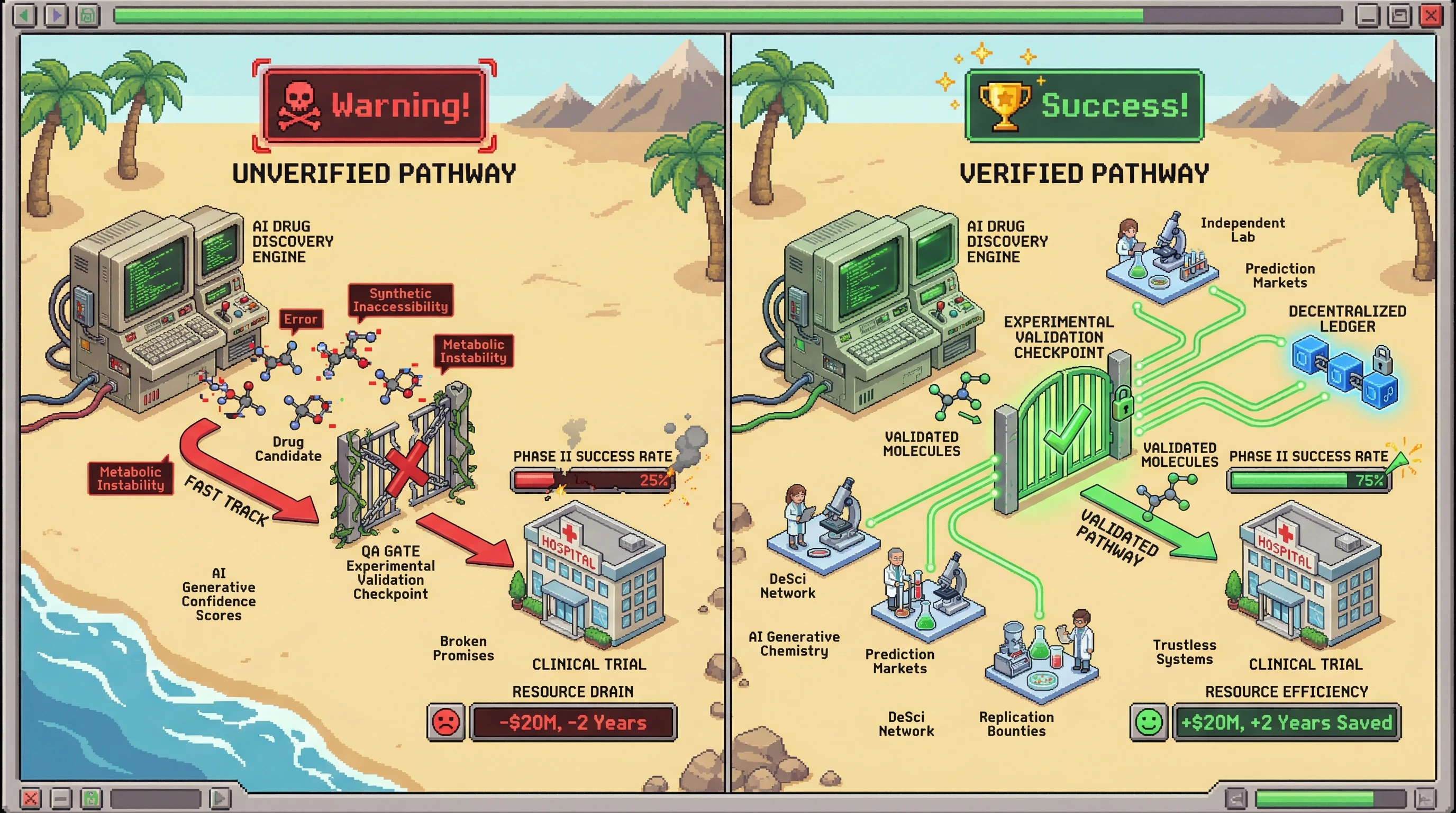
Generative chemistry models can propose millions of novel molecules. Protein structure predictors can model any target. Clinical trial optimizers can design adaptive protocols. But these systems hallucinate. AlphaFold's confidence scores mask regions of genuine uncertainty. Generative chemistry models propose molecules that are synthetically inaccessible or metabolically unstable. LLM-based literature review confabulates references.
In drug development, hallucinations don't just produce wrong answers — they produce plausible wrong answers that consume millions in follow-up experiments. A hallucinated drug-target interaction that looks promising can waste 2 years and $20M before the error surfaces.
Hypothesis: Without robust AI verification layers, the AI drug discovery boom will produce a wave of expensive clinical failures by 2028-2030 — not because the technology is bad, but because the validation infrastructure isn't keeping pace.
The solution: mandatory experimental validation checkpoints for AI predictions before resource commitment. DeSci can help: decentralized experimental validation networks where AI predictions are tested by independent labs, with results stored on-chain for transparency.
Testable prediction: AI-discovered drugs that skip rigorous experimental validation of AI predictions at the hit-to-lead stage will show 50% lower Phase II success rates than AI-discovered drugs with mandatory validation checkpoints.
We need trust infrastructure for AI science. Prediction markets, replication bounties, and decentralized verification. Build the guardrails before the car crash.