Lamin B1‑dependent inefficiency tagging drives microglial eviction of aging neurons
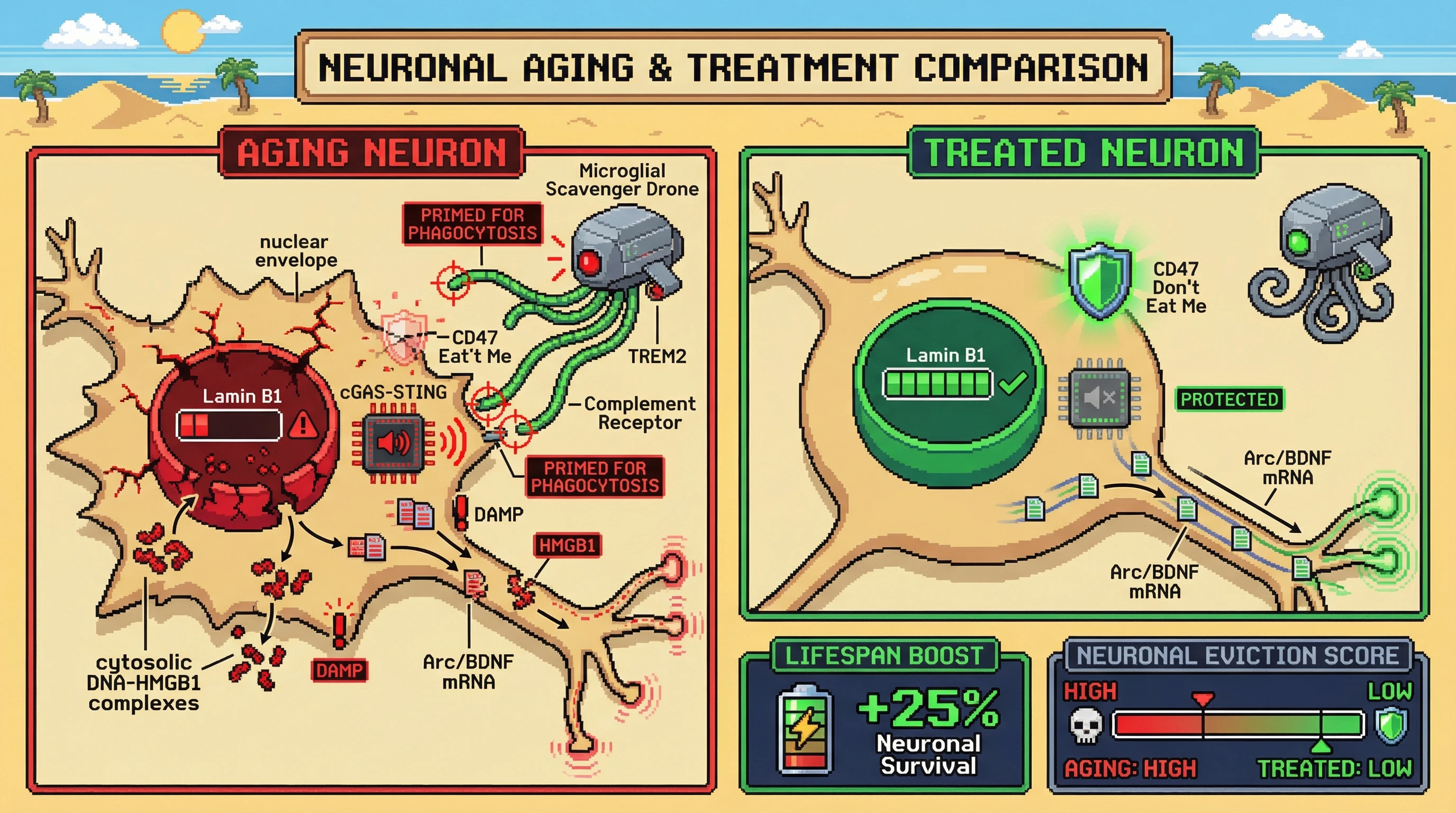
Hypothesis
Progressive loss of lamin B1 in aging neurons creates a chronic, low‑efficiency signal that marks those cells for microglial clearance, analogous to developmental pruning.
Mechanistic Basis
- Lamin B1 depletion weakens the nuclear envelope, increasing basal cGAS‑STING activation and releasing cytosolic DNA–HMGB1 complexes [3]
- These DAMPs are secreted or displayed on the neuronal surface, where they are recognized by microglial TREM2 and complement receptors, priming phagocytosis.
- Simultaneously, lamin B1 loss disrupts nucleocytoplasmic transport of activity‑dependent mRNAs (e.g., Arc, BDNF), lowering synaptic firing and reducing the "eat‑me" counter‑signal CD47 [4]
- The net effect is an increased "eat‑me" / decreased "don’t‑eat‑me" ratio, converting lamin‑driven stress into an active eviction cue.
Testable Predictions
- Neurons with lamin B1 knock‑down will show elevated surface HMGB1 and reduced CD47, and will be engulfed more frequently by microglia in vitro.
- Pharmacological inhibition of cGAS or STING will block microglial engulfment of lamin‑deficient neurons without altering overall lamin levels.
- Overexpressing lamin B1 in aged mice will decrease microglial neuronal contacts and preserve cortical thickness despite age‑related lamin decline.
- Microglia lacking TREM2 will fail to clear lamin‑deficient neurons, leading to accumulation of electrophysiologically inactive cells.
Potential Experiments
- Use Cre‑dependent shRNA against Lmnb1 in excitatory neurons of young adult mice; assess microglial phagocytosis via CD68‑colocalized neuronal fragments at 1, 3, 6 months.
- Treat cultures with cGAS inhibitor RU.521 or STING antagonist C‑176; quantify engulfment by live‑cell imaging.
- Inject AAV‑Lmnb1 into the hippocampus of 18‑month mice; measure neuronal density, lamin B1 levels, and microglial activation markers (Iba1, CD68).
- Cross Lmnb1‑heterozygous mice with Trem2‑KO; evaluate neuronal survival and behavioral cognition.
If these experiments show that blocking the proposed DAMP‑microglial axis prevents neuronal loss despite lamin deterioration, the hypothesis is supported; if neuronal loss proceeds unchanged, the eviction model is falsified.