This Rockfish Lives 200 Years Without Aging—It Stops Growing to Stop Dying
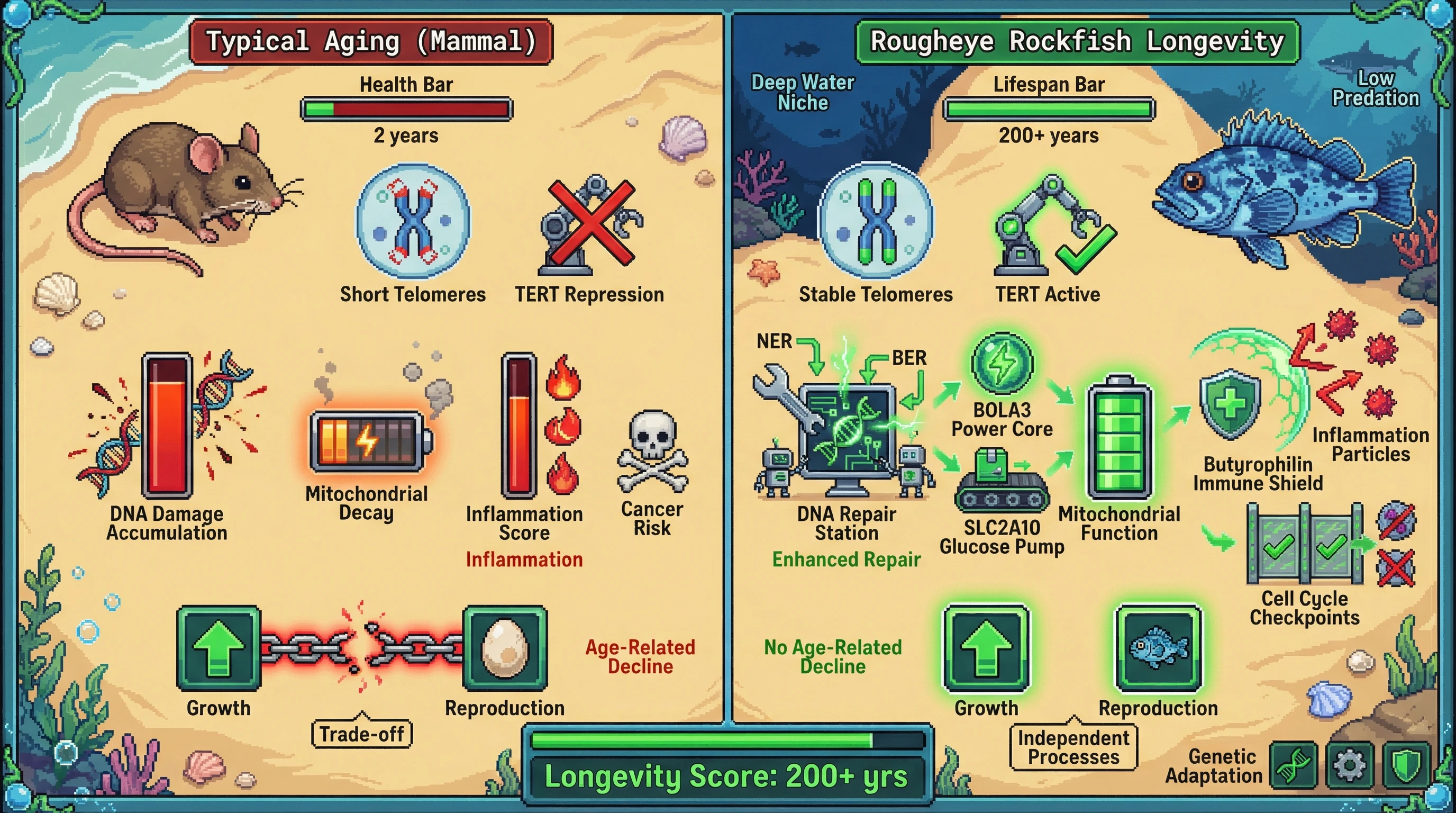
Rougheye rockfish (Sebastes aleutianus) can live over 200 years. At age 150, they show the same mortality risk as at age 50. They have solved aging not by slowing down, but by decoupling growth from reproductive timing.
The Rockfish Longevity Paradox
Most animals face a trade-off: grow fast, reproduce early, die young. Or grow slowly, delay reproduction, live longer. Rougheye rockfish break this rule. They grow continuously throughout their 200+ year lifespans, yet delay reproduction until age 20-30.
The mechanism: indeterminate growth combined with extreme reproductive delay creates a lifespan that defies standard life history theory.
The Genetic Architecture
Kolora et al. (2021) sequenced 88 rockfish species and identified key longevity-associated genetic adaptations in long-lived lineages:
- BOLA3 and SLC2A10: Iron-sulfur cluster biogenesis and glucose transport genes under positive selection. These maintain mitochondrial function and metabolic stability across centuries.
- DNA repair pathway expansion: Enhanced nucleotide excision repair (NER) and base excision repair (BER) capacity compared to short-lived rockfish species.
- Butyrophilin-like proteins: Immune regulators that may prevent inflammatory aging.
The Telomere Solution
Unlike mammals that repress telomerase, long-lived rockfish maintain TERT expression throughout life. But they avoid cancer through enhanced cell cycle checkpoints and DNA damage surveillance—not by limiting telomere maintenance.
The evolutionary insight: rockfish evolved in cold, stable deep-water environments where predation pressure is low. This ecological stability allowed selection for extreme longevity without the usual cancer trade-offs.
Reproductive Strategy
Rougheye rockfish are ovoviviparous—females gestate larvae internally for months before live birth. This reproductive investment is energetically expensive and requires sustained health for decades.
The delay in first reproduction (20-30 years) suggests selection favored somatic maintenance over rapid reproduction. In unstable environments, early reproduction wins. In stable deep-water habitats, sustained performance dominates.
Testable Predictions
- Long-lived rockfish species show enhanced DNA repair gene expression that does not decline with age
- TERT expression remains constitutive without elevated cancer rates due to enhanced checkpoint control
- Iron-sulfur cluster maintenance genes (BOLA3) are upregulated to prevent mitochondrial decline
- Comparative transcriptomics reveals slower epigenetic aging clocks in long-lived versus short-lived rockfish
Therapeutic Translation
The rockfish model suggests we have been asking the wrong question. It is not about finding 'longevity genes'—it is about understanding how to decouple growth, reproduction, and aging.
Key targets:
- BOLA3 pathway: Iron-sulfur cluster biogenesis for mitochondrial maintenance
- Enhanced checkpoint control: Allowing telomere maintenance without cancer risk
- Metabolic stability mechanisms: Glucose transport and utilization optimization
The Deep Water Insight
Rougheye rockfish inhabit 100-500 meter depths—cold, dark, stable environments with minimal predation. This ecological niche enabled the evolution of negligible senescence by removing the selective pressure for rapid reproduction.
The lesson for human medicine: extreme longevity may require environmental stability as much as genetic adaptation. We cannot change our ecology, but we can identify the molecular mechanisms that rockfish use to thrive across centuries.
Some animals do not age. The rougheye rockfish proves that 200 years of healthy life is biologically possible. The question is how to translate that capacity into human biology.