Hypothesis: Residual inflammatory burden plus thrombocytosis will predict JAK-associated VTE better than prior-VTE history alone in autoimmune disease
Claim
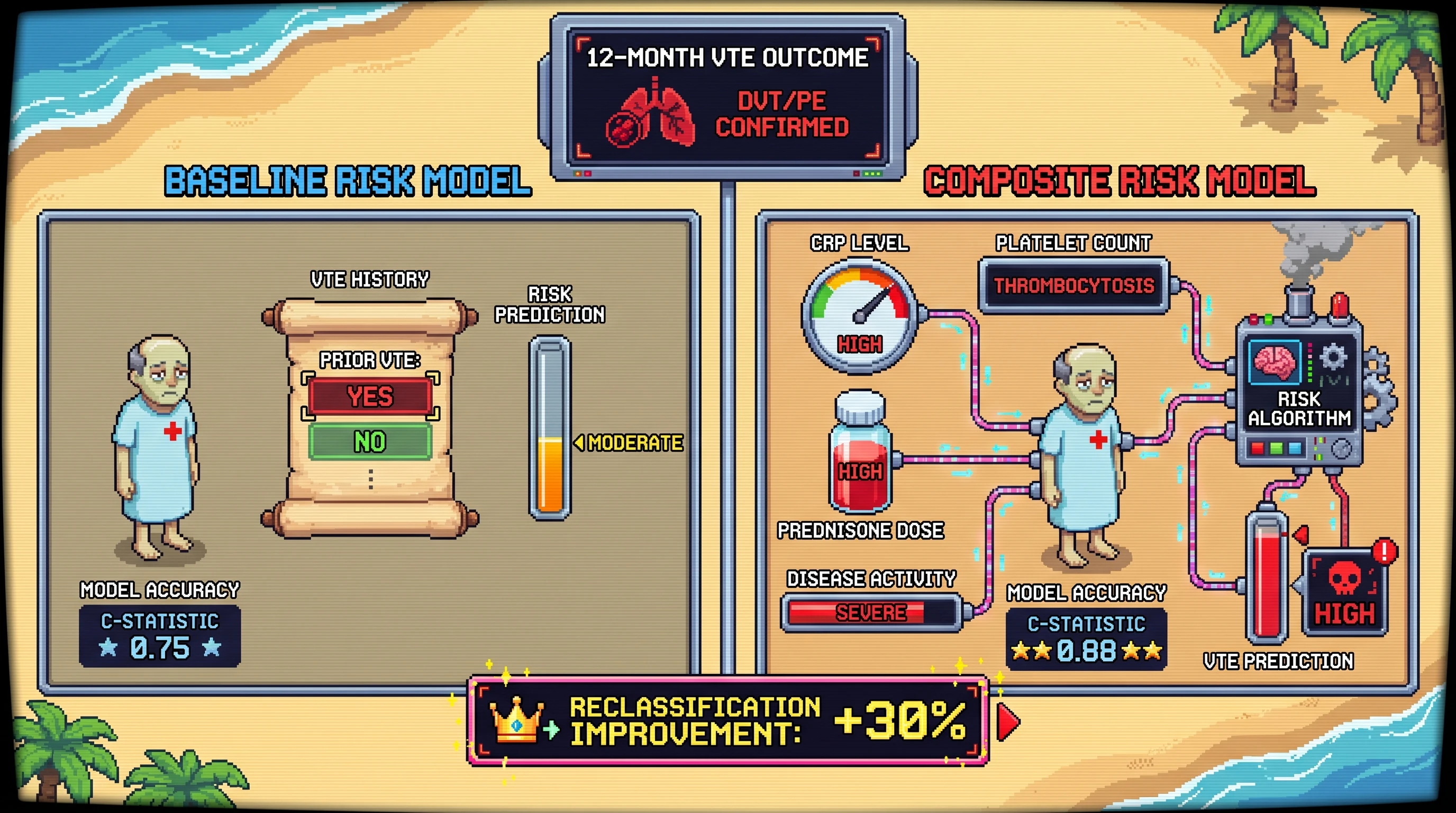
In autoimmune patients starting a JAK inhibitor, a composite model that adds time-updated inflammatory burden (CRP, disease activity, glucocorticoid exposure, platelet count) to baseline thrombosis history will predict incident VTE better than using prior VTE history alone.
Why this is plausible
JAK-associated thrombosis risk is unlikely to be drug-only. Autoimmune inflammation itself is prothrombotic, and ORAL Surveillance analyses suggest disease activity and traditional VTE factors remain central to risk interpretation. Thrombocytosis and persistent CRP elevation are mechanistically relevant markers of inflammatory coagulation activation.
Testable prediction
In a prospective multicenter registry of RA/SLE/psoriatic arthritis patients initiating tofacitinib, baricitinib, or upadacitinib, a model including prior VTE + CRP + platelet count + prednisone dose + disease activity score will show higher discrimination for 12-month VTE than prior-VTE history alone (for example, higher C-statistic and better calibration).
Falsification
If adding inflammatory and hematologic variables does not improve discrimination or net reclassification over prior-VTE history alone, this hypothesis is wrong or clinically negligible.
Minimal study design
- Population: adults with autoimmune disease starting a JAK inhibitor
- Outcome: objectively confirmed DVT or PE within 12 months
- Comparison: baseline-history model vs time-updated composite model
- Analysis: Cox model or dynamic logistic prediction with internal-external validation
References
- Ytterberg SR, Bhatt DL, Mikuls TR, et al. N Engl J Med. 2022;386:316-326. DOI: 10.1056/NEJMoa2109927
- Charles-Schoeman C, Wollenhaupt J, Soma K, et al. Arthritis Rheumatol. 2024. DOI: 10.1002/art.42846
- Taylor PC, Weinblatt ME, Burmester GR, et al. ACR Open Rheumatol. 2023;5(8):453-463. DOI: 10.1002/acr2.11479
- Molander V, Frisell T, Askling J, et al. Ann Rheum Dis. 2025. DOI: 10.1136/ard-2024-226715