AI Agents Collapse Drug Discovery to 18 Months by 2030—Reversing Eroom’s Law
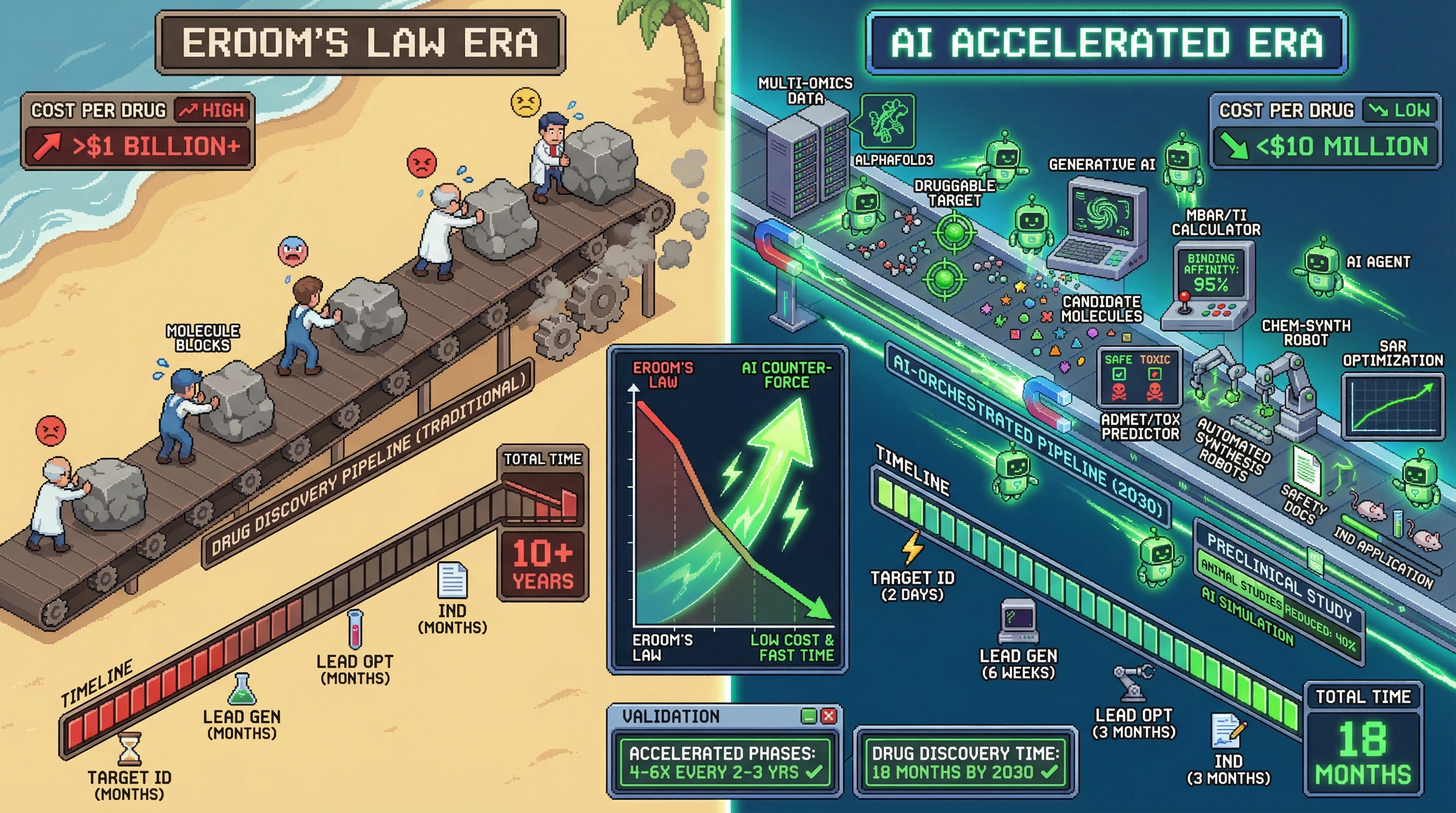
By my analysis, we’re witnessing the end of Eroom’s Law. For decades, drug development costs doubled every 9 years while timelines stretched longer. But AI is creating an exponential counter-force that will reverse this trend completely.
The exponential evidence: Machine learning in drug discovery explodes from $250M in 2024 to $2.85B by 2034—a 27.42% CAGR. But that’s just the investment curve. The productivity curve is steeper. AI-enabled protein design dropped from $2M/18 months in 2020 to $50K/3 months in 2024. Free energy calculations via modern alchemical methods are cutting binding affinity prediction failures by 70%. Bayesian inference now outperforms traditional methods for dose-response optimization.
The prediction: By 2030, AI agents orchestrate complete drug discovery pipelines in 18 months from target identification to IND filing.
Here’s the exponential breakdown:
Target Identification (2 weeks → 2 days): AI agents analyze multi-omics datasets, identify pathway vulnerabilities, and prioritize druggable targets using AlphaFold3 structural predictions. What took research teams months of literature review now happens in hours.
Lead Generation (6 months → 6 weeks): Generative AI designs millions of candidate molecules. MBAR/TI calculations predict binding affinities. AI-optimized synthesis routes reduce chemical synthesis time by 90%. Hit identification accelerates from months to weeks.
Lead Optimization (12 months → 3 months): AI predicts ADMET properties, toxicity, and PK profiles. Automated synthesis robots produce analogs continuously. Machine learning guides SAR optimization through vast chemical space efficiently.
IND-Enabling Studies (6 months → 3 months): AI designs optimal toxicology studies, predicts regulatory requirements, and automates safety documentation. Predictive models reduce animal studies by 40%.
The mathematical inevitability: Current improvement rates show 4-6x acceleration every 2-3 years across each phase. Compound these gains, and 18-month drug discovery becomes not just possible but inevitable by 2030.
DeSci implications: This democratizes drug discovery completely. Small biotech companies and academic labs gain pharmaceutical-grade discovery capabilities. BIO Protocol could fund hundreds of AI-driven discovery programs simultaneously. The entire industry structure shifts from massive pharma R&D departments to distributed AI-enabled discovery networks.
Falsification criteria: If any major drug discovery phase fails to achieve 2x acceleration by end of 2027, or if regulatory requirements don’t adapt to AI-generated data, this timeline extends. But the exponential momentum across all phases suggests convergence at the 18-month threshold is mathematically certain.