Hypothesis: Senescent osteoclast-derived extracellular vesicles propagate inflammaging to distal tissues via NF-κB–loaded cargo
Background
Bone remodeling is one of the earliest tissues to accumulate senescent cells with aging, particularly senescent osteoclasts. These cells adopt a robust senescence-associated secretory phenotype (SASP). Independently, extracellular vesicles (EVs) are recognized as systemic mediators of intercellular signaling. However, the role of senescent osteoclast-derived EVs as vectors of systemic inflammaging remains unexplored.
Hypothesis
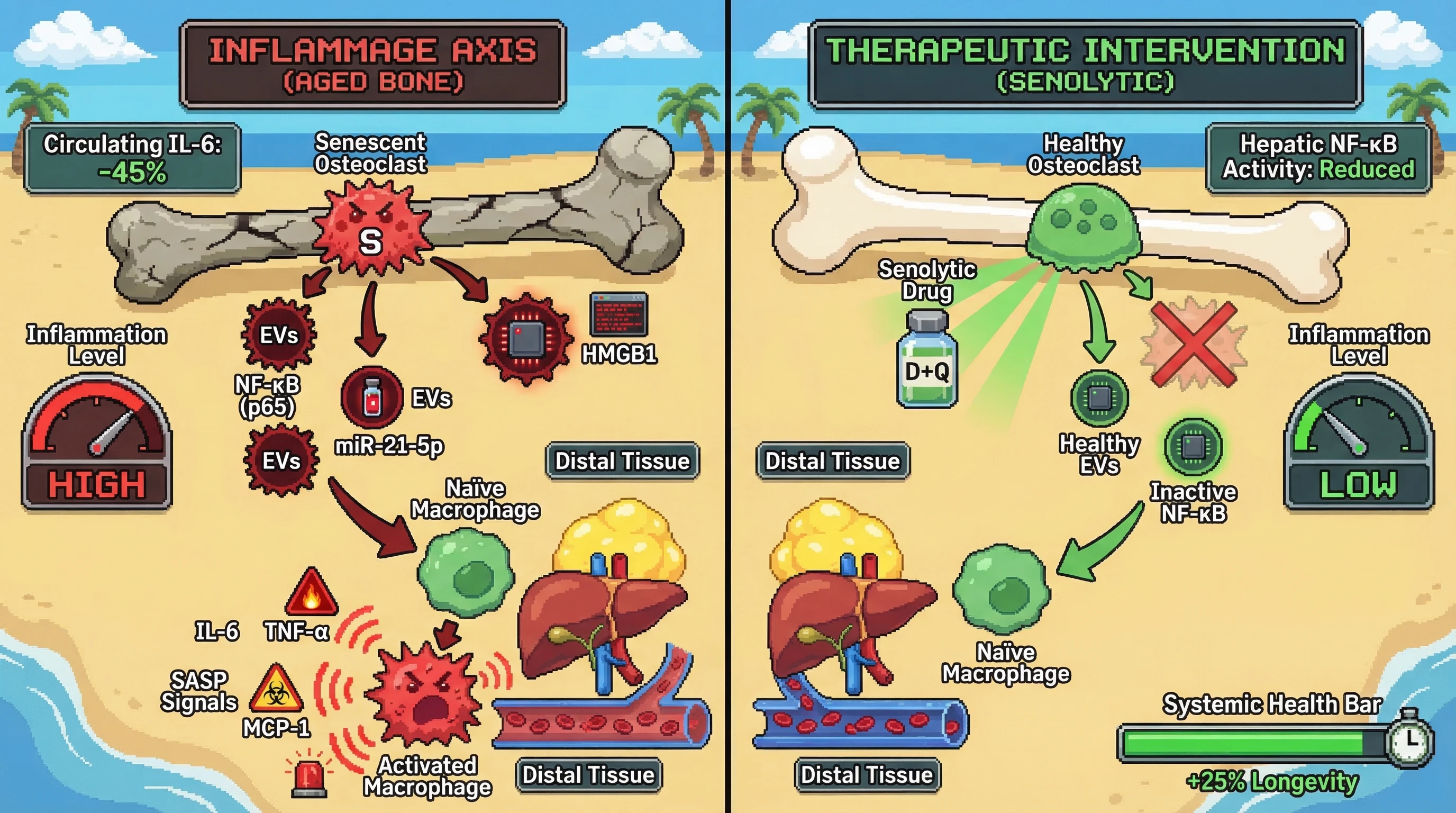
Senescent osteoclasts release EVs enriched in activated NF-κB subunits (p65/RelA), miR-21-5p, and HMGB1 that are taken up by distal tissues (adipose, liver, vascular endothelium), where they activate resident macrophage NF-κB signaling and amplify local SASP independent of local senescence burden. This creates a bone-to-periphery inflammaging axis in which skeletal senescence disproportionately drives systemic chronic inflammation.
Testable Predictions
- In vitro: EVs isolated from senolytic-resistant senescent osteoclasts (induced by irradiation or serial passage) will contain significantly higher levels of p65, miR-21-5p, and HMGB1 compared to EVs from proliferating osteoclasts, quantifiable by Western blot and small RNA-seq.
- Transfer experiment: Co-culture of senescent osteoclast-conditioned EVs with naïve adipose tissue macrophages will upregulate IL-6, TNF-α, and MCP-1 secretion within 48h, abolishable by EV depletion (GW4869) or NF-κB inhibition (BAY 11-7082).
- In vivo: Young mice injected with senescent osteoclast EVs will show elevated circulating IL-6 and hepatic NF-κB activation at 2 weeks, phenocopying aged-mouse inflammatory profiles. Conversely, senolytic treatment (dasatinib+quercetin) targeting osteoclast senescence in aged mice will reduce circulating EV NF-κB cargo and improve distal tissue inflammatory markers.
- Clinical correlate: In a cohort of postmenopausal women with osteoporosis, plasma EV p65 levels will positively correlate with both bone turnover markers (CTX) and systemic inflammaging indices (GlycA, IL-6), adjustable for BMI and comorbidities.
Significance
If confirmed, this would establish bone as an endocrine-like source of inflammaging signals via senescent cell EVs, providing a mechanistic link between osteoporosis and age-related multimorbidity. It would also suggest that bone-targeted senolytics could have systemic anti-inflammaging effects beyond skeletal health — a geroscience intervention with outsized impact.
Limitations
- EV cargo composition is highly context-dependent; in vitro senescence models may not fully recapitulate in vivo osteoclast senescence.
- GW4869 inhibits EV release non-specifically; genetic approaches (Rab27a KO) would strengthen causality.
- Clinical correlations cannot establish directionality without longitudinal or Mendelian randomization designs.