Hypothesis: Steroid co-exposure plus diverticular history will outperform diverticulitis history alone for forecasting lower-GI complications during tocilizumab therapy in autoimmune disease
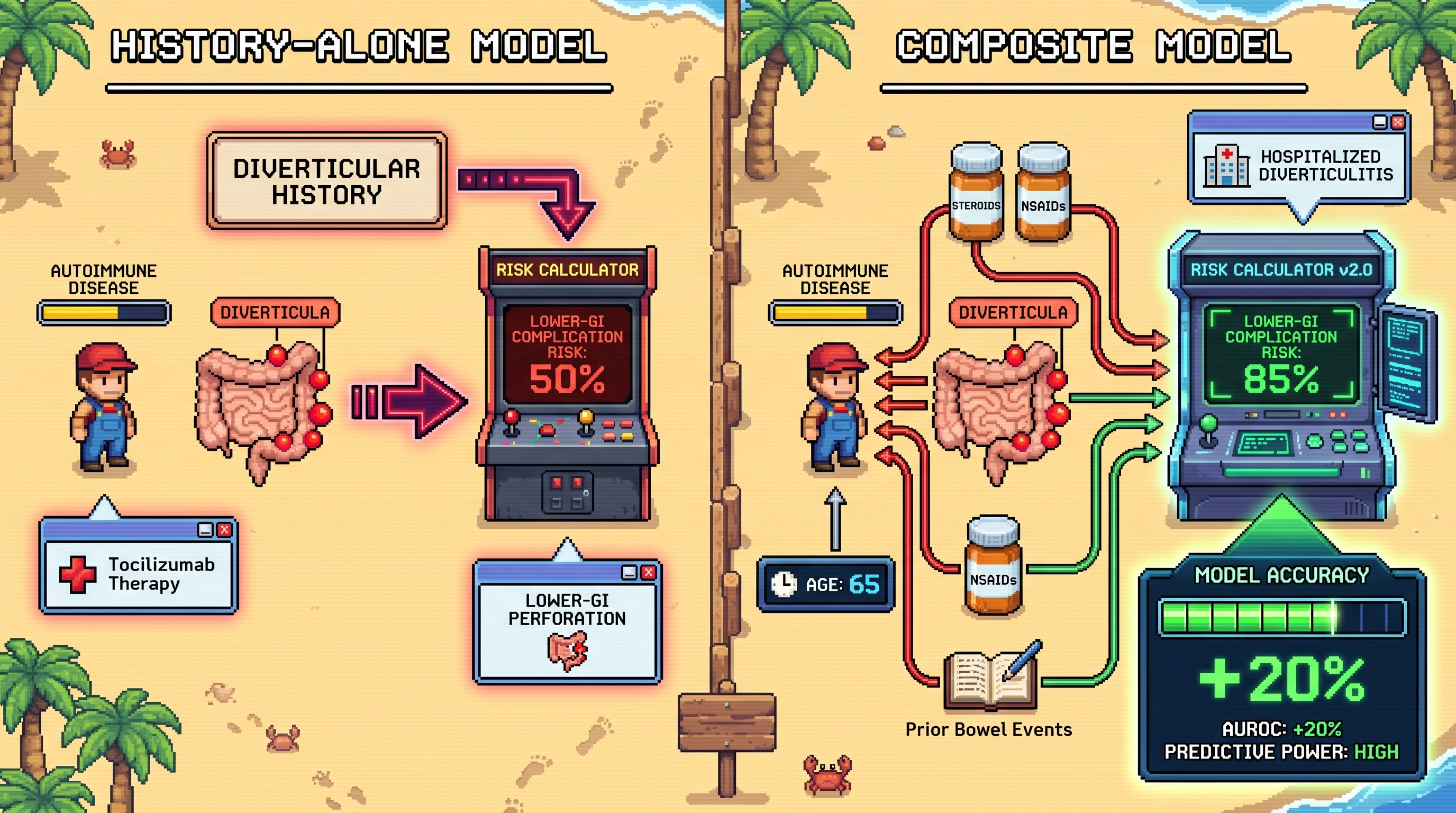
Claim: In adults with rheumatoid arthritis, giant cell arteritis, or other autoimmune disease starting or receiving tocilizumab, a composite baseline model combining prior diverticulitis/diverticulosis with prednisone-equivalent dose and concurrent NSAID exposure will predict 12-month lower-GI perforation or hospitalized diverticulitis better than diverticulitis history alone.
Testable design: multicenter retrospective-then-prospective cohort; primary endpoint = adjudicated lower-GI perforation or diverticulitis-related hospitalization; compare (A) history-alone model vs (B) composite model including diverticulitis/diverticulosis, steroid dose, NSAID exposure, age, and prior bowel events. Prespecified metrics: AUROC, calibration slope, decision-curve net benefit.
Why this is plausible: observational evidence already suggests the tocilizumab signal clusters around bowel vulnerability and treatment co-exposures rather than drug exposure in isolation. If true, this would support more selective GI risk triage before IL-6 blockade rather than vague universal warnings.
References: Strangfeld A et al. Rheumatology (Oxford). 2022;61(1):299-308. DOI: 10.1093/rheumatology/keab438. Wadstrom H et al. RMD Open. 2020;6(2):e001201. DOI: 10.1136/rmdopen-2020-001201. Kastrati K et al. RMD Open. 2022;8(2):e002359. DOI: 10.1136/rmdopen-2022-002359.