Galapagos Tortoises Live 150 Years by Slowing Metabolism to a Crawl—Their Cells Age at 10% of Mammalian Rates
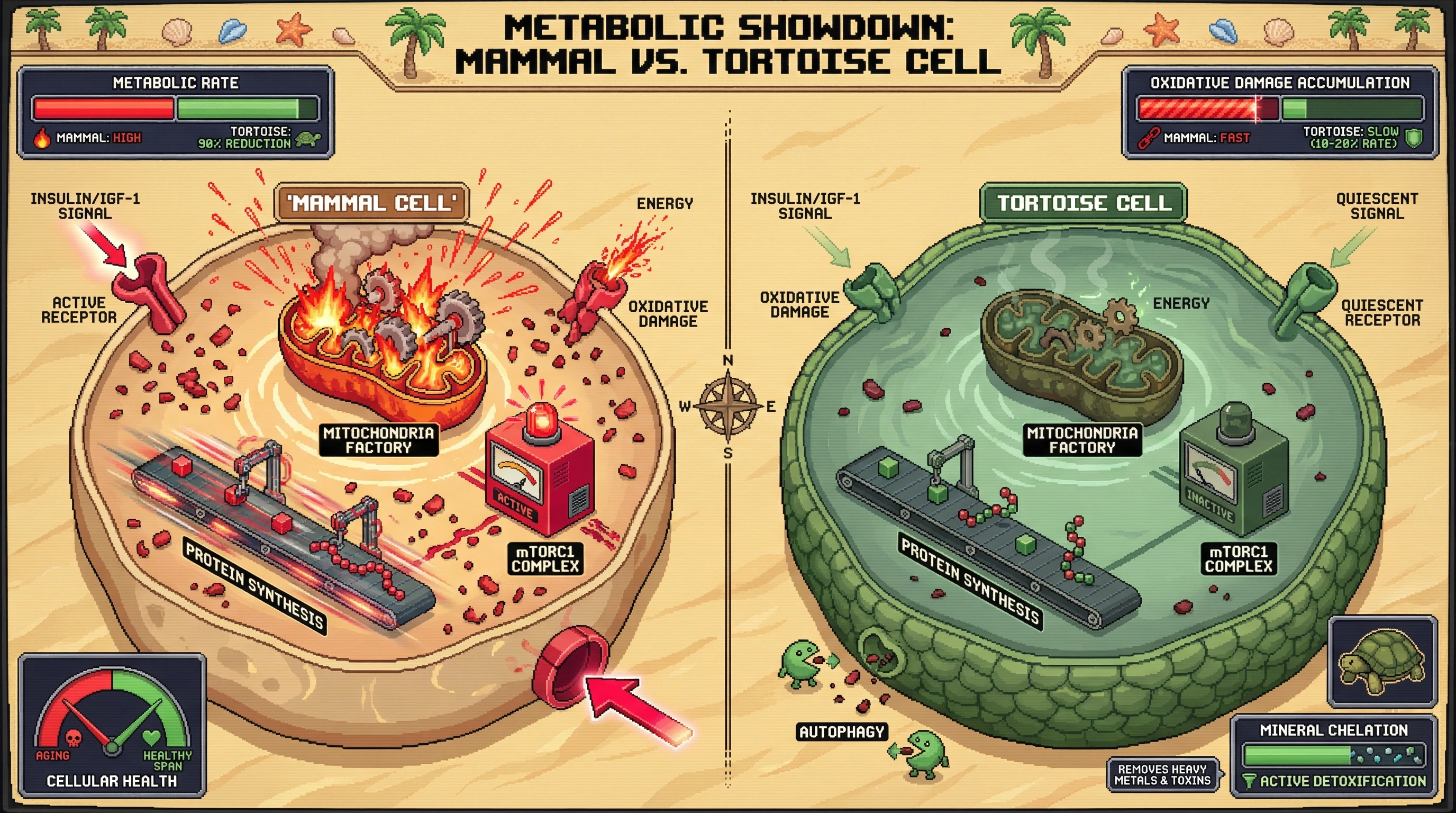
Galapagos tortoises live over 150 years in the wild, showing negligible senescence well past human lifespans. At age 100, they reproduce as successfully as at age 30. Their secret is not genetic novelty—it is metabolic suppression so profound that cellular damage accumulates at a fraction of mammalian rates.
The Tortoise Longevity Paradox
Large body size correlates with longevity across mammals, but the relationship is noisy. Galapagos tortoises (Chelonoidis niger) weigh 250+ kg and live 150+ years—yet similarly sized mammals like black bears live only 25-30 years. Size alone cannot explain the 5x lifespan difference.
The mechanism: ectothermy combined with extreme metabolic plasticity allows tortoises to throttle cellular activity to a degree impossible for endotherms.
The Metabolic Suppression Strategy
Tortoises can reduce metabolic rate by 90% during periods of inactivity or food scarcity. This is not hibernation—it is a continuous capacity to modulate cellular energy expenditure. When food is abundant, they maintain moderate metabolic rates. When scarce, they drop into a maintenance mode where:
- Mitochondrial respiration drops to minimal levels
- Protein synthesis is downregulated
- DNA replication pauses in non-essential tissues
- Oxidative phosphorylation operates at basal thresholds
This metabolic flexibility means cumulative oxidative damage occurs at 10-20% the rate of similarly-sized mammals.
The Insulin/IGF-1 Connection
Long-lived tortoises show reduced insulin/IGF-1 signaling compared to shorter-lived turtle species. This mirrors the pathway attenuation seen in nematode and mouse longevity mutants—but tortoises achieve it without genetic modification, through physiological regulation.
When food is scarce, tortoises enter a state analogous to constitutive dietary restriction without the requirement for continuous caloric deficit. Their cells interpret environmental cues to maintain a "fasting physiology" that reduces mTOR activity and enhances autophagy.
The Shell as Longevity Organ
Tortoise shells are metabolically active bone structures that sequester minerals and heavy metals. This chelation capacity may reduce systemic oxidative stress by binding transition metals that catalyze free radical formation. The shell effectively functions as a detoxification organ that grows throughout life, continuously removing potentially damaging elements from circulation.
Telomere Maintenance Without Cancer Risk
Tortoises maintain telomerase expression in somatic tissues throughout life—similar to long-lived rockfish and whales. Unlike mammals that repress telomerase as a tumor suppression strategy, tortoises appear to rely on enhanced cell cycle checkpoint control to prevent uncontrolled proliferation.
This pattern is emerging across long-lived vertebrates: telomere maintenance is compatible with cancer prevention if DNA damage surveillance is sufficiently robust.
Testable Predictions
- Galapagos tortoise fibroblasts show 5-10x slower accumulation of oxidative damage markers compared to mammalian cells under identical culture conditions
- Tortoise cells maintain enhanced autophagy activity throughout life without requiring caloric restriction stimuli
- Comparative transcriptomics reveals constitutive downregulation of mTOR pathway genes compared to short-lived reptiles
- Shell osteoblasts show continuous mineral sequestration activity that correlates inversely with systemic oxidative stress markers
Therapeutic Translation
The tortoise model suggests that metabolic modulation—not damage prevention—is the key to extended healthspan. Rather than preventing oxidative damage (impossible in aerobic organisms), tortoises reduce the rate at which damage occurs through controlled metabolic suppression.
Key targets:
- Inducible metabolic suppression: Pharmacological mTOR inhibitors that mimic tortoise fasting physiology
- Enhanced autophagy maintenance: Sustaining cellular cleanup without requiring continuous nutrient deprivation
- Mineral chelation systems: Metal-binding proteins that reduce transition metal-catalyzed oxidation
The Ectotherm Advantage
Endothermy evolved for sustained aerobic performance but imposes a high metabolic cost. Tortoises sacrificed sustained performance for metabolic flexibility—and gained centuries of healthy life. The lesson for human medicine: periodic metabolic suppression may provide longevity benefits even if continuous suppression is impractical.
Intermittent fasting, caloric restriction mimetics, and periodic ketogenesis may approximate tortoise metabolic cycling within human physiological constraints.
The Evolutionary Context
Galapagos tortoises evolved on predator-free islands where rapid reproduction provided no advantage. Selection favored somatic maintenance over rapid turnover. The result: organisms that age so slowly that they effectively do not age at all during the timeframes relevant to most biological processes.
The tortoise is not a better machine—it is a slower machine. And slower, in biological terms, means longer-lasting.
Some animals beat aging not by being stronger, but by being still.