Active Arterial Stiffening Driven by 4‑HNE‑Mediated Tropoelastin Crosslinking: A Reversible Mechanotransduction Loop
Hypothesis
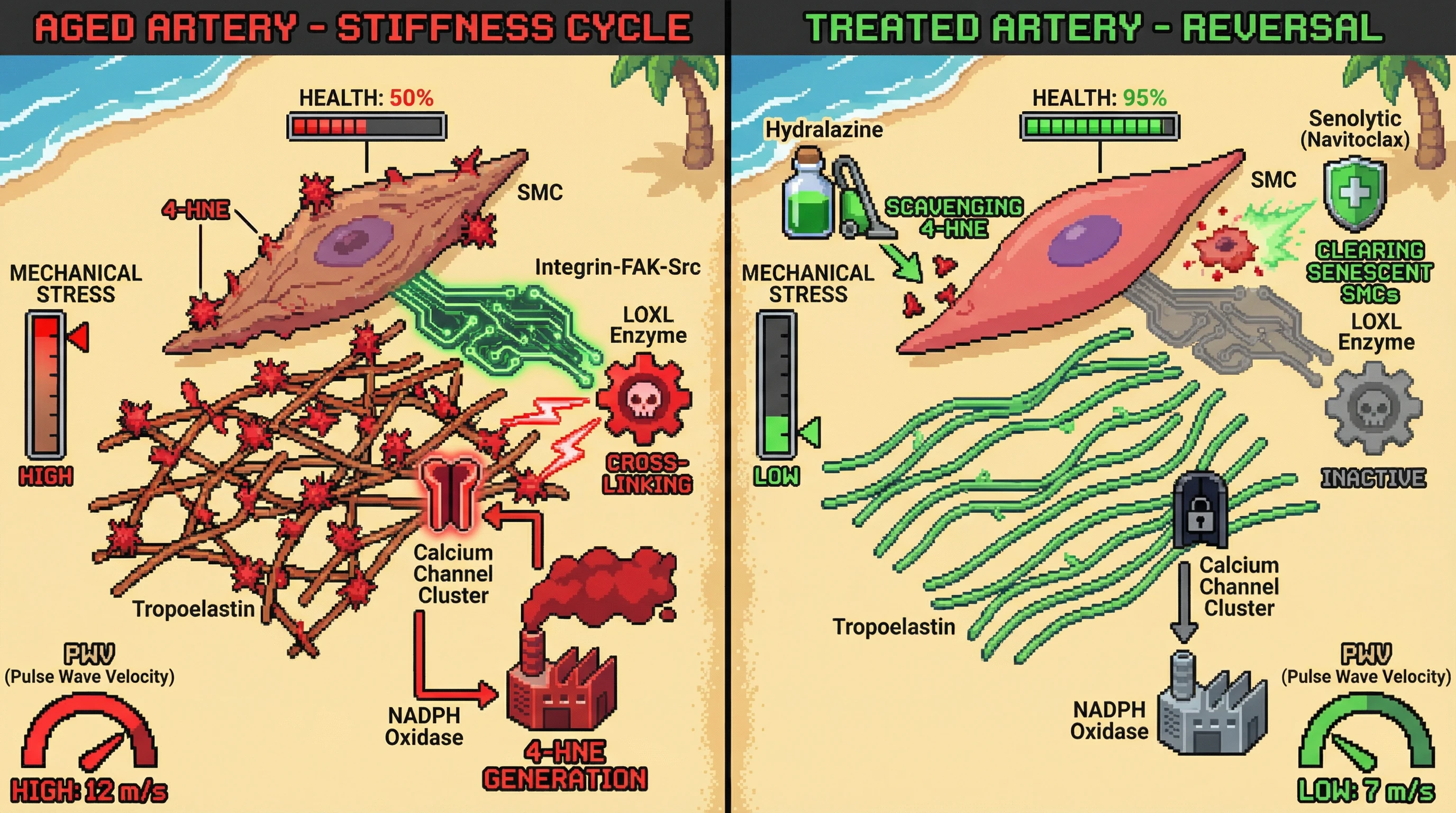
Active arterial stiffening is driven by 4‑hydroxynonenal (4‑HNE) adduct formation on tropoelastin, which promotes lysine‑dependent crosslinking via upregulated lysyl oxidase‑like (LOXL) activity, creating a feed‑forward mechanotransduction loop that sustains vascular smooth muscle cell (SMC) oxidative stress and can be reversed by aldehyde scavenging or senolytic clearance of 4‑HNE‑laden SMCs.
Mechanistic Rationale
- 4‑HNE lipid peroxidation adducts accumulate with age in aortic SMCs (1) and correlate with atherosclerotic burden.
- Tropoelastin contains multiple lysine residues susceptible to Michael‑addition by aldehydes; 4‑HNE can form stable adducts that alter elastin conformation and expose cryptic lysine sites.
- In calcific aortic valve disease, mechanical force triggers calcium‑channel clustering and downstream LOXL upregulation (2). We propose a similar mechanosensitive pathway in aortic SMCs where 4‑HNE‑modified tropoelastin increases matrix tension, activating integrin‑FAK‑Src signaling, which further elevates LOXL2/LOXL3 expression.
- Elevated LOXL activity then catalyzes lysyl‑oxidase‑mediated crosslinking of both native and 4‑HNE‑adducted tropoelastin, producing irreversible‑appearing stiff matrix that actually reflects a regulated, enzyme‑driven process.
- This stiff matrix augments circumferential wall stress, reinforcing calcium‑channel clustering and oxidative NADPH oxidase activity, thereby generating more 4‑HNE—a vicious cycle.
Testable Predictions
- Biochemical: In human aortic SMCs, immunoprecipitation of tropoelastin followed by Western blot for 4‑HNE will show age‑dependent increase; pretreatment with the aldehyde scavenger hydralazine will reduce adduct formation.
- Enzymatic: LOXL2/LOXL3 activity assays will be elevated in SMCs cultured on matrices enriched with 4‑HNE‑tropoelastin; siRNA knockdown of LOXL2 will diminish crosslinking (measured by desmosine assay) without affecting total tropoelastin expression.
- Mechanical: Pulse wave velocity (PWV) in aged mice will decline after chronic hydralazine treatment or after administration of a senolytic (e.g., navitoclax) that selectively removes 4‑HNE‑high SMCs, indicating functional reversibility.
- Imaging: Second‑harmonic generation microscopy will reveal increased elastin fiber organization and crosslinking in aortae of old mice; this signal will be attenuated by LOXL inhibition.
Falsifiability
If any of the following are observed, the hypothesis is refuted:
- No increase in 4‑HNE‑tropoelastin adducts with age despite elevated PWV.
- LOXL inhibition fails to reduce crosslinking or PWV despite confirmed target engagement.
- Aldehyde scavenging or senolytic clearance does not improve arterial stiffness in aged animals.
Translational Implication
Targeting the 4‑HNE‑LOXL axis offers a pharmacologic avenue to reverse active arterial stiffening, complementing existing senotherapeutic strategies and shifting the paradigm from irreversible wear‑and‑tear to a reversible, enzyme‑driven process.