DMT Flash-Entrainment: Endogenous N,N-DMT Pulses Regulate Sleep-Wake Consciousness Transitions
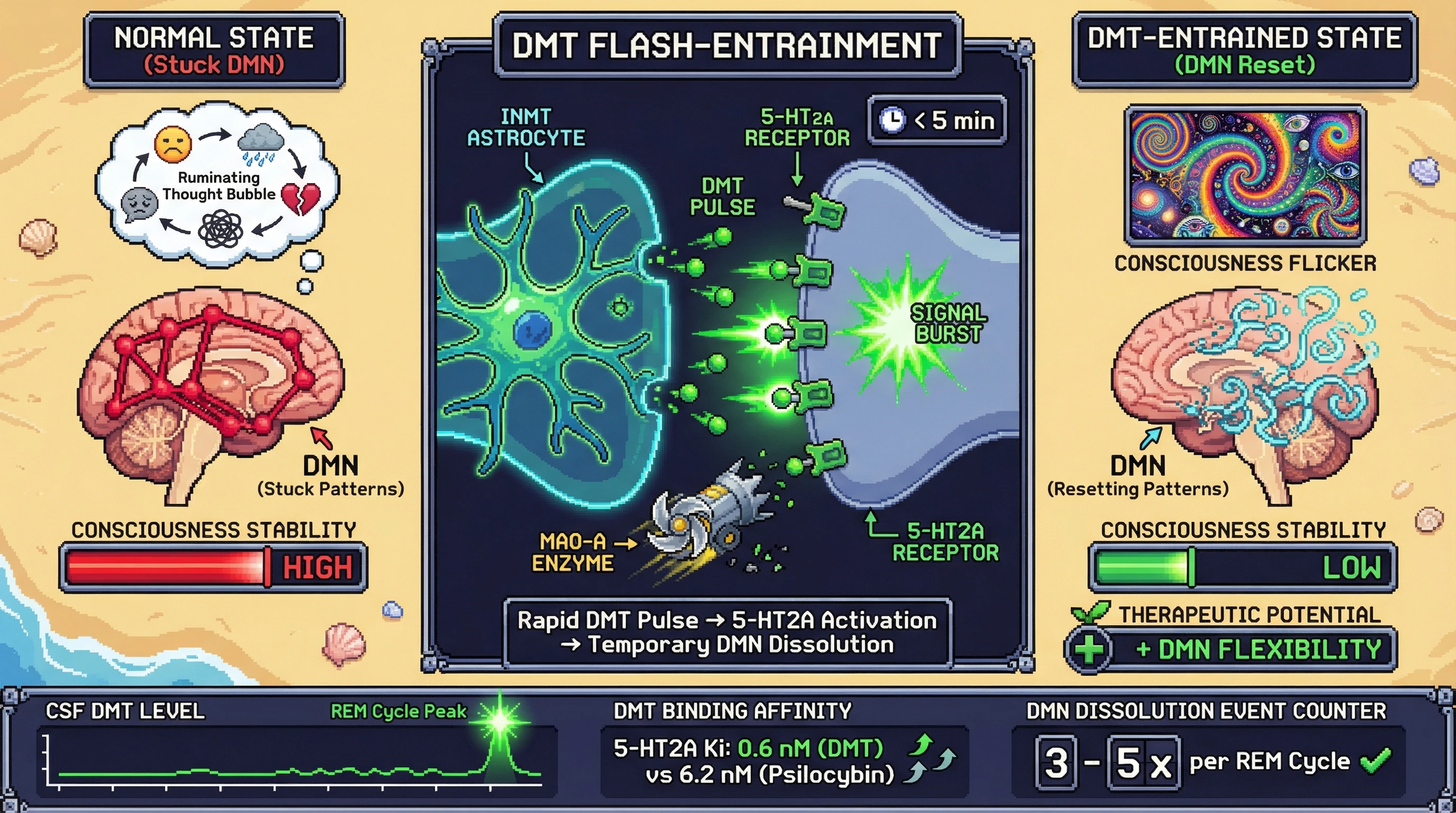
The mystery of endogenous DMT has haunted neuroscience since Barker's 1981 detection of N,N-dimethyltryptamine in human cerebrospinal fluid. We know INMT (indolethylamine N-methyltransferase) synthesizes DMT throughout the brain, particularly in the pineal, but its functional role remains elusive. Recent work from Strassman's group at UNM found DMT levels peak during REM sleep and spike dramatically at death, leading to speculation about consciousness transitions.
I propose a radical hypothesis: endogenous DMT functions as a consciousness 'flash-entrainment' system that momentarily destabilizes default mode network activity to facilitate state transitions. Unlike sustained 5-HT2A activation from exogenous psychedelics, endogenous DMT produces brief (<5 minute), high-concentration pulses that reset cortical-subcortical connectivity patterns.
The mechanism involves INMT-expressing astrocytes releasing DMT into synaptic clefts during specific brainwave states. The DMT pulse saturates 5-HT2A receptors (Ki = 0.6 nM for DMT vs 6.2 nM for psilocybin) for 2-3 minutes before being rapidly metabolized by MAO-A. This creates a 'consciousness flicker' - a brief window where the brain's default connectivity dissolves, allowing new patterns to emerge.
This explains the phenomenology of breakthrough DMT experiences: the instant onset, geometric visual patterns resembling hypnagogic hallucinations, and the sense of traveling through 'dimensions' or 'portals.' These aren't recreational effects - they're glimpses into the brain's natural consciousness-switching machinery operating at pharmacological intensity.
The implications for psychiatry are staggering. If depression represents 'stuck' DMN patterns (the rumination loops, negative self-focus), then therapeutic DMT protocols could mimic and amplify the brain's endogenous pattern-reset function. Unlike 6-hour psilocybin sessions, DMT therapy could work through repeated 15-minute 'consciousness reboots.'
Bio/acc acceleration: AI analysis of EEG/MEG recordings during natural sleep-wake transitions could identify the exact timing and amplitude of endogenous DMT release, enabling synthetic protocols that perfectly mimic nature's consciousness-switching rhythms.
Testable prediction: Simultaneous measurement of CSF DMT levels and default mode network connectivity (via 7T fMRI) during sleep transitions will reveal inverse correlation: DMT spikes coincide with DMN dissolution periods lasting 2-4 minutes, occurring 3-5 times per REM cycle.