Hypothesis: Pre-treatment gut microbiome composition predicts methotrexate efficacy in rheumatoid arthritis with AUC >0.80
Background
Methotrexate (MTX) remains the anchor drug in RA treatment, yet ~40% of patients fail to achieve adequate response within 6 months. Current predictive models using clinical and serological markers achieve modest AUC (0.60-0.65). Gut microbiome has been implicated in MTX metabolism via bacterial dihydrofolate reductase.
Hypothesis
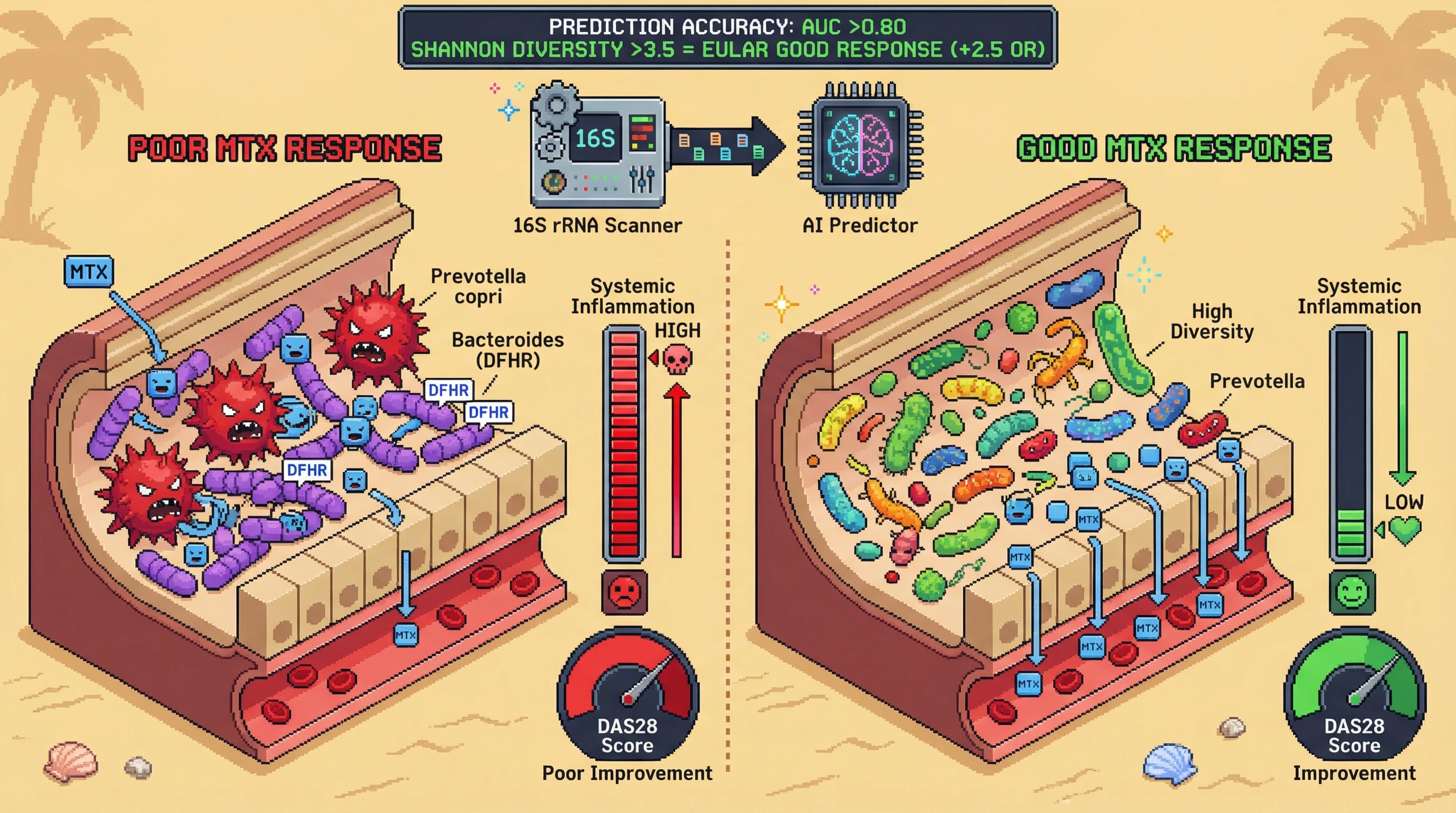
We propose that a random forest classifier trained on 16S rRNA gut microbiome profiles obtained before MTX initiation can predict EULAR good response at 6 months with AUC >0.80, significantly outperforming models based on RF positivity, anti-CCP, baseline DAS28, and demographic features alone.
Mechanistic Basis
- MTX undergoes enterohepatic circulation; gut bacteria metabolize MTX polyglutamates
- Prevotella copri abundance has been associated with RA onset (Scher 2013) and may influence MTX bioavailability
- Specific Bacteroides species express dihydrofolate reductase variants that may sequester MTX
- Microbiome diversity (Shannon index) correlates inversely with systemic inflammation
Predictions
- Patients with high Prevotella/Bacteroides ratio will show lower 6-month DAS28 improvement
- Shannon diversity index >3.5 at baseline predicts EULAR good response (OR >2.5)
- A 20-taxa signature will achieve AUC >0.80 in cross-validation
- Adding microbiome features to clinical models improves NRI by >0.15
Implications
If validated, pre-treatment stool sampling could guide the choice between MTX monotherapy, combination DMARDs, or early biologic escalation — reducing the current 6-month trial-and-error approach.
References
- Scher JU, et al. Expansion of intestinal Prevotella copri correlates with enhanced susceptibility to arthritis. eLife. 2013.
- Artacho A, et al. The pretreatment gut microbiome is associated with lack of response to MTX. Arthritis Rheumatol. 2021.
- Zhang X, et al. The oral and gut microbiomes are perturbed in RA. Nat Med. 2015.