NAD+‑Dependent Completeness of SIRT6‑Driven Autophagy Determines Whether Cellular Siege Leads to Survival or Necrosis
Hypothesis
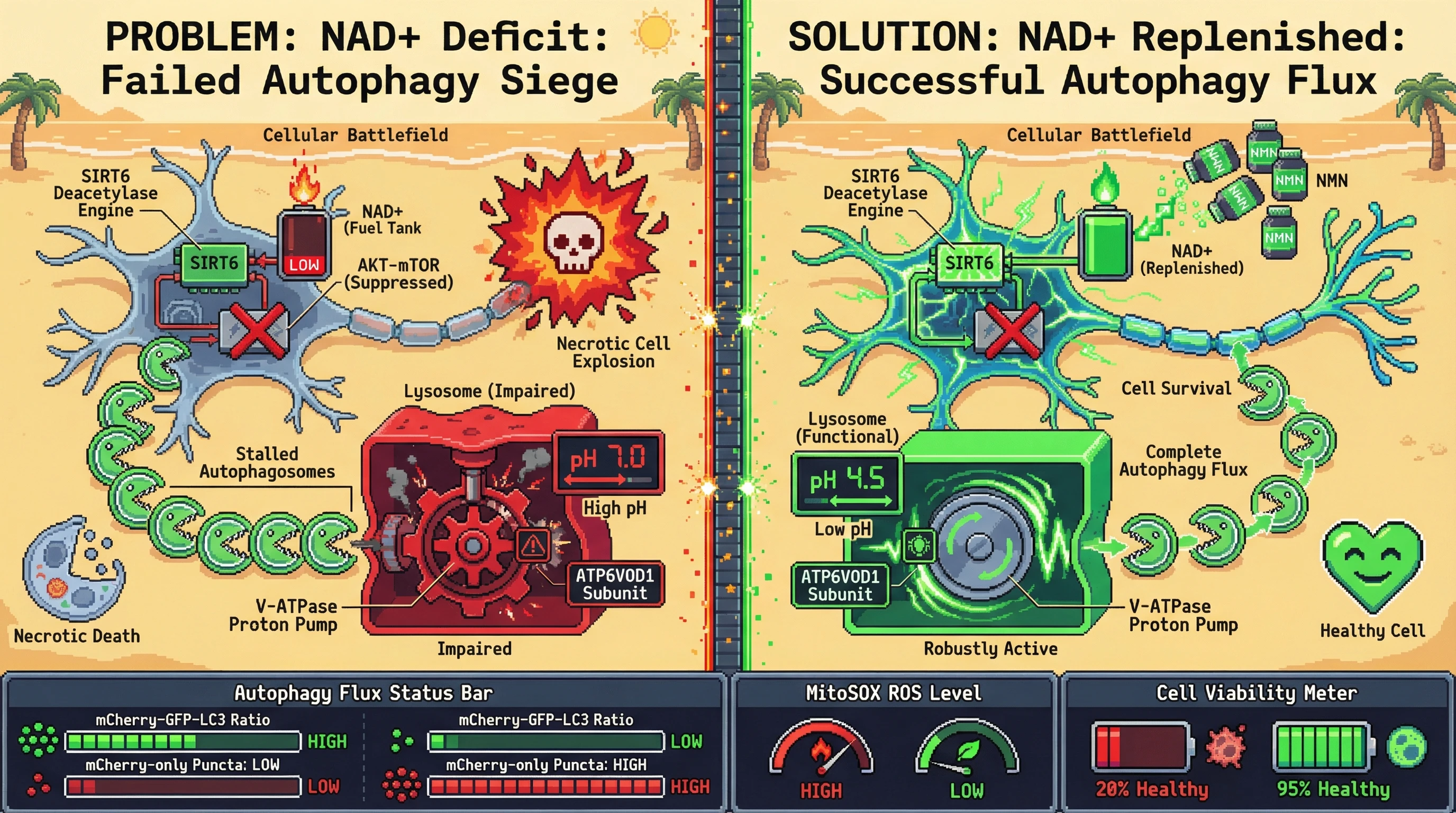
SIRT6 activation initiates autophagosome formation but the subsequent completion of autophagic flux depends on sufficient NAD+ to fuel both SIRT6 deacetylase activity and lysosomal V‑ATPase function. When NAD+ becomes limiting, autophagosomes stall, accumulate, and trigger necrotic death rather than protective recycling.
Mechanistic Rationale
SIRT6 is an NAD+-dependent deacetylase that suppresses AKT‑mTOR to induce autophagy under nutrient stress [1]. However, SIRT6 also deacetylates lysosomal-associated proteins such as the V‑ATPase subunit ATP6V0D1, promoting lysosomal acidification and protease activity (novel link). During prolonged stress, continuous SIRT6 activity consumes NAD+, lowering the co‑substrate pool needed for (i) its own deacetylase cycle and (ii) the NAD+-dependent enzymes that sustain lysosomal proton pumping. The resulting NAD+ deficit stalls autophagosome–lysosome fusion and impairs lysosomal acidification, blocking flux while autophagosome biogenesis proceeds—a “failed siege” where the cell eats itself but cannot digest the meal.
Evidence: Cholesterol depletion uncouples autophagy gene transcription from flux completion [2]; NAD+ supplementation rescues SIRT6‑mediated protective autophagy in vascular calcification [4]; NAD+/NADH imbalance reduces sirtuin activity and impairs homeostasis [5]. If SIRT6 also regulates lysosomal V‑ATPase, then NAD+ loss would simultaneously impair the degradative arm of autophagy, explaining why autophagy inhibition can be neuroprotective under severe SIRT6‑driven stress [1].
Predictions and Experimental Design
- Flux read‑out: Express mCherry‑GFP‑LC3 in neurons; SIRT6 overexpression should increase GFP‑only puncta (autophagosomes) but decrease mCherry‑only puncta (autolysosomes) under basal NAD+. Adding NMN should restore the mCherry‑only/GFP‑only ratio only when lysosomal V‑ATPase activity is intact.
- NAD+ and lysosomal pH: Measure lysosomal pH with LysoSensor after SIRT6 +/- NMN; predict NAD+ replenishment raises lysosomal acidity (lower pH) concomitant with restored flux.
- V‑ATPase dependence: Knock down ATP6V0D1; under these conditions, NMN will fail to rescue flux and will increase necrotic markers (LDH release, PI positivity) despite SIRT6 overexpression.
- ROS correlation: Stalled autophagosomes will correlate with elevated mitochondrial ROS (MitoSOX); rescuing flux should lower ROS.
Potential Implications
If confirmed, the hypothesis reframes NAD+ boosters as context‑dependent adjuncts: they are beneficial only when the lysosomal degradative capacity is functional. In conditions where lysosomal V‑ATPase is compromised (e.g., aging, lysosomal storage disorders), NAD+ supplementation may exacerbate autophagy‑mediated necrosis, suggesting a need to combine NAD+ precursors with lysosomal enhancers or inhibitors of SIRT6 activity in specific disease settings.