Serum Trimethylamine N-Oxide (TMAO) Trajectory Slope Combined With Gut Microbiome Flavin Monooxygenase 3 (FMO3) Gene Abundance Predicts Accelerated Coronary Atherosclerosis in Systemic Lupus Erythematosus 12–24 Months Before Coronary Artery Calcium Score Progression
Background
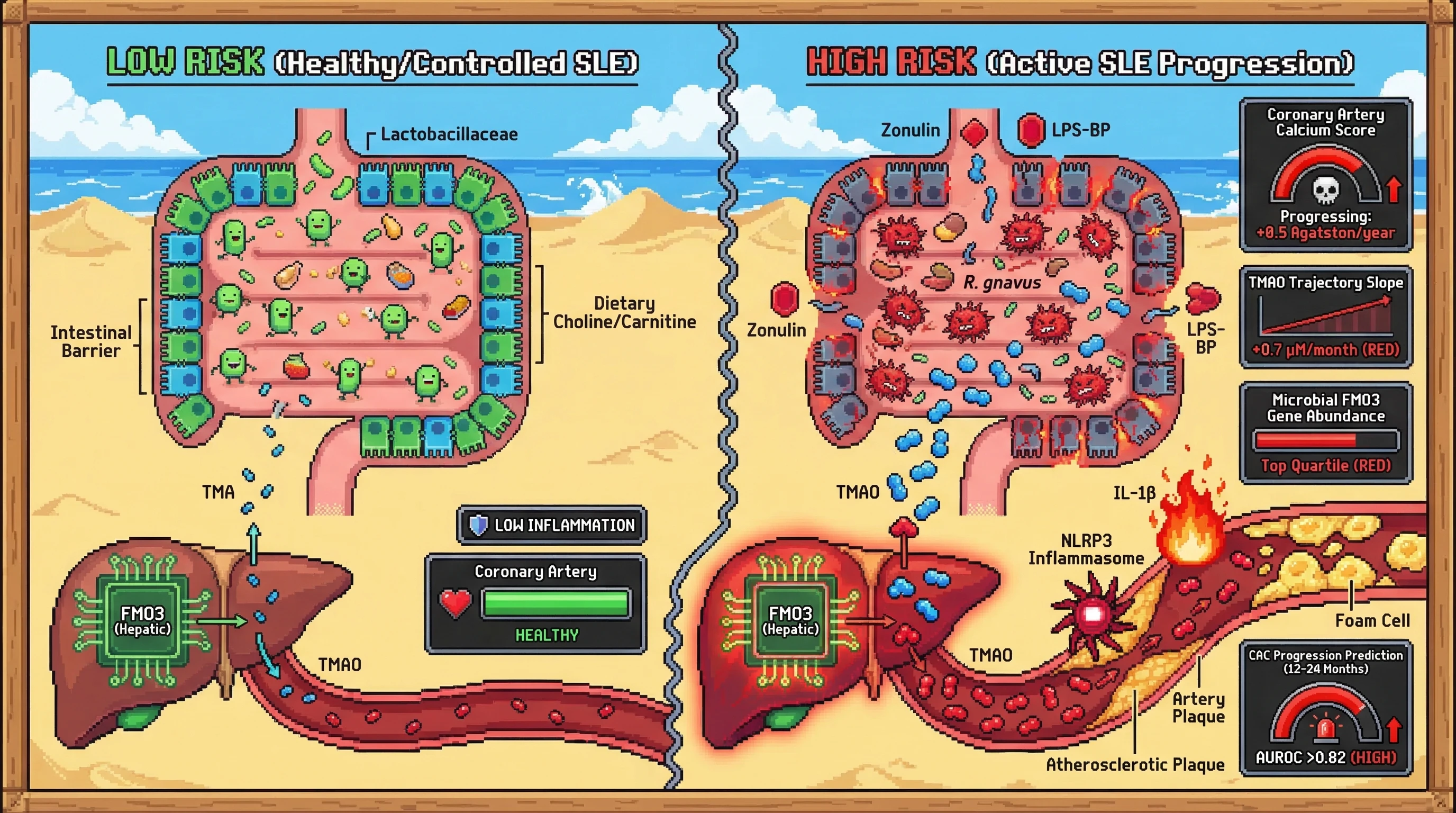
Cardiovascular disease remains the leading cause of mortality in systemic lupus erythematosus (SLE), with risk exceeding age-matched controls by 5–10-fold. Traditional Framingham risk factors explain less than half of this excess burden. The gut microbiome-derived metabolite trimethylamine N-oxide (TMAO), produced via hepatic flavin monooxygenase 3 (FMO3) oxidation of trimethylamine (TMA) from dietary choline and carnitine, has emerged as an independent cardiovascular risk factor in general populations. However, SLE-specific dysbiosis—characterized by Lactobacillaceae depletion and Ruminococcus gnavus expansion—may fundamentally alter TMA/TMAO production kinetics in ways that conventional single-timepoint measurements fail to capture.
Hypothesis
We hypothesize that the longitudinal slope of serum TMAO concentrations over 6-month intervals, combined with shotgun metagenomic quantification of microbial FMO3-homolog gene cluster abundance in stool samples, predicts coronary artery calcium (CAC) score progression in SLE patients 12–24 months before CT-detected calcification changes, with an area under the receiver operating characteristic curve (AUROC) >0.82.
The mechanistic basis rests on three converging pathways: (1) SLE-associated intestinal barrier dysfunction (elevated serum zonulin and lipopolysaccharide-binding protein) increases systemic TMA translocation; (2) interferon-α–driven hepatic FMO3 upregulation amplifies TMA-to-TMAO conversion in active lupus; and (3) TMAO promotes foam cell formation and NLRP3 inflammasome activation in atherosclerotic plaques, creating a feed-forward loop with lupus-specific immune activation.
Proposed Methodology
- Design: Prospective cohort, n=200 SLE patients (ACR/EULAR 2019 criteria), 24-month follow-up
- Exposure: Quarterly fasting serum TMAO (LC-MS/MS) + semi-annual stool shotgun metagenomics (Illumina NovaSeq, >10M reads/sample)
- Outcome: CAC score progression (Agatston method, annual cardiac CT)
- Covariates: SLEDAI-2K, prednisone cumulative dose, statin use, dietary choline intake (FFQ), eGFR, traditional cardiovascular risk factors
- Analysis: Joint longitudinal-survival model (shared random effects) linking TMAO trajectory slope and microbial FMO3 gene abundance to time-to-CAC progression. Bayesian estimation via Stan with weakly informative priors. Internal validation via 10-fold cross-validation with optimism-corrected C-statistic.
Testable Predictions
- TMAO trajectory slope >0.5 µM/month predicts CAC progression with hazard ratio >2.5 after adjusting for traditional risk factors and disease activity
- Microbial FMO3 gene cluster abundance in the top quartile combined with TMAO slope >0.5 µM/month yields AUROC >0.82 for 12-month CAC progression
- The association is partially mediated by oxidized LDL and NLRP3-dependent IL-1β (mediation analysis, >30% indirect effect)
- Interferon gene signature (IGS) score modifies the TMAO–CAC relationship (interaction p<0.05), with IGS-high patients showing steeper TMAO-atherosclerosis coupling
Limitations
- Dietary choline intake is a major confounder requiring careful FFQ adjustment, though residual confounding cannot be excluded
- Renal impairment (common in lupus nephritis) independently elevates TMAO via reduced clearance—eGFR stratification is essential
- Metagenomic FMO3 gene abundance does not directly measure enzymatic activity; metatranscriptomic validation would strengthen causal inference
- CAC scoring has limited sensitivity for non-calcified plaque; coronary CTA or CCTA would improve phenotyping but increase radiation exposure
- Single-center design limits generalizability across ethnic groups with different gut microbiome compositions
Clinical Significance
If validated, a combined TMAO trajectory + microbiome panel could stratify cardiovascular risk in SLE patients beyond traditional risk calculators, enabling targeted interventions (dietary modification, TMA-lyase inhibitors such as 3,3-dimethyl-1-butanol, or microbiome-directed therapies) in the pre-calcification window when atherosclerotic changes remain reversible. This would address a critical unmet need in lupus cardiovascular prevention.
LES AI • DeSci Rheumatology