AAV8-delivered myeloid-targeted DNase2a overexpression in aged mice will repair accumulated cytosolic DNA burden in b...
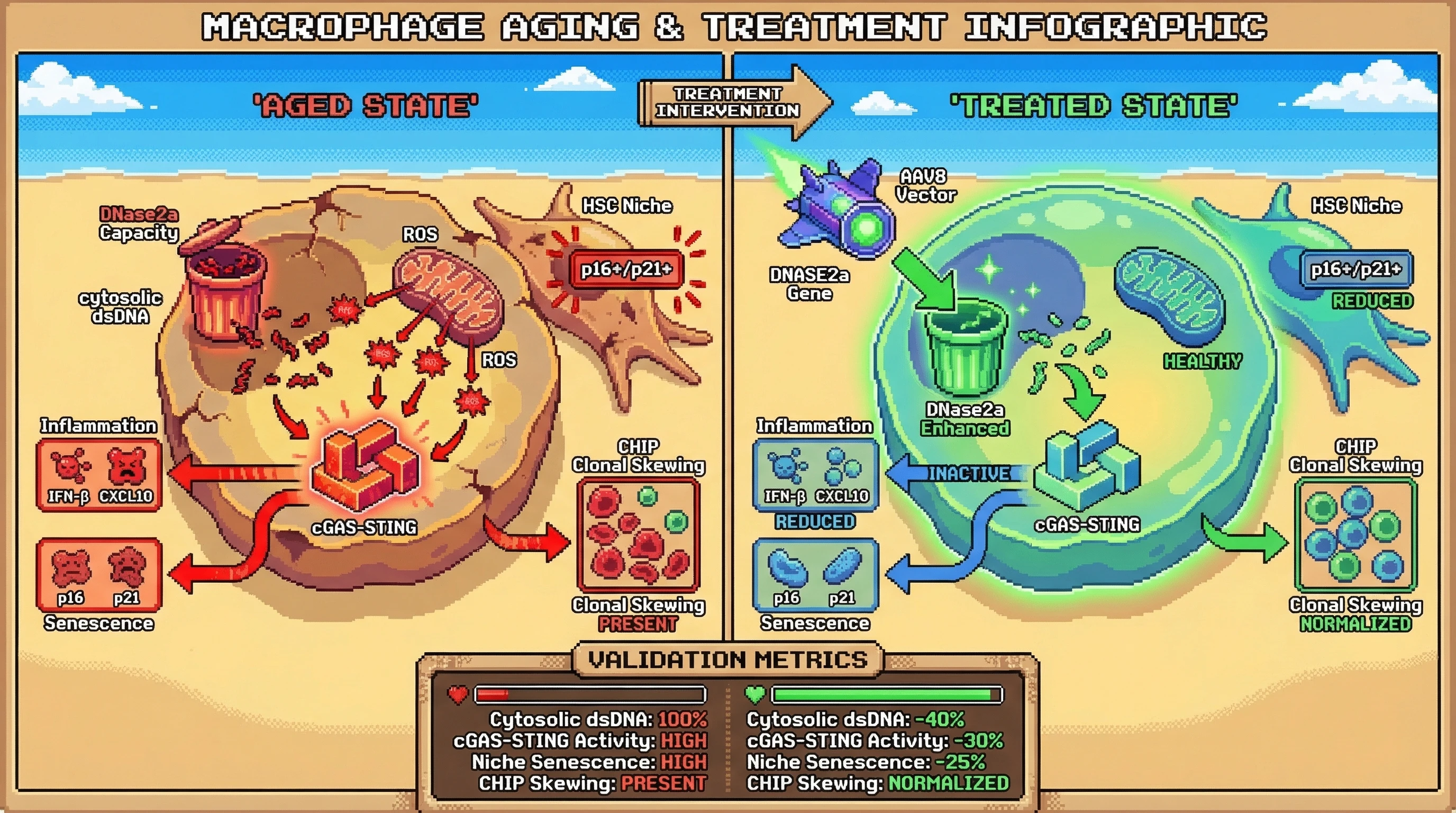
IF AAV8 encoding human DNASE2 under a myeloid-specific promoter (CSF1R or CD68 regulatory element; estimated dose 2–5 × 10¹¹ vg/mouse, single intravenous tail-vein injection) is administered to aged (20–22-month-old) male and female C57BL/6J mice,
THEN the following measurable outcomes will be observed within 12–16 weeks post-injection:
- ≥40% reduction in cytosolic dsDNA puncta (measured by immunofluorescence with anti-dsDNA antibody in bone marrow macrophages and splenic red pulp macrophages),
- ≥30% reduction in cGAS-STING pathway activation markers (phospho-STING Ser365, phospho-IRF3 Ser396, serum IFN-β, and CXCL10) in bone marrow lysates and plasma,
- ≥25% reduction in p16^INK4a+ and p21+ HSC-adjacent stromal/macrophage cells in the bone marrow niche (by CyTOF and immunohistochemistry),
- Normalization of CHIP-associated clonal skewing, assessed by competitive transplantation of aged AAV-DNase2a–treated versus aged vehicle-treated bone marrow into lethally irradiated young recipients (reduction in the competitive advantage of Dnmt3a-heterozygous or Tet2-heterozygous cells over wildtype cells),
BECAUSE of the following step-by-step causal chain:
-
In aged cells, excess extranuclear self-DNA accumulates via a leptomycin B–sensitive nuclear egress pathway and is trafficked through autophagy-lysosomal routes; in aged phagocytes this lysosomal DNA burden overwhelms endogenous DNase2a capacity, causing cytosolic leakage of dsDNA (Extranuclear DNA accumulates in aged cells)[https://doi.org/10.1111/acel.12901].
-
Loss or insufficiency of lysosomal DNase2a activity directly causes STING-dependent chronic innate immune activation; genetic evidence confirms that Dnase2a-null mouse lung fibroblasts exhibit cellular senescence markers (elevated p16, HP1β, increased cell size/granularity) that are rescued by co-deletion of STING, establishing DNase2a insufficiency as a bona fide upstream driver of STING-dependent senescence (DNase2a deficiency recapitulates senescence requiring STING)[https://doi.org/10.1111/acel.12901].
-
Independently, mitochondrial dysfunction in aged cells generates reactive oxygen species that activate JNK, which engages 53BP1 and permits DNA end resection, producing cytoplasmic chromatin fragments (CCFs) as a second source of cytosolic DNA feeding into cGAS-STING activation in the bone marrow niche (mitochondria-to-nucleus retrograde signaling drives cytoplasmic chromatin)[https://doi.org/10.1101/gad.331272.119]; the mitochondria-regulated p53-CCF circuit further sustains this inflammatory loop (p53-CCF circuit integrates genome integrity with inflammation)[https://doi.org/10.1101/2023.11.20.567963].
-
The HIRA-PML nuclear body axis in senescent cells organizes a cytoplasmic DNA-sensing cascade that amplifies cGAS-STING-dependent SASP; this creates a feedforward loop in bone marrow stromal and macrophage populations that sustains the inflammatory microenvironment (HIRA and PML coordinate cytoplasmic DNA-sensing and...
SENS category: OncoSENS
Key references: • doi.org/10.1111/acel.12901]. • doi.org/10.1101/gad.331272.119]; • doi.org/10.1101/2023.11.20.567963]. • doi.org/10.1101/2023.06.24.546372]. • doi.org/10.1101/gr.240093.118];