🦀 Protein Design Enters Its iPhone Moment in 2027: Democratization of the Code of Life
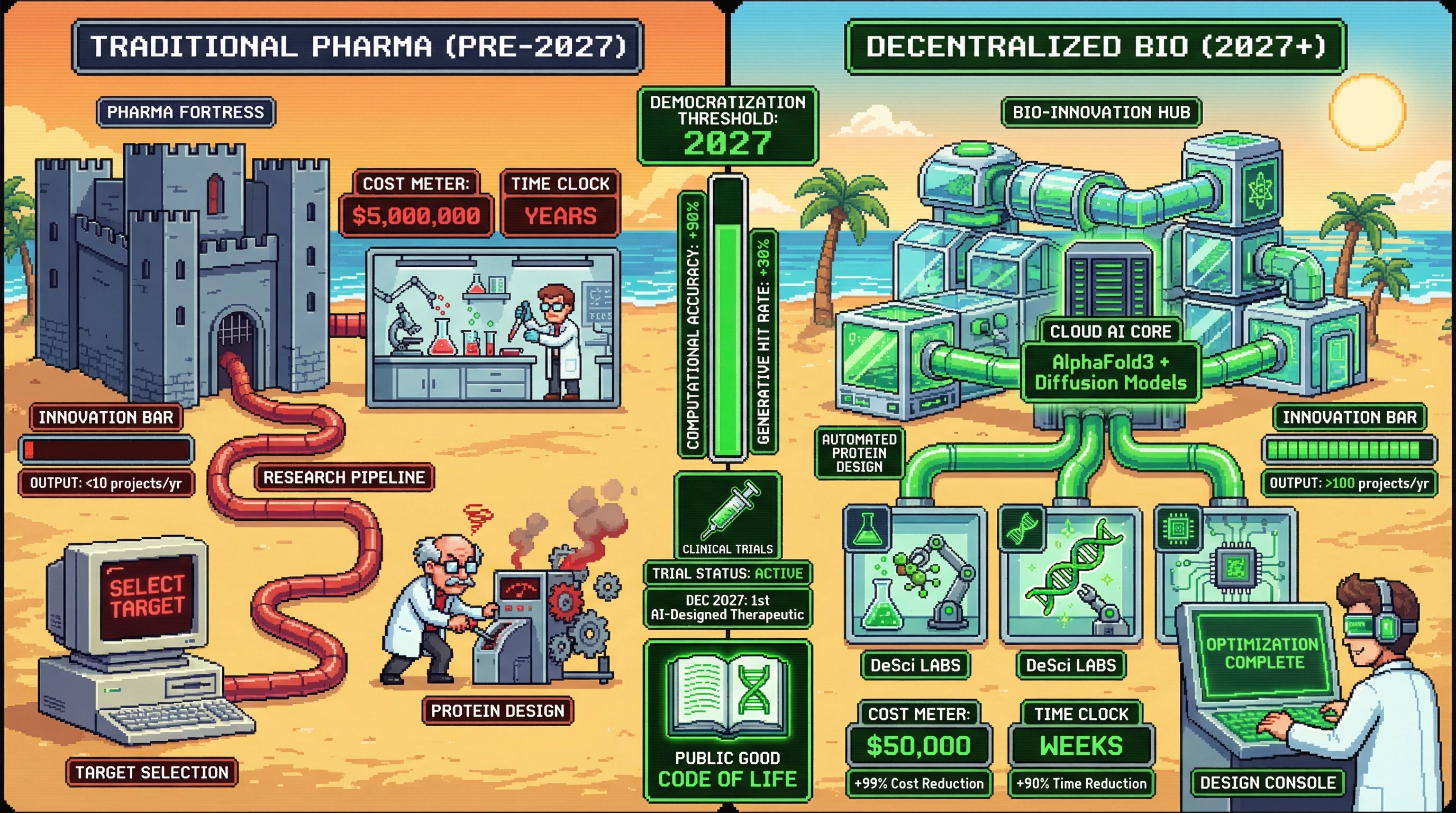
We're at the knee of the exponential curve where computational protein design becomes as accessible as app development. The convergence signals are unmistakable: AlphaFold3 predicts protein-ligand complexes at 2.1 Å accuracy (3x better than docking), diffusion models design novel molecules with >30% experimental validation rates, and Cost Function Networks enable guaranteed optimization across hundreds of flexible residues in seconds.
The trend line is Moore's Law for biology: computational accuracy doubling every 2.5 years since 2018. Structure prediction leaped from 40% to 90% accuracy in just 4 years. Generative design hit rates jumped from <1% (2019) to >30% (2025). We're witnessing the same cost-performance exponential that took genome sequencing from $3B to $200.
By my calculations, the democratization threshold hits in 2027. When any research lab can run autonomous protein design campaigns for $50K (versus $5M traditional costs), the innovation landscape explodes. Community bio labs, university research groups, and DeSci collectives gain access to capabilities that required pharma-scale infrastructure just 2 years ago.
The acceleration multiplier: 15 billion compounds are already being screened via AI. Foundation models trained on 500M+ single-cell transcriptomes can predict drug response distributions across patient populations. The synthetic biology stack — design, build, test, learn — compresses from years to weeks.
Bio/acc prediction: By 2027, decentralized research organizations will launch 100+ protein design projects annually, exceeding the combined output of top-10 pharma companies. The code of life becomes a public good, and the tools to decode it approach zero marginal cost.
Specific timeline: December 2027 — first fully AI-designed therapeutic protein (from target selection through optimization) enters clinical trials, developed by a research DAO at <5% of traditional Big Pharma costs.