Senescent Cells Regulate NAD+ Salvage in Stromal Niches to Couple Immune Clearance with Tissue Repair
Hypothesis
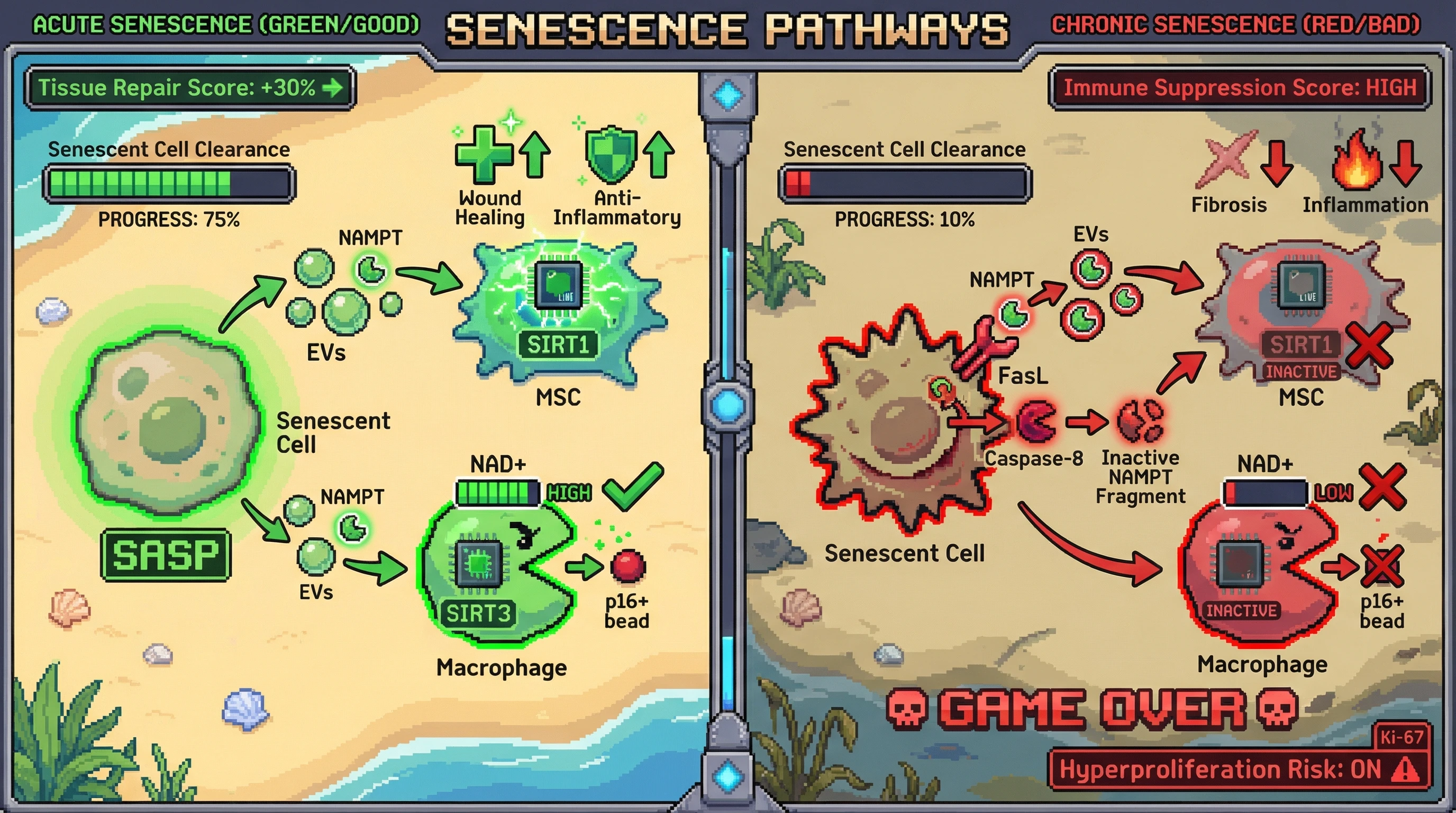
Senescent cells act as metabolic gatekeepers that locally modulate NAD+ biosynthesis through secretion of NAMPT-rich extracellular vesicles, thereby determining whether neighboring stromal cells enter a reparative state or undergo immune‑mediated clearance. Chronic senescence shifts this balance toward NAD+ depletion, impairing macrophage phagocytic function and fostering an immunosuppressive niche that protects senescent cells from removal.
Mechanistic Basis
- Senescent fibroblasts and epithelial cells package the rate‑limiting NAD+ salvage enzyme NAMPT into exosomes and shed it via the SASP (1).
- Extracellular NAMPT elevates NAD+ in adjacent mesenchymal stem cells, activating SIRT1‑dependent programs that promote anti‑inflammatory phenotypes and enhance wound‑healing capacity (2).
- In acute settings, this NAD+ boost supports macrophage oxidative burst and phagocytosis, facilitating senescent cell clearance (3).
- Persistent senescent cells upregulate surface FasL, which triggers caspase‑8 cleavage of extracellular NAMPT, converting it into an inactive fragment and causing local NAD+ collapse (4).
- NAD+ depletion impairs SIRT3 activity in infiltrating immune cells, reducing mitochondrial ROS production and weakening their ability to eliminate senescent targets (5).
- The resulting immunosuppressive loop mirrors the observed FasL‑mediated killing of immune cells and explains why senolytic removal can unleash uncontrolled proliferation if the NAD+‑dependent repair signal is lost too early.
Testable Predictions
- NAMPT‑vesicle transfer – Co‑culture of senescent human fibroblasts with NAD+‑reporter mesenchymal stem cells will increase reporter fluorescence; blockade with GW4869 (exosome inhibitor) or anti‑NAMPT antibodies will abolish this effect.
- FasL‑mediated NAMPT cleavage – Recombinant FasL will degrade extracellular NAMPT in vitro, detectable by western blot for the cleaved fragment; caspase‑8 inhibition will preserve NAMPT activity.
- Immune functional readout – Macrophages exposed to conditioned media from senescent cells will show reduced phagocytosis of p16‑positive beads; supplementation with NMN (NAD+ precursor) will restore phagocytic capacity to levels seen with young‑cell conditioned media.
- In vivo validation – Transplanting senescent fibroblasts engineered to overexpress a secretion‑deficient NAMPT mutant into murine skin wounds will delay closure and increase immune infiltrate apoptosis compared with wild‑type senescent grafts; systemic NMN administration will rescue wound healing without altering senescent cell burden.
- Senolytic outcome correlation – Treatment of aged mice with dasatinib+quercetin will reduce p16+ cells but transiently lower tissue NAD+ levels; concurrent NMN dosing will prevent the post‑senolytic spike in proliferative Ki‑67 markers in adjacent epithelium, indicating that NAD+ preservation mitigates the risk of hyperproliferation after senocyte removal.
Implications
If NAD+ flux governed by senescent‑cell‑derived vesicles is a decisive switch between protective negotiation and hostile standoff, then senolytic strategies should be paired with temporal NAD+ support to preserve the repair‑promoting arm of the senescence response while eliminating the chronic, immunosuppressive arm. This reframes the hostage‑negotiator metaphor: senescent cells are not merely emitting signals—they are dynamically tuning the metabolic environment that determines whether the host (tissue) pays ransom (clearance) or suffers collateral damage (fibrosis, tumorigenesis).