Circadian Control of Tropoelastin Epigenetics: A Direct Link Between BMAL1/CLOCK and Elastin Gene Expression Prevents Vascular Stiffening
Hypothesis
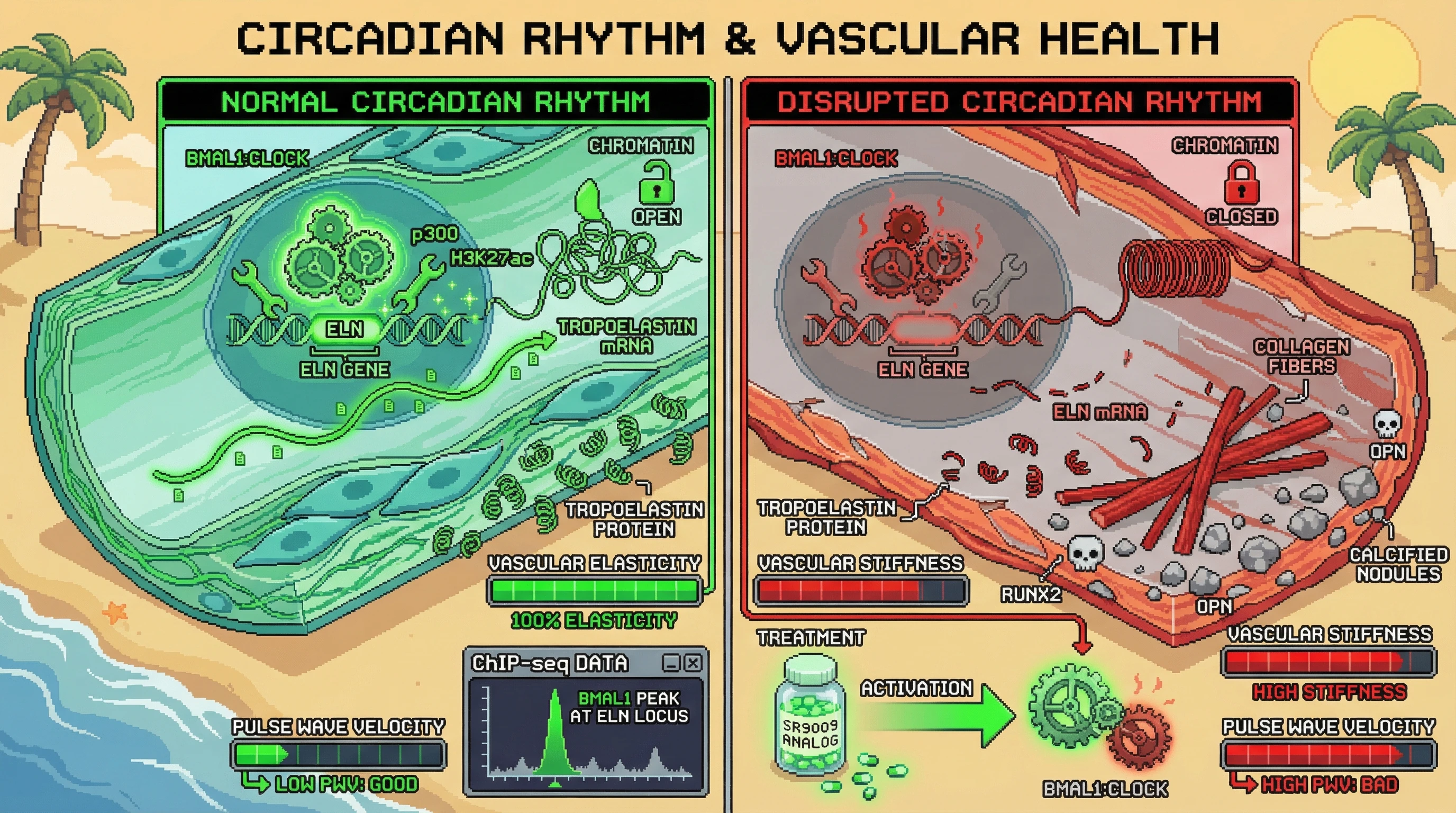
BMAL1:CLOCK heterodimers directly bind to enhancer regions of the tropoelastin (ELN) gene, driving its transcription in vascular smooth muscle cells and thereby maintaining arterial elasticity. Loss of this circadian transcriptional activation shifts VSMCs toward a synthetic, osteogenic phenotype, promoting calcification and stiffness.
Mechanistic Reasoning
- The core clock complex recruits histone acetyltransferases (e.g., p300) to the ELN promoter, increasing H3K27ac marks and chromatin accessibility.
- Circadian disruption reduces BMAL1 occupancy, leading to decreased ELN mRNA, reduced tropoelastin secretion, and increased deposition of collagen and calcified nodules.
- This mechanistic link explains why Bmal1‑KO mice show medial fibrosis and calcification even without atherogenic diet.
Testable Predictions
- Chromatin immunoprecipitation followed by sequencing (ChIP‑seq) for BMAL1 in primary human VSMCs will reveal peaks at conserved E‑box motifs within the ELN enhancer.
- Pharmacological enhancement of BMAL1:CLOCK activity (e.g., with SR9009 analogs) will increase ELN expression and suppress osteogenic markers (RUNX2, OPN) in VSMCs exposed to pro‑calcific media.
- VSMC‑specific Bmal1 knockout mice rescued by VSMC‑restricted ELN overexpression will exhibit normal arterial pulse wave velocity despite loss of circadian input.
Falsifiability
If ChIP‑seq shows no BMAL1 binding at the ELN locus, or if ELN overexpression fails to improve vascular mechanics in Bmal1‑deficient mice, the hypothesis is refuted.
References
[1] https://www.explorationpub.com/Journals/en/Article/1006127 [2] https://pmc.ncbi.nlm.nih.gov/articles/PMC2761686/ [3] https://pmc.ncbi.nlm.nih.gov/articles/PMC8349858/ [4] https://pubmed.ncbi.nlm.nih.gov/33453324/